

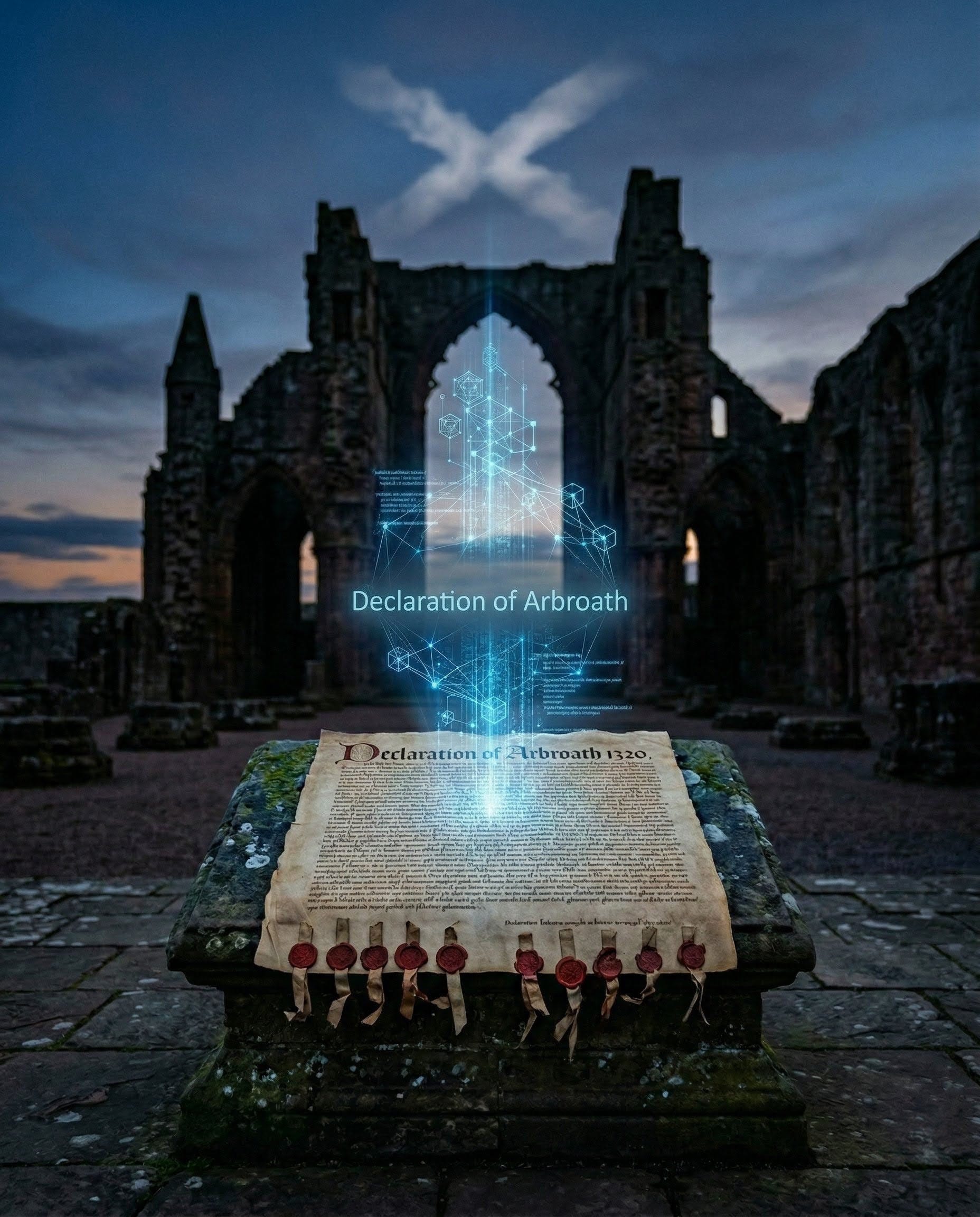
#SovereigntySeries Part 3
Six hundred and ninety-seven years before the United Nations drafted its Charter on the right of peoples to self-determination, a group of Scottish nobles and prelates sat down in the Abbey of Arbroath and produced a document that codified the ancient self-determination rights and practices of the people of Scotland.
Today, on the 6th of April 2026, we celebrate 706 years since that document was sealed and dispatched. Not as a historical curiosity. Not as romantic heritage. But as a living constitutional instrument that at its core has never been repealed, never been refuted, and, understood correctly, is a fundamental expression of humanity.
The Kingdom of the Realm of Scots
To understand the Declaration of Arbroath, you must first understand the world into which it was born.
By 1320, Scotland had endured nearly three decades of sustained English military aggression. Edward I of England, a monarch who styled himself ‘Hammer of the Scots’ on his own tomb, had sought to absorb Scotland into an English-controlled archipelago. He manipulated the Scottish succession crisis of 1290–92 to install a client king, John Balliol. When Balliol reasserted Scottish sovereignty, Edward invaded, removed him from the throne, and attempted to govern Scotland as a conquered territory. He removed the Stone of Destiny from Scone, stripped Scotland of its regalia, and demanded fealty from nobles, clergy, and community leaders through the Ragman Rolls of 1296.
What followed was not merely resistance but an assertion and defence of the will of Scots, including their right of self-determination. William Wallace and Andrew de Moray raised Scotland at Stirling Bridge in 1297. Wallace’s defeat at Falkirk in 1298 did not end his defence of the realm, it only changed its character. Robert Bruce claimed the Scottish throne in 1306, was initially defeated and driven into exile, and returned to mount the most sustained and ultimately decisive campaign of Scotland’s defence against the English colonial forces. On 23 June 1314, the Scottish host under Robert I defeated the army of Edward II at Bannockburn in what remains one of the most significant military victories in European medieval history.
Whilst Bannockburn settled the military question, it did not subdue the colonial lust Edward Longshanks had set in motion.
Edward II continued in his father’s vain, refusing to accept the sovereignty of Scots, and England continued to press overlordship claims at the Papal Court in Avignon, where Pope John XXII held office. The Pope, under English pressure, had declined to recognise Robert Bruce’s kingship and had placed Scotland under an interdict. English diplomacy portrayed the Scottish Wars of Independence as a rebellion against legitimate English authority, trying to frame it as a domestic matter, not a question of his kingdom trying to invade and absorb the much older sovereign nation of Scotland.
The Scots following the international traditions of the period decided to directly petition the highest recognised arbiter of the international order and did so on the 6th of April 1320.
A Declaration of Fact and Intent
The Declaration of Arbroath was drafted from long standing Scots traditions by Bernard de Linton, Abbot of Arbroath and Chancellor of Scotland, a man of exceptional Latin scholarship and constitutional intelligence. It was addressed to Pope John XXII and sealed by eight earls and thirty-one barons, acting on behalf of the entire ‘community of the realm’ of Scotland.
The choice of the Pope as recipient was not incidental: in 1320, the Bishop of Rome held a position of international authority with no contemporary parallel, the nearest equivalent the medieval world possessed to a supreme international arbiter. Placing the Declaration before him was a deliberate act of constitutional diplomacy: lodging a statement of sovereign right and intent with the most credible international witness and arbiters available.
The declaration was written in polished Latin, formal, assured, and constructed with the precision of statecraft befitting of its fundamental importance to Scotland. It opens not with genealogy or military claims but with something far more fundamental: the ancient and independent history of the Scottish people, their origins, their faith, and the fact that their Kingdom, rights and culture had freely endured from time immemorial.
The declaration then addresses the English aggression directly, naming the acts of destruction, the burning of churches, the killing of clergy, and the attempted subjugation of the free Scots people. It credits Robert Bruce for leading the defence of Scotland from ‘a thousand evils’, but does so in terms that are constitutionally extraordinary.
The declaration’s most important passage, for us all, reads, in translation from the Latin:
‘Yet even he, should he turn aside from the task he has begun, and yield Scotland or us to the English king and people, we would strive at once to drive him out as our enemy and a subverter of his own rights and ours, and make some other man who was well able to defend us our King.’
This is the passage that makes the Declaration of Arbroath unlike almost any constitutional document of its age. It does not merely assert Scottish sovereignty as a nation, it explicitly confirms that the power of the King of Scots is subordinate to the will of the Scottish people. It states, without ambiguity, that kingship in Scotland is conditional, held in trust for the people, exercisable only in their service, and revocable by them if that trust is broken.
And then, immediately following, comes the passage that has meaning for us all and one that has resonated across seven centuries and within the hearts of freemen:
‘For as long as a hundred of us remain alive, we will never on any conditions be subjected to the lordship of the English. For we fight not for glory, nor riches, nor honours, but for freedom alone, which no good man gives up except with his life.’
This is not just the poetry of truth but the very foundation of constitutional law stated in 1320 with definitive clarity by a people who have fought and died for it to this day.
The Scot’s Social Contract
The mainstream colonial reading of the Declaration of Arbroath tends to focus on its diplomatic purpose, applied through the dominant Anglosphere elitist lens of ‘UK democracy’ framing, that the declaration sought ‘papal recognition of disputed Scottish sovereignty’. What the Scots actually sought was affirmation of existing sovereignty and arbitration. Pope John XXII wrote to Edward II in 1320 urging him to make peace with the Scots, and the Treaty of Edinburgh–Northampton in 1328 saw England formally conceding their claim to the Kingdom of the Realm of Scots.
What the Declaration of Arbroath confirms, in constitutional terms that have no expiry date, is a doctrine of popular sovereignty that predates, and is structurally more radical than, virtually any comparable instrument produced anywhere in the medieval world. Magna Carta (1215) constrained the English Crown in favour of the barons. The Golden Bull of Hungary (1222) secured noble privileges against royal excess. These were significant documents, but they negotiated the distribution of their native peoples’ powers among elites. The Declaration of Arbroath did something categorically different: it confirmed sovereign authority not in any elite at all, but in the people as a whole.
The Declaration’s fundamental doctrine is this: sovereign authority in Scotland resides in the Scots people. In Scots constitutional tradition, the Crown is the legal personality of the Community of the Realm — not a monarch, not a parliament, not a government. A lawful monarch swears to uphold and never transfer its rights, rents and privileges in the real and still statutory Oath of Accession. The territorial assets of the Crown, the ‘major regalia’, are Common Good Assets. It is from the character of the Scottish Crown that we get popular sovereignty — territorial, political and judicial. The monarch who wore and swore to defend it was thus ‘the first among equals’. Sovereign authority resides in the people collectively, inalienably, immutably and without condition. Any head of state who serves the people of Scotland holds power legitimately only when directly serving that doctrine and the popular will of Scots. Any head of state who fails them, or who tries to surrender the freedoms of Scots, loses that power — not by parliamentary vote, not by legal process, but by the inherent sovereign right of the people to withdraw consent.
In many of the dominant constitutional documents of medieval European nations, sovereignty was framed as descended from God to a monarch and in overlordship of the populace. Power projected downward.
The Scots sovereignty tradition, despite what is often portrayed by the colonially lock-stepped political classes of Europe’s elitist institutions, is not alone in its structure or intent. There are similar doctrines to the declarations and traditions to be found when looking beyond the institutionalisation of organised elitism.
Three years after Arbroath, in 1323, the Haadlingen of Fryslân, a term carefully chosen to mean ‘head-men’ or ‘first among equals’ rather than hereditary nobility, gathered at the Upstalsboom, an ancient assembly mound on the Frisian plain, and codified their own remarkably similar doctrine in the face of external domination. Sovereignty resided in the free Friezen people. No dwingers could suppress it; no frjemde hearen could extinguish it. The Friezen community held ultimate authority over those who ruled in its name.
This was no mere coincidence of history, nor a case of one nation borrowing from the other. Though no known formal envoys crossed the grey waters between the Forth and the Vlie, the Scots and the Friezen were drawing from the same waters of North Sea tradition. Bound by a shared Ingvaeonic heritage and a tongue so similar it was nearly one, these peoples held an ancestral instinct that power was a ‘social contract,’ not a divine right. To them, the Toisaci and the Haadlingen were first among equals, whose authority evaporated the moment they betrayed the common law. In the salt-streaked air of the North Sea basin, freedom was not a radical new theory; it was a lived and ancient memory, codified in defiance of a feudal world that sought to turn free men into slaefs.
That the spirit of Calgacus the Toisax, invoked by Tacitus, endures in the hearts, minds, and records of freemen to this day is testament to the foundational truth of human self-sovereignty.
The Sovereign Tenet: Fifteen Acts of Affirmation
The popular sovereignty of Scots did not begin with the Declaration of Arbroath. Whilst Arbroath gave it its definitive constitutional expression, the covenant of the people as noted stretches far back into pre-history. The predecessor documents that affirm the rights of Scots were already embedded in Scottish constitutional practice before 1320 giving it permanent form. What follows is a succession of asserted sovereignty unbroken across several centuries.
1290: Treaty of Birgham
The Guardians of Scotland negotiating and securing the formal preservation of Scottish independence, laws and liberties as explicit conditions of a proposed royal marriage. The treaty states Scotland shall remain “separate, apart and free in itself without subjection to the English kingdom.” The sovereign people of Scotland, acting through their Guardians, placed their independence on the international record as a non-negotiable condition. Primary record: Treaty of Birgham, 18 July 1290, National Records of Scotland.
1291-1292: The Great Cause
The Guardians of Scotland formally presented the competing claims to the Scottish throne before an international arbitration process, asserting throughout that Scotland’s sovereignty and laws must be preserved regardless of outcome. The claimants themselves submitted to the process on the explicit condition that Scottish independence would remain intact. The community of the realm’s sovereignty over its own succession was the foundational premise of the entire proceedings. Primary record: Great Cause proceedings 1291-92, National Records of Scotland and Public Record Office. Award of the Scottish throne to John Balliol, November 1292.
1296: The Ragman Rolls
When Edward I invaded and demanded submission, Scottish nobles, clergy and community leaders were required to sign. Many refused. Many who signed subsequently withdrew that submission and rejoined the defence of Scotland, William Wallace raising the country at Stirling Bridge in 1297 within a year of the Rolls being signed. The submissions extracted under occupation were not the sovereign will of Scots. The subsequent rising was. The people’s rejection of forced submission is itself a sovereignty instrument, the community of the realm reasserting what the occupation could suppress but never extinguish. Primary record: Ragman Rolls 1296, National Records of Scotland. Wallace’s rising 1297, primary chronicle record.
1309/10: The Declarations of the Clergy and People
In 1309 and 1310, Scottish clergy and nobles codified the Declarations of the Clergy and the Barons, asserting the community of the realm’s right to choose, and if necessary replace, its king. The doctrine of popular sovereignty was declared here defensively, not only for the people in the face of the deposed traitor John Balliol, but also for the Scottish Church’s own survival in a time of ecclesiastical and political upheaval across Europe. The 1309 genesis of this document grounds the Declaration of Arbroath not as a politically expedient instrument invented under military pressure from England, but as the formal continuation of an established constitutional tradition. The 1310 revision was declared with the addition of the words ‘forsaken’ and ‘betrayed’, specifically as a result of Balliol and Edward I’s failed attempts to subjugate the ‘community of the realm’ in their collective sovereign capacity.
1320: The Declaration of Arbroath
The ancient practices of Scots were given codified constitutional form by the Declaration of Arbroath on the 6th of April 1320. This declaration affirmed that sovereignty was grounded inalienably in the people — the Crown in Scotland being the legal personality of the Community of the Realm, not the monarch — incapable of being permanently surrendered by any king, parliament, treaty, or vote, and was addressed to the highest international arbiter of the age, witnessed, sealed, and never repealed.
1328: Treaty of Edinburgh-Northampton
Eight years after the Declaration of Arbroath placed Scotland’s sovereignty on the international record, the Treaty of Edinburgh-Northampton, 1 May 1328, saw England formally recognise the Kingdom of the Realm of Scots and the kingship of Robert de Bruice. Scotland’s sovereignty was not granted by that treaty. It was acknowledged by it. The distinction matters constitutionally, acknowledgement of what already existed, not creation of something new. Primary record: Treaty of Edinburgh-Northampton, 1 May 1328, National Records of Scotland.
1592 and 1663: The Salvo Practice Codified
The ancient Scots practice of salvo jure cujuslibet, the living right of the sovereign people to challenge any legislation that violated their freedoms, predates its first parliamentary codification in 1592 and its formal Act in 1663 by centuries. These dates mark when the Scottish Parliament institutionalised what the people had always exercised, not when the right itself came into being. From 1592 it was offered at the close of every session of the Scottish Parliament, a standing affirmation by the people that no parliamentary act could override their fundamental rights without challenge. It was not a petition. It was the people declaring, session by session, that sovereignty remained theirs to withdraw.
1603: The Union of the Crowns: A Double-Edged Sword
The succession of James VI of Scotland to the English throne in 1603 was no accident of history. James had actively courted the English succession through years of careful correspondence with Elizabeth’s court, and England had managed the dynastic succession to deliver a Scottish king, but on England’s terms, in England’s capital, with the Scottish court and its sovereign centre of gravity absorbed southward almost immediately. Scotland became peripheral. The patronage, the power, and the political weight all shifted to London. What appeared to be a Scottish king ruling two kingdoms was, in constitutional practice, the beginning of Scotland’s managed marginalisation.
Yet 1603 cuts both ways, and England’s political classes have never reckoned honestly with what they accepted that year. By inviting James VI onto the English throne, England accepted a king whose crown was held conditionally, on the ancient sovereign terms of the Scots people. You cannot accept a Scottish king without accepting the constitutional order that produced him. The people who had granted James his Scottish crown conditionally, on the terms Arbroath had affirmed in 1320 and the Salvo had practised for centuries, never released those conditions simply because he moved south. Scotland remained constitutionally distinct: its own parliament, its own courts, its own laws, and its own sovereign people. The powers in England’s Westminster parliament accepted that reality without choice for 104 years because it had no constitutional basis to do otherwise.
1603 is therefore a formal English acceptance of Scottish sovereignty. The rogues of 1707 attempted to dissolve what 1603 had confirmed. They had to resort to bribery, economic coercion, and the corruption of a parliament acting beyond its authority, precisely because they had no constitutional ground to stand on. England accepted a Scottish king on Scottish constitutional terms in 1603. Seventy-four years later they tried to dissolve those terms. The terms were never theirs to dissolve.
1660: The Restoration: Scotland’s Sovereignty Formally Acknowledged
Prior to 1707, England had already invaded Scotland taking partial control through military conquest. In 1650 Cromwell’s New Model Army defeated the Scots at Dunbar, occupied Edinburgh, and garrisoned the Castle. By 1652, without consulting a single Scot, England issued the Tender of Union, declaring Scotland incorporated into the Commonwealth by right of conquest. On 12 April 1654, the Ordinance for the Union of England and Scotland attempted to legally formalise England’s absorption of Scotland, and Westminster produced a faux ratification on 26 June 1657, abolishing Scotland’s Parliament of their own accord, without Scottish consent. Thirty ‘Scottish’ MPs were permitted at Westminster, most of them English military men. As the historical record confirms, government as experienced on a daily basis by Scottish people remained essentially government by garrison.
The faux Cromwellian union lasted eight years and was dissolved without contest when Charles II was restored to the throne in 1660. Scotland’s Parliament, its Gaelic soul rooted in the ancient assembly of mormaers at the Moot Hill of Scone, the King ruling with the counsel of the Seven Earls for centuries before the Norman administrative structures arrived and of considerably greater antiquity than its first surviving written record, a colloquium at Kirkliston in 1235, one year before England’s first recorded parliamentum in 1236, that record itself one of the very few to survive Longshanks’ seizure and dispersal of Scotland’s national archives, was duly reinstated, as were its courts and its Kirk
The Scottish Parliament then passed the Rescissory Act 1661, formally nullifying all legislation of the Commonwealth period and explicitly asserting that the forced incorporation had possessed no legitimate constitutional basis from the moment of its imposition.
These four documents, the 1652 Tender, the 1654 Ordinance, the 1657 ratification, and the 1661 Rescissory Act, together constitute an explicit English and Scottish acknowledgement that Scottish sovereignty had been suppressed, not extinguished. England had to legislate to absorb Scotland in 1654 because Scotland was a sovereign entity that could not simply be annexed. England had to formally dissolve that legislation in 1660 because the sovereignty was always there to be restored. If it had been legitimately transferred, no dissolution would have been necessary or possible. Scotland’s independence was restored in 1660 as a matter of legal fact. The ancient sovereignty of Scots had survived conquest, occupation, and eight years of forced incorporation intact.
England kept the garrison in Edinburgh Castle. It returned Scotland’s parliament. It did not return Scotland’s fortress.
1689: The Claim of Right: Enacted
When James VII of Scotland violated the rights of Scots and the grounds of his representation, through the illegal exercise of power, the subversion of Scots law, and the imposition of arbitrary rule, the Convention of the Estates declared as codified that he had forfeited the Crown through his actions — the Crown being the legal personality of the Community of the Realm, which he had ceased to serve. The people, acting through their Convention, exercised precisely the sovereign right the Scots had always held and Arbroath had affirmed 369 years earlier: the right to withdraw consent from a government that had ceased to serve them. The Claim of Right 1689 is that ancient practice in action, the lived consequence of governmental betrayal, codified and enforced.
1707: The Ancient Sovereignty Suppressed
The English Crown, having failed to subjugate the sovereign Scottish people militarily and having lived with the validity of Scottish constitutional sovereignty for over a century, then sought subjugation through a series of corrupted parliamentary processes, seeking a Union of parliaments based on a centuries old lust for overlordship and delusions of imperial hierarchy. The Scots people responded as sovereigns, flooding parliament with petitions from communities across Scotland, filling the streets of Edinburgh and Glasgow in open defiance, making their will plain on the record. The second coming of the now famous ‘parcel of rogues’, the same elite class that had borrowed the people’s sovereignty in 1689 to legitimise their own transaction with William, signed what was never theirs to sign without the majority consent of Scots. No king, queen, parliament, or treaty has ever owned Scottish sovereignty to transfer. What England secured in 1707 was not Scotland’s consent, it was the signatures of men and a rogue Queen acting beyond their authority. The ancient sovereignty of Scots may have been suppressed, but it was never surrendered.
1745: The Declaration of James VIII and the Proclamations of Charles Edward Stuart
What followed 1707 was not acceptance. In 1743 James VIII, issuing from exile, produced a formal declaration naming Charles Edward Stuart as Prince Regent of the Kingdoms of Scotland, England, and Ireland, explicitly asserting the illegitimacy of the Hanoverian succession and the unlawfulness of the incorporating Union. In May 1745 Charles issued his own proclamation drawing directly from his father’s declaration, asserting the sovereign rights of the Scottish people and their right to restoration of a government that served them. When Charles raised the Jacobite standard at Glenfinnan in August 1745, twenty thousand citizens greeted his army in Edinburgh and James VIII was declared King of Scots on Scottish soil. The rising was, as its own founding documents make plain, not merely a dynastic claim, it was a constitutional assertion that the Union of 1707 had been illegitimate from the moment of its signing.
Westminster’s response confirmed what the Scots had always known and often suffered from as a result of their betrayal at the hands of the lords and Queen Anne. Following Culloden in April 1746, the English Crown-in-Parliament unleashed systematic terror across the Highlands: the Act of Proscription banning the Highland way of life and the pipes, the beginning of the ethnic cleansing of Scots; the Heritable Jurisdictions Act destroying the clan governance system; the Forfeited Estates seizures stripping Jacobite families of their land; executions, transportations to the Caribbean, and the burning of homes across the glens. Then came the occupation. Contemporary British Army manuscripts, the Cantonment Register and Situation Reports, record over 400 military garrisons across Scotland between 1746 and 1755, stretching from Orkney to the Scottish Borders. Their orders were explicit: to enforce the disarming of Highlanders, suppress the dress, and prevent any organised resistance. By 1740 General Wade had built 250 miles of military roads and 40 bridges over a fifteen-year programme beginning in 1725, specifically planned to move troops rapidly into Scottish territory; Major Caulfeild expanded that network to over 1,000 miles by the mid-18th century. Fort George at Ardersier, the largest military fortification built in 18th century Britain, was constructed from 1748 to 1769 as a permanent garrison on Scottish soil, and remains a British Army base to this day. Edinburgh Castle, the most visible symbol of Scottish nationhood, sitting atop its volcanic base and dominating the city skyline of Scotland’s own capital, has remained an occupied English Army garrison since Cromwell in 1650, a colonial occupation so normalised that millions of tourists photograph it annually without a second thought. As historian Professor Murray Pittock observed when the cantonment map was published: the occupation did not just affect the Highlands. England did not deploy 400 garrisons from Orkney to the Borders against a people whose sovereignty it legitimately took. This deployment was made against a people whose sovereignty it intended to take without right.
1949: The Scottish Covenant: Two Million Voices
After a period of two hundred and forty-two years of suppression of Scottish sovereignty and cultural identity, the sovereign people of Scotland spoke en masse in 1949 and in numbers that should not have been dismissed. The Scottish Covenant, initiated by John MacCormick and written at the Church of Scotland Assembly Halls in Edinburgh in October 1949, was a formal, witnessed petition asserting the ancient right of the Scottish people to the restoration of a parliament of their own. It was signed by two million people, some 40 per cent of Scotland’s entire population at the time. The Covenant document itself is held today in the National Records of Scotland and the National Library of Scotland, preserved as the largest direct expression of Scottish popular sovereignty between 1707 and the present day.
Westminster’s response was contempt. Labour Peer Lord Morrison told the House of Lords in 1950 that the government objected in principle to Home Rule and that the matters involved were in any case far too complicated to be put to a referendum. Prime Minister Clement Attlee’s particular brand of ‘democratic socialism’ dismissed the Covenant and sovereign rights of Scots as an irrelevance and not one of Scotland’s 71 Westminster MPs gave their support to proposed devolution. Two million Scots sovereign voices, formally expressed, witnessed, and lodged on the record, were told the issue was ‘too complicated to be heard’. In 1950, four members of the Covenant Association famously removed the Stone of Destiny from Westminster Abbey, where Edward I had placed it in 1296, and returned it to Scottish soil. The sovereignty of Scots remained and as throughout Alba’s history it kept asserting itself.
1953: Lord Cooper and the Living Distinction
When Elizabeth Windsor was proclaimed Elizabeth II across the United Kingdom in 1952, Scotland was presented with an act of constitutional presumption that laid bare the illegitimacy of the Union in a single numeral. There had never been an Elizabeth I of Scotland. The Scottish Crown carried no such numeral. By adopting the English numbering without qualification, the Westminster state implicitly asserted that Scottish constitutional history had been absorbed into England’s at the Union of 1707, that Scotland’s distinct identity, its distinct crown, and its distinct sovereign tradition simply ceased to exist as a matter of record. The Scottish people were to be counted from England’s history, not their own.
John MacCormick, the same man who had led two million Scots in signing the 1949 Covenant, and Ian Hamilton, one of the four who had returned the Stone of Destiny to Scottish soil just two years earlier, brought a legal challenge directly to that presumption. The case of MacCormick v Lord Advocate placed before the Scottish courts the question of whether Westminster could assert without constitutional basis that Scotland’s distinct identity had simply been absorbed. The case was lost on procedural standing grounds. But in delivering the judgment, Lord President Cooper made an observation whose constitutional weight has never been matched before or since.
The ancient distinction between Scots sovereignty and English parliamentary authority was placed before a Scottish court of law and affirmed, by a senior Scottish judge, to be constitutionally operative. Lord President Cooper confirmed that the unlimited sovereignty of Parliament is a distinctively English construct with no counterpart in Scottish constitutional law. This was not an obiter pleasantry. It was a judicial affirmation on the Scottish legal record that the ancient sovereign practices of Scots remained legally distinct and had never been absorbed. Westminster had attempted to erase Scotland’s constitutional history with a numeral. A Scottish court confirmed the history remained intact. That affirmation has never been overturned, never met with a counter-ruling, and never superseded.
The lesson was ignored entirely. When Charles Windsor was proclaimed Charles III across the United Kingdom in 2022, the same constitutional presumption was repeated without acknowledgement or challenge. Scotland had no more had a Charles III than it had had an Elizabeth II, the English succession numbering was applied across Scotland as though Scottish constitutional history simply did not exist. Seventy years after Lord Cooper’s affirmation, the erasure continued with the same indifference.
More revealing still is what Charles III did not do. The true Scottish Coronation Oath, which required the monarch to preserve the rights and privileges of the Crown of Scotland, to forbid oppression, and to keep justice and equity to all, had last been taken by Queen Anne in 1702. After the Union of 1707, Westminster replaced it with an oath under the Act for the Security of the Church of Scotland: a stripped instrument covering only Presbyterian church governance, with every sovereignty provision removed. Charles took that Westminster-invented replacement. He could not have taken the real oath. To do so would have required him to acknowledge before God and witness that sovereignty in Scotland resides with the Scottish people, a community of equals, not subjects of a crown. That acknowledgement is constitutionally impossible for a Westminster Crown-in-Parliament to make. The real Scottish Coronation Oath has not been taken since 1702. Its absence from every coronation since is not an oversight. It is a constitutional confirmation of a feart and oppressive state, terrified of the reality of its legal position.
1979: The Cunningham Amendment
The 1979 devolution referendum did not arise from Westminster’s goodwill or any sudden constitutional enlightenment. It arose because the Scottish National Party had won eleven seats and 30.4 per cent of the Scottish vote in the October 1974 general election, a surge that terrified the Labour Party, whose Scottish electoral dominance was directly threatened. By 1977, James Callaghan’s Labour government had no parliamentary majority and was dependent on SNP support for its survival. The Scotland Act 1978, proposing a limited Scottish Assembly with devolved powers over education, health, and housing, falling well short of sovereignty or independence, was the price Labour paid to keep the lights on at Westminster. It was not a recognition of Scottish sovereign rights. It was a political management exercise designed to neutralise the SNP’s momentum while conceding as little as possible.
The Labour Party had in fact consistently opposed Home Rule for decades. As recently as 1974 the Scottish Executive of the Labour Party had reaffirmed its opposition to devolution by a single vote, preferring instead to argue that Scotland’s difficulties would be resolved by greater nationalisation. The Scotland Act 1978 was not conviction. It was political survival instinct dressed in constitutional clothing.
In the 1979 devolution referendum, the Scottish people voted for a Scottish Assembly, exercising their ancient and living right of self-determination through the ballot. Westminster’s response was revealing. Rather than argue against that right, which it could not do, Westminster rigged the mechanism: the Cunningham Amendment, introduced by George Cunningham, a Scottish Labour MP representing a London constituency, required 40 per cent of the entire electorate, not of those voting, to constitute a valid result. The Scottish people voted yes; Westminster changed the rules. Even Cunningham’s most ardent opponent in the No campaign, Tam Dalyell, later admitted the amendment was an English trick. Dalyell’s own contribution to the constitutional chaos of 1979 was the West Lothian Question, his pointed demand to know why a Scottish MP at Westminster could vote on legislation affecting only English constituencies, while English MPs would have no equivalent right to vote on matters devolved to a Scottish Assembly. Westminster had created a constitutional contradiction it could not resolve, and rather than address it, it buried the Assembly with a rigged threshold. Forty-two years later Westminster attempted to answer the West Lothian Question with English Votes for English Laws, EVEL, introduced in 2015 as a procedural mechanism to restrict Scottish MPs from voting on England-only legislation. It was quietly abolished in 2021 because it created more constitutional problems than it solved. Westminster spent four decades failing to resolve a contradiction that only exists because it refuses to acknowledge what the Declaration of Arbroath established in 1320. You do not build a rigged mechanism unless you are afraid of what a free people’s voice means. Westminster could not argue against the right. It could only subvert the count.
The fifteen acts noted from 1290 to 1979 stretch unbroken across seven centuries as a living record of Scots sovereignty. Each act carries forward the will and immutable rights of a people whose tradition of self-sovereignty stretches beyond written record.
Parapraxis: Colonial Confessions
Running concurrent with the record of Scottish sovereignty asserting itself is a parallel record of equal constitutional weight. At every juncture since the Treaty of Birgham of 1290, the English Crown and its Westminster cohorts were forced, through their own actions, to unwillingly reveal their true intentions, whilst simultaneously and unintentionally confirming the very sovereignty they sought to suppress. This is not interpretation. It is the record of power behaving as power always does when it knows, at some level, that the ground beneath it is not its own. You do not seek consent from a people over whom you hold uncontested authority, as seeking is itself a concession.
The 1290 Treaty of Birgham was signed by the Eglish Crown. You do not negotiate the preservation of a sovereignty you already hold. The negotiation is the acknowledgement. Before the Wars of Independence, before Bannockburn, before the Declaration — England was already at a treaty table confirming through its own signature that Scottish sovereignty was not its to command.
From 1291 to1292, ‘The Great Cause’ Edward I positioned himself as arbiter of the Scottish succession, not as overlord issuing a command to his own territory. The entire apparatus of the Great Cause proceedings is England performing the role of external arbiter over a sovereign nation. You arbitrate the succession of a sovereign nation. You do not arbitrate your own internal affairs. Edward’s Award of the Scottish throne to John Balliol in November 1292 is a judicial act, the act of an external authority, not an internal one. The process is the confession.
In 1296, ‘The Ragman Rolls’ had over 1,500 signatures extracted by force from Scottish nobles, clergy and community leaders. You extract fealty from a sovereign people you are subjugating. You do not extract it from subjects you already hold, their submission would be inherent, not requiring extraction. Every signature on the Ragman Rolls is England’s confession that Scottish sovereignty was never its to command. It had to be taken by force. Because it was never given. The extraction is the acknowledgement.
1320 to 1328 saw a ‘Papal Rebuke’ an English Treaty Concession. England had argued its case to the highest international arbiter of the age, presenting the Scottish Wars of Independence as a domestic rebellion against legitimate English authority. Pope John XXII rejected that argument and wrote to Edward II urging him to make peace with the Scots as a sovereign people. England lost its own diplomatic argument on its own petition. Eight years later England signed the Treaty of Edinburgh-Northampton, formally conceding its claim over the Kingdom of the Realm of Scots. You do not concede a claim you legitimately held. The concession is the confession.
In 1603 England accepts a Scottish King o the throne of England on Joint Constitutional Terms. England broke its own Act of Succession of 1544, which had explicitly barred the Scottish descendants of Margaret Tudor from the English throne, to accept James VI. England’s own lawyers described the resulting arrangement as “two sovereign states under a common authority”, an “imperfect union” of two distinct sovereign entities operating on joint constitutional terms. England could not even legally use the title “King of Great Britain” in any legal proceeding, instrument or assurance. You do not break your own statute, accept a foreign king, and acknowledge two sovereign states under a common authority unless the sovereignty you are accepting is real and operative. England’s own legal record confirms it knew exactly what it was accepting.
Primary record: Henry VIII’s Act of Succession 1544. English constitutional discourse 1604 — “imperfect union” terminology confirmed in contemporary legal and parliamentary record. Francis Bacon’s legal opinion on the title “King of Great Britain.”
Between 1650 and1660 England Legislated to absorb what it could not simply annex. England had to pass legislation to absorb Scotland, the Tender of Union 1652, the Ordinance for the Union 1654, the faux ratification 1657. You do not legislate to absorb what you already hold. Then England had to formally dissolve that legislation in 1660 because the sovereignty was always there to be restored. If it had been legitimately transferred no dissolution would have been necessary or possible. Both acts of legislation are the confession. Primary record: Tender of Union 1652. Ordinance for the Union of England and Scotland, 12 April 1654. Westminster ratification 26 June 1657. Restoration 1660.
The 1689 Convention of the Estates could not hand William the Scottish Crown on their own authority. They needed the Claim of Right, grounded explicitly in the ancient and fundamental rights of the Scottish people, to give the transaction constitutional legitimacy. In reaching for that foundation, they acknowledged that the authority they were acting upon derived not from themselves but from a constitutional tradition that sat above them and predated them. They borrowed the people’s sovereignty to legitimise their own transaction, and in doing so created a constitutional instrument considerably bigger than their intentions. The Claim of Right bound the Crown to the people’s fundamental rights whether the Estates intended it or not. That condition was never lifted. It has never been repealed.
England did not command Scotland over the Darien disaster of 1695-1700 — it could not. It sabotaged Scotland’s colonial venture through economic isolation and diplomatic pressure because direct authority over Scottish commercial enterprise did not exist. You resort to sabotage when you lack the power to prohibit. When the Scottish Parliament passed the Act of Security in 1704 and the Act anent Peace and War, England had no constitutional mechanism to strike them down. It responded with the Alien Act of 1705, threatening to treat Scots as foreign nationals unless Scotland entered union negotiations. Threats are the instruments of a party that cannot issue commands. England threatened because it could not order. And then England sat down at a treaty table in 1706. You only negotiate with a party whose agreement you require. The Scottish people were not at that table, their sovereignty was the foundation every party was negotiating over, while the ordinary Scots who flooded parliament with petitions and filled the streets of Edinburgh and Glasgow in protest were ignored by the same elite class that had ignored them in 1689.
Between 1745 and 1746 English forces begin their continued military occupation of Scotland. Following Culloden, the English Crown-in-Parliament deployed over 400 military garrisons across Scotland from Orkney to the Scottish Borders. General Wade’s 250 miles of military roads and Major Caulfeild’s expansion to over 1,000 miles were built specifically to move troops rapidly into Scottish territory. Fort George at Ardersier, the largest military fortification built in 18th century Britain, was constructed as a permanent garrison on Scottish soil and remains a British Army base to this day. Edinburgh Castle has remained an occupied English Army garrison since Cromwell in 1650, a colonial occupation so normalised that millions of tourists photograph it annually without a second thought. You do not occupy what you legitimately hold. You do not stay for 375 years in territory whose sovereignty is yours. The occupation that began in 1650 has never ended. Primary record: British Army Cantonment Register and Situation Reports 1746-1755. Fort George construction records 1748-1769. Current British Army Scotland HQ: Edinburgh Castle.
In 1989, the Campaign for a Scottish Assembly produced ‘A Claim of Right for Scotland’, a document deliberately engineered to carry no legal force. Labour built the mechanism and ensured it remained explicitly non-legally binding, because a legally binding affirmation of Scottish popular sovereignty would have been constitutionally catastrophic for the Union they were trying to preserve. Powerful enough to contain the sovereignty surge and channel it toward devolution, but permanently toothless. It was signed on 30 March 1989 by 58 of Scotland’s 72 MPs, 7 of 8 MEPs, and 59 of 65 Scottish councils, with Gordon Brown and Alistair Darling among the signatories. Canon Kenyon Wright answered Thatcher’s opposition with the line that cut to the constitutional truth: ‘We say yes, and we are the people.’ Labour acknowledged the principle. Labour engineered the impotence. Westminster’s proxy did both simultaneously.
On 11 September 1997, 74 per cent of Scottish voters voted for a Scottish Parliament. Tony Blair did not hold that referendum out of constitutional conviction. In his 2010 memoir A Journey he was unambiguous: ‘The strategy was clear: to devolve after a hundred years of waiting. The tactic was obvious: get the people to say yes, then the Lords could not say no.’ The Scottish people’s sovereign will was deployed as a parliamentary management tool. The deeper architecture was the Holyrood electoral system, proportional representation specifically engineered to prevent the SNP winning a majority. Devolution was the containment. The parliament was the cage. Blair later admitted the project failed. The support for independence was not killed. It grew.
Westminster asked the Scottish people in 1997 because you only ask permission from someone with the authority to grant or withhold it. Westminster listed what it was keeping in 1998 because you only list reservations when the remainder was never yours. The Scotland Act 1998 is not a devolution document. It is a reservation document. Enoch Powell’s dictum, ‘power devolved is power retained’, is the language of a system that knows it never owned what it claims to have given. Sovereignty cannot be leased. It can only be lived by the people.
Then 2012. Motion S4M-01822 Nicola Sturgeon: Claim of Right was passed by the Scottish Parliament 102 votes to 14, acknowledging the sovereign right of the Scottish people to determine their own form of government. A motion in a parliament whose competence is defined and limited by a Westminster statute carries none of the legal force of the instrument whose name it borrows. What was placed on the record in 2012 was politically significant. What it was not was constitutionally operative. Nine months later David Cameron came to Edinburgh, not Salmond to Westminster, and signed the Edinburgh Agreement on 15 October 2012. You do not travel to the territory of the people whose right you are acknowledging unless you understand, at some level, that the authority does not flow from you. Cameron’s journey to Edinburgh is its own colonial confession.
Then 2016, the moment Westminster abandoned even the pretence of honouring what it had acknowledged. Scotland voted 62 per cent to remain in the European Union. The United Kingdom as a whole voted to leave. Scotland’s clearly expressed sovereign will was overridden without constitutional justification, without Scottish parliamentary consent, and without any mechanism acknowledging the irreconcilable difference between Scotland’s decision and England’s. The contradiction has never been resolved and has not even been addressed.
Then 2018, the most forensically revealing moment in the entire sequence. On 4 July 2018, the House of Commons passed a motion moved by SNP Westminster leader Ian Blackford: ‘That this House endorses the principles of the Claim of Right for Scotland, agreed by the Scottish Constitutional Convention in 1989 and by the Scottish Parliament in 2012.’ Westminster MPs voted to affirm that the Scottish people are sovereign. That vote is on the Commons record. It has never been formally retracted.
It was also entirely meaningless as a constitutional instrument, and that meaninglessness was not incidental. It was the point.
The motion was passed in the middle of the EU Withdrawal Bill debates. Scotland had voted 62 per cent to remain in the European Union two years earlier. Westminster was not pausing to honour that sovereign expression — it was overriding it. The motion was a procedural pressure point deployed in a parliamentary battle already being lost, and Westminster passed it and carried on regardless. The acknowledgement and the violation were not sequential. They were simultaneous. One act. Two faces.
This is the pattern in its most contemporary and most brazen form. Not acknowledgement followed by violation. Not respect performed before the betrayal. Westminster affirmed Scottish popular sovereignty while overriding it, in the same parliamentary session, on the same legislative question, in the same breath. The gap between the principle and the practice had, by 2018, collapsed entirely.
England does not perform respect for a right it intends to honour. It performs respect for a right it intends to override.
Sovereign Scots
To this day the Scots people have never surrendered their sovereignty, throughout several centuries of continued colonial oppression. Not a historical curiosity, our history. Not romanticised heritage, our real heritage. The Declaration of Arbroath is a living constitutional instrument that can never be repealed, as it is as much a fundamental expression of humanity as Scots are.
Alba Gu Bràth.
Eòin J Màrtainn
#DeclarationOfArbroath #SovereigntySeries #ArbroathAt706 #OccupiedScotland
Wow, very powerful and informative, thank you. There is an argument I have heard that because Scotland voted No in 2014, we handed our sovereignty away which annuls some of the sovereignty statements. I have argued that it was not a free and fair referendum due to the one-sided nature of the media, the opening of votes to everyone, no matter how short a time they lived in Scotland, and thirdly of course the breaking of the Purdah, but I would be interested to hear your thoughts on this.