

There are many pro-Union accounts on social media, and X has its share. Most are what they appear to be: people who disagree, and say so. But there is a pattern inside that traffic which anyone arguing for Scotland's right to self-determination will recognise on sight, because it has been running long enough to become routine. Long enough, indeed, that a Labour peer coined a word for the people on the receiving end of it, and the press adopted it wholesale. 'Cybernat' has been doing the same work since 2008: not a rebuttal, a category, and one that saves anyone the trouble of answering what was actually said.
The accounts examined here belong to that pattern. They exist to maintain the Westminster hegemony, and they do it in a particular way.
There is an example account on X that postulates, at length and with confidence, that Scotland’s constitutional instruments are dead letters and that anyone who says otherwise is inventing them.
It posts as Henry Dundas, from the handle @MotorcycleDeli1. The handle bears no relation to the persona, which is worth noticing only because everything else about the account is chosen with care. Its avatar is Raeburn’s portrait of the man whose monument in St Andrew Square now carries a plaque, fought for by the late and much loved Sir Geoff Palmer, Scotland’s first black university professor, recording that he was instrumental in deferring the abolition of the Atlantic slave trade, that more than half a million enslaved Africans crossed the Atlantic as a result, and that he curbed democratic dissent in Scotland while imposing colonial rule on indigenous peoples. Its stated location is Lasswade Old Parish Church, where he is buried. Its biography reads: ‘lawyer, fixer, and the man who ran Scotland so efficiently they called me King Harry the Ninth. Misunderstood abolitionist. I remove followers.’
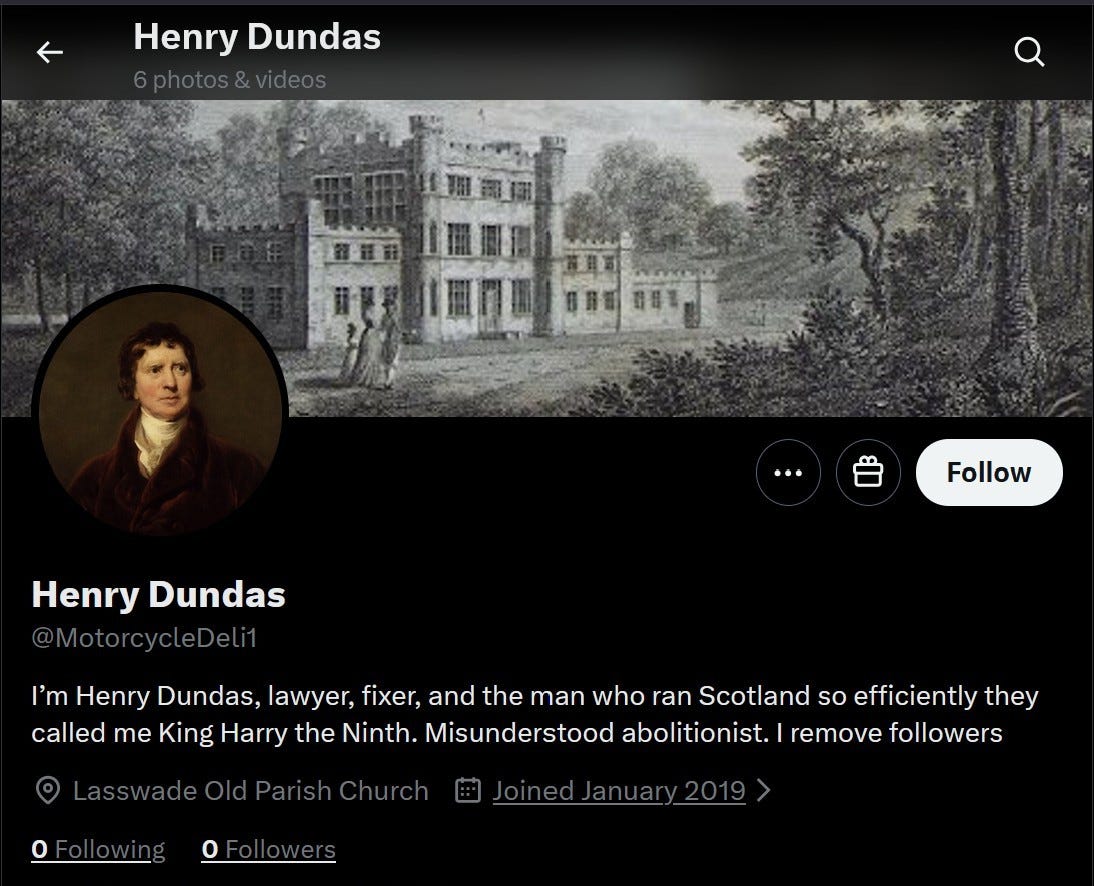
This account has been on the platform since January 2019. It follows nobody. It has no followers, by its own declared policy.
I am not going to speculate about who operates it, and nothing below depends on knowing. What I am going to do is read the output issued from behind the mask, because that mask was chosen, and it was chosen as a shield to hide behind whilst attempting to obscure the recorded truth of Scotland’s colonial suppression.
Freud gave the name parapraxis to the slip: the misdirected word, the forgotten name, the unintended act that says what the speaker cannot bring himself to say directly. The useful quality of a slip is that it cannot be argued with, because it was never an argument. It is simply something that got out.
The colonial version is rarely a slip of the tongue. It is a slip of the whole performance, and it is generally made in public, at length, and with confidence. Which is the difficulty with this account. Almost everything it does hands over the case.
This is one specimen. It is not the only one, and the interest here is the species rather than the individual.
I. The mask
Henry Dundas, first Viscount Melville, was the most powerful Scot of his age and he exercised that power entirely on London’s behalf. Lord Advocate, Home Secretary, Secretary of State for War, Treasurer of the Navy. What he actually ran was the machine: the patronage network through which he delivered Scottish parliamentary votes to Pitt’s government with a reliability no English manager could match. They called him Harry the Ninth and the uncrowned King of Scotland, and both names meant the same thing. Scotland was governed, and it was governed by a Scot, for the government sitting in Westminster and for their interests and his own. He thrived on that centralised authority, used it to advance himself and his allies, and wielded it ruthlessly enough that the names stuck.
He is, in other words, the precise historical embodiment of what postcolonial theory calls the “native intermediary”. Professor Alf Baird states the principle flatly in ‘The Socio-Political Determinants of Scottish Independence’: colonialism is always a co-operative venture. It cannot be run from the centre alone. It requires a class drawn from the colonised people who will administer the arrangement, and whose position within it depends on the arrangement continuing.
He adds the observation that explains the quality of that class: the meritocratic elite in a colonial environment is, in his words, “always mediocre, reflecting the narrow stream from which it is mostly sourced”. This is a structural claim rather than an insult. A class selected for reliability rather than tested against genuine opposition never has to develop the capacity to meet a serious challenge. It develops instead the capacity to manage, to placate, and to route around.
Baird’s work, which brings this apparatus to bear on Scotland with more rigour than anyone before him, sets out the consequence: an Anglophone cultural hegemony, an ethnic and cultural division of labour, and a subaltern people deprived of learning and valuing their own language and much of their own history.
Someone has chosen to argue the Unionist case in Scotland while wearing Dundas’s face.
II. Misunderstood abolitionist
The biography does not stop at Harry the Ninth. It also claims the contested defence.
The facts are not seriously in dispute. In April 1792, William Wilberforce brought a motion to the House of Commons for the immediate abolition of the Atlantic slave trade. Dundas, then Home Secretary, moved an amendment inserting one word, so that the trade ought gradually to be abolished. Amended, the motion passed, 230 to 85. The Lords deferred it. The trade continued until 1807, and in the fifteen years between the amendment and the abolition it carried more than half a million enslaved Africans across the Atlantic. Edinburgh City Council agreed the wording in June 2020, with Sir Geoff Palmer central to its drafting, and the permanent plaque was installed on the Melville Monument in October 2021. Its wording is worth having in full, because it is not ours: Dundas was instrumental in deferring the abolition of the Atlantic slave trade; as a result of that delay more than half a million enslaved Africans crossed the Atlantic; and he curbed democratic dissent in Scotland, and both defended and expanded the British Empire, imposing colonial rule on indigenous peoples. The plaque was physically removed in September 2023 by a committee led by a descendant. The council reported the removal to Police Scotland and installed a replacement in March 2024, with the wording unchanged.
The amendment’s meaning is contested among historians. Michael Fry, Angela McCarthy and Sir Tom Devine argue that immediate abolition was unpassable in 1792 and that gradualism was the only route with any prospect of success. Stephen Mullen and Sir Geoff Palmer argue that the insertion handed pro-slavery interests the years they needed, and that Dundas’s subsequent conduct shows where his interests lay. Both readings have serious scholarship behind them.
But notice what the persona has done. Of all the available self-descriptions, it selected the one that defends deferral. [1] Not the denial that anything happened. The insistence that what happened has been misunderstood, that the delay was prudence, that the people complaining have failed to grasp the realities of what was achievable.
Hold that sentence in your head, because you are going to meet it again.
III. Deferral as method
Deferral is not a historical curiosity. It is the operative technique of Scotland’s constitutional position, and it has been for three centuries. [1]
The Treaty guarantees are the model. Article XVIII preserves Scots law and permits alteration of private right only for the evident utility of the subjects within Scotland, a condition never once demonstrated in three hundred and nineteen years. Article XIX preserves the Court of Session and the High Court of Justiciary in all time coming, and forbids any cause in Scotland being cognoscible by the courts of Westminster Hall. The Kirk settlement was declared fundamental and essential, and Westminster restored lay patronage within five years.
Nothing was repealed. Everything was deferred, and the deferral became permanent by simply continuing. No repeal was required, and none was offered.
Fanon called the general form “cultural obliteration”. Aimé Césaire called the trajectory “the law of progressive dehumanisation”. Baird names the Scottish instance directly: a devolved administration making its own accommodation with colonialism, producing a political stasis that is itself a common feature of the decolonisation process, leading the people up one blind alley after another and always stopping short.
Gradually. Not never. Just gradually, and then the war came, and then the priorities changed, and then it was not the moment, and then the trade had carried half a million people across the Atlantic.
IV. A ruling on standing
Now to the substance, and to why the register matters more than the content.
When a constitutional claim is put to this account, it does not answer it. It denies that the claim belongs to the category of things that get answered. The response is not “your reading of Article XXIV is mistaken, and here is why.” It is that the whole line of argument is fantasy, that the person advancing it has invented it, that they ought to be embarrassed.
That is not refutation. It is a ruling on standing.
It is also the oldest move in the colonial repertoire, because it is the one Baird’s framework describes structurally. A subaltern people, deprived of their own history and their own language, are not recognised as competent to speak in the register of law about their own constitution. They are permitted grievance. They are permitted identity, sentiment, heritage, folk memory. What they are not permitted is instruments.
So when a Scot produces the Coronation Oath Act 1567, never repealed and given its short title by Westminster’s own Statute Law Revision (Scotland) Act 1964, or the Claim of Right 1689, unrepealed, invoked by the United Kingdom Government itself before the Supreme Court in 2019 in defence of its own prorogation, and whose principles, restated in the Claim of Right for Scotland, the Commons endorsed without a division in 2018, the reply is not a counter-citation. It is a raised eyebrow. These cannot be real law, because real law is what happens in London, and what happens here is heritage.
Albert Memmi: as soon as the colonised adopt the coloniser’s values, they adopt their own condemnation and that of their culture and people. Craig Beveridge and Ronald Turnbull gave the Scottish instance its name in The Eclipse of Scottish Culture. Inferiorism. Not quite the belief that Scotland is worse, but the deeper assumption that Scotland is not the kind of place where serious things originate.
Inferiorism needs enforcement, and the enforcement is usually local. Someone has to patrol the boundary of what a Scot may claim. [2] That is the co-operative venture, still operating, now with a profile picture.
V. The terror of the record
Here is what makes the register diagnostic rather than merely unpleasant.
Nobody who holds the instrument calls the question absurd. They produce it. Ridicule is what remains available when citation is not, and reaching for it in public is an admission made in front of witnesses.
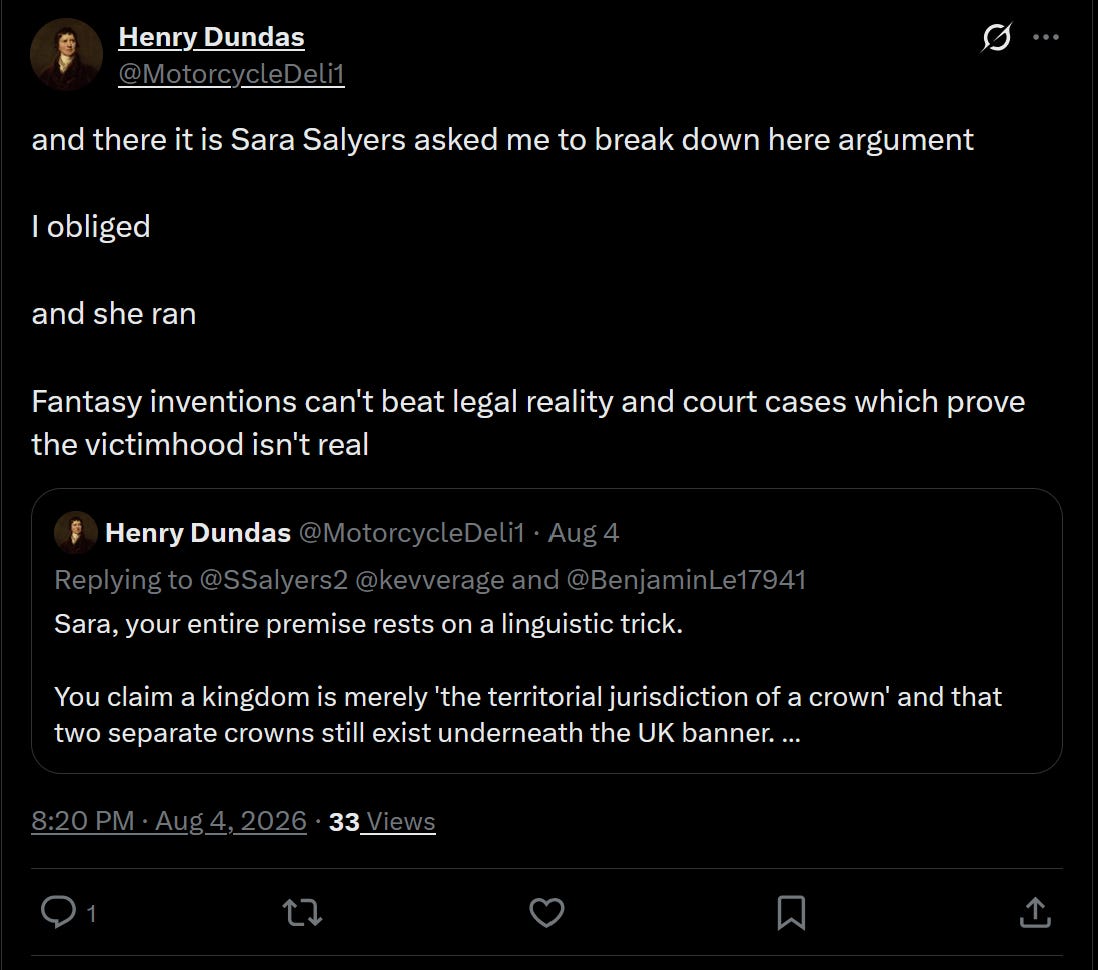
There is a second tell, sitting on the profile page. An account that announces ‘I remove followers’ has spent recent days arguing that its opponent, confronted with statutory text and binding precedent, could find no way to avoid losing except to remove it from the screen.
The complaint and the policy are the same act. Section VII returns to what that actually tells us.
I would add one further observation, and it is not mine. Writing in 2021, the journalist David Leask reported the existence of anonymous accounts engaged in detailed debate about obscure episodes of Dundas’s career, during the same period as the Melville Monument plaque dispute. That is on the published record, in the academic commentary on the Dundas historiography. Readers can do their own arithmetic about what kind of dispute attracts that kind of attention.
VI. A position, not a principle
What is being defended here is not the incorporation. The incorporation does not need defending by anonymous accounts; it has the entire apparatus of the state.
It is a position. If the Scots instruments are live, then a great many settled careers, arguments and self-understandings were built on the premise that they were dead. That is expensive, and expense shows up as heat.
This is why the energy is always disproportionate to the occasion. Nobody argues this hard about a thing they find genuinely ridiculous. Ridicule that requires sustained effort over days is not contempt. It is management.
VII. The account block as objective
There is a detail in this that reorders everything above it.
The account posted a screenshot of the block notice. Not as a complaint. As a result. ‘Why would I, it’s clear I have already won.’

You cannot win an argument you are no longer having. What that post announces is that the argument was never the object. The block was. The block is the artefact, the artefact is what circulates, and the circulating artefact says that the other side would not engage.
Which explains the shape of everything that precedes it. If persuasion were the aim, the method makes no sense: nobody persuades by telling the person they are embarrassing themselves. If the aim is to produce evidence of the target’s unreasonableness, the method is efficient and the block is success.
It also explains the profile line. An account that announces ‘I remove followers’, and then presents having been blocked as proof of victory, is not being inconsistent. It is being precise. Removal is a tool when it does it, and a trophy when it is done to it. The same act, valued twice, in whichever direction produces the artefact.
Nor is this the only account that works that way, and the objective is sometimes stated before the outcome. In another thread, on a different subject, one participant announced in advance that he had expected a particular post to induce a block, and reported with satisfaction that it had. Not an argument he hoped to win. A reaction he hoped to provoke. The persona replied approvingly.
Set that beside the trophy screenshot and the shape is unmistakeable. The block is not what happens when the argument fails. The block is what the exchange was for.
Note what this does to the accusation. ‘She ran,’ we are told. What the record shows is a person who answered at length, repeatedly, with citations, and then declined to continue with an anonymous persona that had produced none. Declining to keep feeding something is not flight. It is maintenance.
VIII. The legal case is the target
Look at what is being attacked, and by whom.
Not the sentiment. Nobody bothers arguing with Scottish sentiment; it has been safely available for three centuries and it changes nothing. Not the economics either, and not the history. Those can be conceded all day long, because conceding them costs the arrangement nothing.
What draws the response, every time, is the legal case. The instruments. The clauses. The question of what was actually done in 1707 and by what authority.
Notice, too, who arrives to make that response. Not historians. Not economists. The arguments come in legal register, from participants who present themselves as legally literate: the language of binding precedent, of internationally wrongful acts, of what a court has and has not held. People who understand exactly what a citation is, and what it is for.
Which makes the omission conspicuous. Of everyone who has arrived in this argument wearing legal authority, not one has produced the clause. They have produced the manner of a lawyer, the vocabulary of a lawyer, the confidence of a lawyer. The one thing a lawyer would actually produce is the one thing absent.
That is not incompetence. Anyone fluent enough to argue state responsibility is fluent enough to cite an article of a treaty. The clause is missing because there is nothing to cite, and the register is doing the work the citation cannot.
So the pattern reads plainly. The legal case is the target, because the legal case is the vulnerability. [3] Everything else in the Scottish argument can be lived with. That cannot, and the people who understand law best are the ones who understand that first.
IX. Why law and nothing else
It is worth asking why this particular argument, and why this particular person.
The Scottish constitutional question has been debated for decades in registers that are safe to lose in. Sentiment is safe. Identity is safe. Economics is safe, because the figures can always be disputed and nobody’s authority is at stake. History is safe, because history is about the past.
Law is not safe, because law is about now.
An instrument either exists or it does not. It has either been repealed or it has not. A condition has either been demonstrated or it has not been. There is no interpretive fog to retreat into and no way to hold a position without producing something. Which is precisely why the question was kept out of that register for three centuries, and why the reaction is what it is when someone puts it back there.
Sara Salyers did not invent a claim. She did something more difficult and more dangerous. She moved the argument into the one register where the state’s position has to be evidenced rather than assumed, and she did it with the instruments in front of her.
That is what draws the response. Not because the claim is weak, but because in that register weakness becomes visible, and the visibility runs the wrong way.
The responses themselves confirm it. They arrive in legal costume, citing, invoking precedent, adopting the register of settled authority. Checked against the record, the citations do not say what they were said to say. The costume is doing the work the content cannot.
That is the shape of the whole three hundred and nineteen years, compressed into a comment thread. An authority that cannot produce its own instrument, performing the manner of one that can.
Fanon locates the mechanism exactly, in the opening chapter of The Wretched of the Earth: the settler’s work of breaking in the native is finished only when the native openly concedes the supremacy of the coloniser’s values. Acceptance is the object, not compliance. Which is why the register itself is treated as trespass. A people held incompetent to speak in law about their own constitution do not merely lose the argument. They are told there was no argument to have.
The moment a Scot speaks in the register of law about Scots law, that arrangement is in difficulty. Everything else is manageable. That is not.
X. Name the clause
So let us make it simple, and let us make it answerable.
The Articles were read into the Scots parliamentary record on 7 March 1707, and sit at RPS 1706/10/363. Article I unites two kingdoms into one kingdom by the name of Great Britain, appoints ensigns armorial, and conjoins the crosses for flags and banners. Kingdoms, a name, and flags. The word crown does not appear in it.
Article XXIV, in the same breath as it creates a new Great Seal for the United Kingdom expressly different from the seal used in either kingdom, provides that a separate seal shall continue in Scotland, and that the crown, sceptre and sword of state, together with the records of parliament, continue to be kept within Scotland in all times coming, notwithstanding the union.
They knew exactly how to create a new unified thing when they intended to. They wrote it down for the seal. They did not write it for the crown, and no new crown was ever made. St Edward’s Crown, made in 1661, is English, and it is the one used at Westminster. The Crown of Scotland, remade in 1540, is in Edinburgh.
An extinction requires an instrument. Continuity requires nothing at all.
So: if the Crown of Scotland was merged, transferred or extinguished in 1707, name the clause that did it.
Not a doctrine. Not a later court. Not a tone of voice.
The clause.
If it exists, this takes one line to settle. If it does not, then everything said in its place was said in place of it. The substitution is the finding.
Harry the Ninth was, after all, a lawyer. He would have understood the difference between citing an instrument and managing an inconvenience.
This article is published on X and is a reading of the public record, put to the account that made the statements it examines. Replies there are restricted to @MotorcycleDeli1. The floor is cleared for a response.
Sources
Scots statutory and constitutional primary records
Treaty Articles, verified at the Records of the Parliaments of Scotland, RPS 1706/10/363, the exemplification read into the Scots parliamentary record on 7 March 1707. rps.ac.uk/trans/1706/10/363
Coronation Oath Act 1567, December 1567 legislation list; short title granted by the Statute Law Revision (Scotland) Act 1964, Schedule 2.
Claim of Right 1689. RPS 1689/3/108; manuscript record, National Records of Scotland, PA2/33. rps.ac.uk/trans/1689/3/108
Parliamentary record
House of Commons motion endorsing the principles of the Claim of Right for Scotland, 4 July 2018. hansard.parliament.uk/Commons/2018-07-04/debates/18070455000001/ClaimOfRightForScotland
Case law
R (Miller) v The Prime Minister and Cherry v Advocate General for Scotland [2019] UKSC 41.
The Dundas abolition historiography
Angela McCarthy, ‘Bad History: The Controversy over Henry Dundas and the Historiography of the Abolition of the Slave Trade’, Scottish Affairs 31:2 (2022).
Stephen Mullen, Edinburgh University Press blog (2021).
Michael Fry, The Dundas Despotism (1992).
Theoretical framework
Alfred J. Baird, ‘The Socio-Political Determinants of Scottish Independence’, Towson University Journal of International Affairs, Vol. LV, No. 2 (Spring 2022), at pages 8 and 27. wp.towson.edu/iajournal/the-socio-political-determinants-of-scottish-independence/
Frantz Fanon, The Wretched of the Earth, ‘Concerning Violence’ (also rendered ‘On Violence’) and ‘On National Culture’, cited by chapter rather than page since the Farrington and Philcox translations paginate differently.
Albert Memmi, The Colonizer and the Colonized.
Aimé Césaire, Discourse on Colonialism.
Craig Beveridge and Ronald Turnbull, The Eclipse of Scottish Culture.
Professor Alf Baird, Doun-Hauden: The Socio-Political Determinants of Scottish Independence.
.
Is what you’re saying in Section X. that the Crown of Scotland may still exist because nobody can point to a clause in the Acts of Union (or anywhere else) that says “the Crown of Scotland shall cease to exist on 1 May 1707”?