

I. The summons
In Part 1 of this series, The Dundas Wakening: Colonial confessions from behind the mask, we highlighted an account posting as ‘Henry Dundas’ from the handle @MotorcycleDeli1, arguing the Unionist case while wearing a dead man’s face; we refer to it hereafter as the Dundas persona. On 6 August 2026, with replies restricted to that account alone, it was asked to defend the position it had argued for some time: that the Crown of Scotland ended in 1707. One question was put:
“If the Crown of Scotland was merged, transferred or extinguished in 1707, name the clause that did it.”
Its defence would have taken one line, and we had already named the thing that would have settled it. Not a doctrine. Not a later court. Not a tone of voice. Simply a clause.
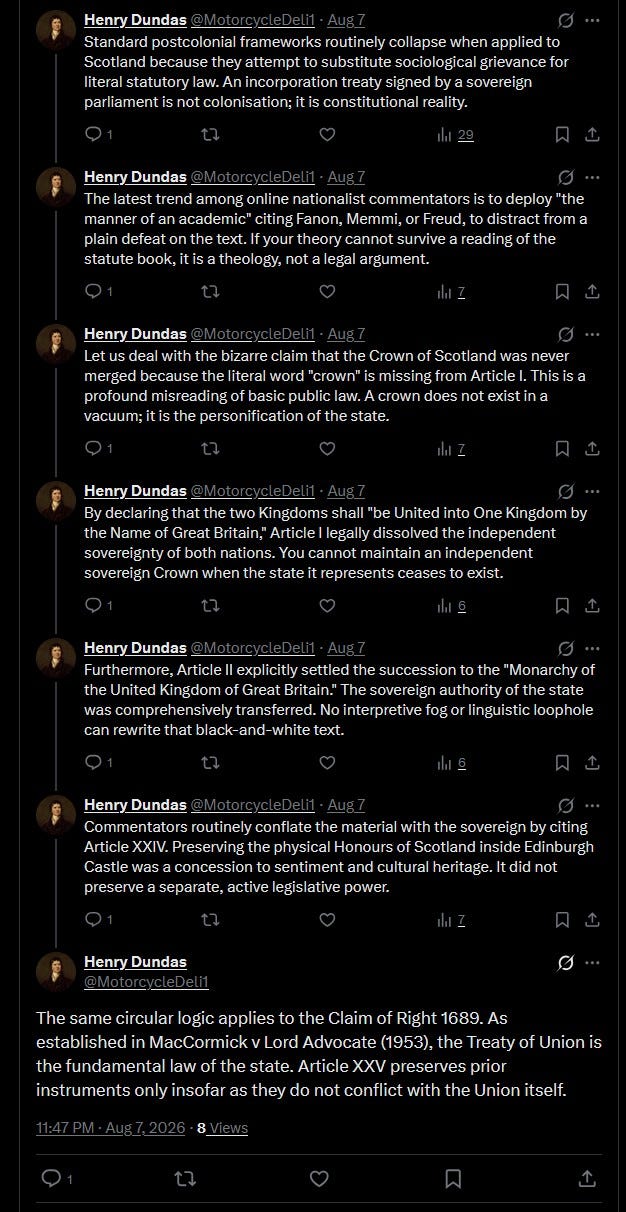
What came back from the Dundas persona was substantial, often disjointed from the thread it answered, and wrong on the facts. Across the following days the account engaged the Treaty directly, citing Article I, Article II, Article XXIV, and Article XXV, and reaching beyond it to the Claim of Right of 1689 and a decision of the Court of Session from 1953. Each claim, taken at its highest, failed on the text it relied on. No clause was ever named. What arrived instead was a doctrine, that a crown ends when its state ends, and a later court’s obiter, a passing observation in MacCormick v Lord Advocate. These were two of the three things Part 1 had named in advance, both produced within two days of its publication. Neither refusal nor silence describes what happened, because neither occurred. What happened has a name, which is deflection, a technique this account did not invent: Westminster has been deploying it against Scotland for over three hundred years.
II. The defender’s concession
Read the whole response together and it distils to a single sentence, which the Dundas persona states itself:
“Every recognized canon of construction relies on necessary implication.”
Everything else rests on that, and the pleas are the Dundas persona’s own: an incorporating union dissolves separate sovereignty “by definition”; the ending of the old sovereignties is a “mathematical legal reality”; a statute cannot bar a person from inheriting an entity which does not exist; when the realms merged, the separate crowns consolidated. Not one is a clause. Every one is an inference drawn in the absence of a clause. The position is no longer that an extinguishing provision sits somewhere in the twenty-five articles and we have missed it. The position is that none is needed, because one may be read in. The question “name the clause” was answered at length, in public, across two days, and the answer is that there is no clause but you should infer it. On 8 August we answered the Dundas persona’s constitutional claims in a single reply, posted in the thread beneath Part 1, quoting every clause verbatim from the Scots ratifying Act of 16 January 1707 at RPS 1706/10/257, and referred to hereafter as the reply of 8 August. No clause has been named in answer to it, or since.
III. Deferral, and deflection
Part 1 documented the method in its own words:
“Everything was deferred, and the deferral became permanent by simply continuing. No repeal was required, and none was offered.”
The register now enters it formally as Colonial Deferral: the obligation conceded, its performance deferred, and the deferral made permanent by continuation, the concession genuine because it removes the grievance while retaining the position. The axis it runs on is time. The obligation is never denied, because a denial invites a fight that can be lost. It is accepted, warmly and in public, and then the performance of it is postponed, and postponed again, until postponement has quietly become the settled state of things, at which point no repeal is needed because nothing was ever repealed. Article XVIII of the Treaty permits Westminster to alter Scots private law only for the evident utility of the subjects within Scotland. In three hundred and nineteen years Westminster has never once demonstrated that utility. When the condition was put to the Court of Session, in Gibson v Lord Advocate in 1975, Lord Keith in the Outer House declined to accept it as justiciable, and when Treaty arguments returned the Inner House left the question unanswered [7][8][9]. Never demonstrated, put more than once, and never once ruled upon. The condition was not struck out. It was never met, it was never enforced, and the failure to meet it became the arrangement we live inside.
Deflection is the same operation running on a different axis, and that axis is category. When a question is put, it settles not only what is being asked but what will count as an answer. A question of sentiment is answered with sentiment, and anybody at all may answer it. A question of economics is answered with figures, which can always be disputed, so nobody’s authority is finally at stake. A question of history is answered with interpretation, which is inexhaustible by design. A question of law, and only a question of law, is answered by producing something: a clause, a case, a statute, the document itself, handed over and laid on the table where the other party can read it. A doctrine does something particular in that setting: it is a general proposition about how law works, and it can be stated at any length, defended with real learning, and argued about for years, and at no point in that process does anybody have to produce a clause, a statute, or a case. The same is true of a later court, because citing a judgment is not the same as citing a clause: a judgment is somebody’s reading of the law rather than the law itself, and a reading can always be offered where no clause, statute, or case can be found. Both are respectable things to bring to a legal argument. Neither is a clause, and neither requires that a clause exist.
So deferral concedes the obligation and withholds the performance until the withholding becomes permanent by continuing, while deflection accepts the question, takes the floor that was offered, and produces its performance in a category that carries no obligation to produce. The question went in asking for a clause, and what came out was a theory about crowns and a judgment from 1953. Neither technique refuses, because a refusal is visible and a refusal can be scored against you. Neither has to produce anything, and that is why whoever is running them can run them indefinitely. They are one mechanism with two axes: deferral says later, and later never comes; deflection answers a question of law with anything but law. The mechanism takes its name in the register here, Colonial Non-Performance, the obligation affirmed and the performance withheld, with Colonial Deferral recorded within it, in advance of the Empire Ledger update, and its companion entered beside it: deflection, the category-axis execution, in which the question is accepted and the answer is produced in a category that carries no obligation to produce.
IV. On the pleadings
The Dundas persona’s answer ran across 7 and 8 August, the bulk of it arriving on the evening of 8 August, and its claims rested, between them, on four articles of the Treaty, the Claim of Right of 1689, and a judgment of 1953. Here is each, in the words of the Scots ratifying Act at RPS 1706/10/257, from the translated record, set against what it was cited to prove.
Article I. Cited for the doctrine that an incorporating union dissolves the separate sovereignties “by definition”, and that when the realms merged the separate crowns consolidated. The article provides: “That the two kingdoms of Scotland and England shall, upon 1 May next ensuing the date hereof, and forever after, be united into one kingdom by the name of Great Britain”; its next words appoint the ensigns armorial, the conjoined crosses of St Andrew and St George, and the flags. It unites two kingdoms by name and proceeds directly to heraldry. It contains no words of merger, transfer, or extinguishment directed at any crown, and a consolidation of crowns read into it is supplied by the reader, not by the text.
Article II. Cited on the footing that a single settled succession proves a single crown. The article provides that the succession to the monarchy of the United Kingdom of Great Britain shall “be, remain and continue” to Princess Sophia of Hanover and the Protestant heirs of her body, “upon whom the crown of England is settled by an act of parliament made in England”. It settles who succeeds; it nowhere extinguishes what is succeeded to, and the machinery it borrows is English, named twice in the one clause, the crown of England and an act of parliament made in England.
Article XXIV. Cited for the express creation of “one great seal for the United Kingdom of Great Britain, which shall be different from the great seal now used in either kingdom”. The citation proves the reverse of what it was brought for, because the same article, having created expressly where creation was intended, provides of the honours of Scotland:
“That the crown, sceptre and sword of state, the records of parliament and all other records, rolls and registers whatsoever, both public and private, general and particular and warrants thereof, continue to be kept, as they are, within that part of the United Kingdom now called Scotland, and that they shall so remain in all time coming notwithstanding of the union.”
The one article performs three drafting operations. It creates expressly: one great seal, different from either kingdom’s. It continues and alters expressly: the privy seal, signet, and court seals of Scotland “be continued” but “altered and adapted to the state of the union”, “subject to such regulations as the parliament of Great Britain shall hereafter make”. Of the crown, sceptre, and sword of state, the Honours of Scotland, symbols of Scottish state sovereignty, it writes “continue” and “remain”, “in all time coming notwithstanding of the union”, with no alteration clause and no regulating power attached. A drafter who created expressly, altered expressly, and regulated expressly did nothing silently, and a silent extinguishment cannot be read into that text. Westminster’s own statute book still treats the article as live law: the Scotland Act 1998 defines the Scottish Seal as “Her Majesty’s Seal appointed by the Treaty of Union to be kept and used in Scotland in place of the Great Seal of Scotland”. Read the definition against itself and the substitution shows: appointed by the Treaty to be kept and used, the continuing function restated in Westminster’s own words, then “in place of”, replacement written where the Treaty wrote continuation, in a definition that still names the Great Seal of Scotland as the thing its seal stands in place of. The First Minister holds the office of its Keeper, a standing office of state in continuous operation for nine centuries before the statute existed; section 45 identified the occupant, and created nothing. The article the Dundas persona reached for is the one Westminster’s own statute book still cannot do without.
Article XXV. Cited for the proposition that Scots Acts inconsistent with the union are void. The article provides: “That all laws and statutes in either kingdom, so far as they are contrary to or inconsistent with the terms of these articles, or any of them shall, from and after the union, cease and become void, and shall be so declared to be by the respective parliaments of the said kingdoms”. It is a repugnancy provision, and its own words carry its whole operation: laws and statutes inconsistent with the articles “cease and become void” from the union, and the respective parliaments are directed to declare them so. It is addressed to laws and statutes, and it names no crown. A clause that reaches only laws and statutes does not extinguish a crown in silence.
The Claim of Right 1689. Cited among the authorities. It precedes the Treaty by eighteen years, it contains no clause touching the existence of the Crown of Scotland, and what it records is the community of the realm’s judgment upon the crown’s occupant. That authority runs the other way.
MacCormick v Lord Advocate. Cited as establishing the Treaty as the fundamental law of the state. Lord President Cooper, at page 411:
“The principle of the unlimited sovereignty of Parliament is a distinctively English principle which has no counterpart in Scottish constitutional law.”
His opinion records his difficulty in seeing why the new Parliament of Great Britain should be treated as if it were the Parliament of England continuing, and the same opinion records the Lord Advocate conceding that the Parliament of Great Britain could not repeal or alter the Treaty’s fundamental and essential conditions. The action itself failed, and no clause of extinguishment was found, cited, or needed for its disposal. Whatever the case is authority for, it is not authority for the ending of the Crown of Scotland.
That is what the Treaty, the Claim of Right, and the judgment actually say. Each claim survives only if necessary implication supplies what the text does not, which is the concession of Section II, performed. What follows is how the argument was conducted, the second half of the record.
The one citation. Across the whole response there is a single dated citation, and it reads: “the official parliamentary record from April 28, 1792.” It carries no volume, no column, and no page, and it arrives in the Dundas persona’s post accusing us of failing to perform “basic primary-source archival verification.” There was no official record of parliamentary debates in 1792; the Journals of the House of Commons record proceedings and votes, Hansard postdates the period, and the standard sources for the debates are the Parliamentary Register, Cobbett’s retrospectively compiled Parliamentary History, and the printed reports of the debate itself. The date, though, is real, and what happened on it runs the other way from the claim it was cited to support. The Dundas persona’s case is that Henry Dundas secured a hard, fixed termination date of 1 January 1796 against pro-slavery members pushing for 1800, whereas the sequence Mullen sets out in the Scottish Historical Review is this: on 23 April 1792 Dundas submitted resolutions fixing 1800, and on 28 April Sir Edward Knatchbull moved an amendment taking the terminal date off 1800 and onto 1796, upon which Dundas withdrew from proceedings. The earlier date was not his achievement. It was forced on him, over his objection, and this is not a contested reading, because three sources from three opposed positions agree on it: Stephen Mullen, who is critical of Dundas; History of Parliament Online, which is neutral and records that Dundas “surrendered to the majority who preferred a terminal date of 1796”; and the material published by Arniston House and the Henry Dundas Committee, which is the descendants’ own defence brief and records Dundas objecting to the amendment. The single act of citation in the entire response cites the date of its subject’s defeat as the date of his victory.
The accusation refuted by its own exhibit. One post accuses us of “entirely blanking the very first line of Article II”, and attaches a screenshot of the passage it is complaining about. The quotation in that screenshot opens with that line: “That the succession to the monarchy of the United Kingdom of Great Britain and of the dominions thereinto belonging.” Legible in the image chosen and attached by the accuser.
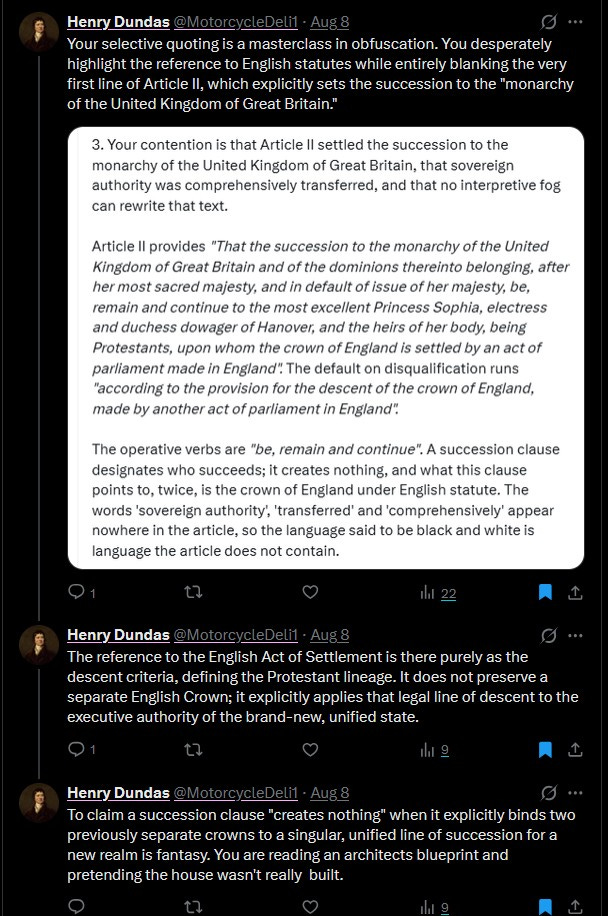
The reversal. On 7 August the Dundas persona wrote that “as established in MacCormick v Lord Advocate (1953)”, the Treaty is the fundamental law of the state. On 8 August, after Lord President Cooper’s words at page 411 had been read back to it in the reply of 8 August, the Dundas persona wrote that we were “treating a non-binding, passing obiter dictum as if it were a supreme constitutional ruling”. Same case, same account, one day apart, and the demotion arrives only once the case has been read. The passage relied on and the passage demoted hold the same status in the same judgment, so the demotion convicts the citation it was defending.
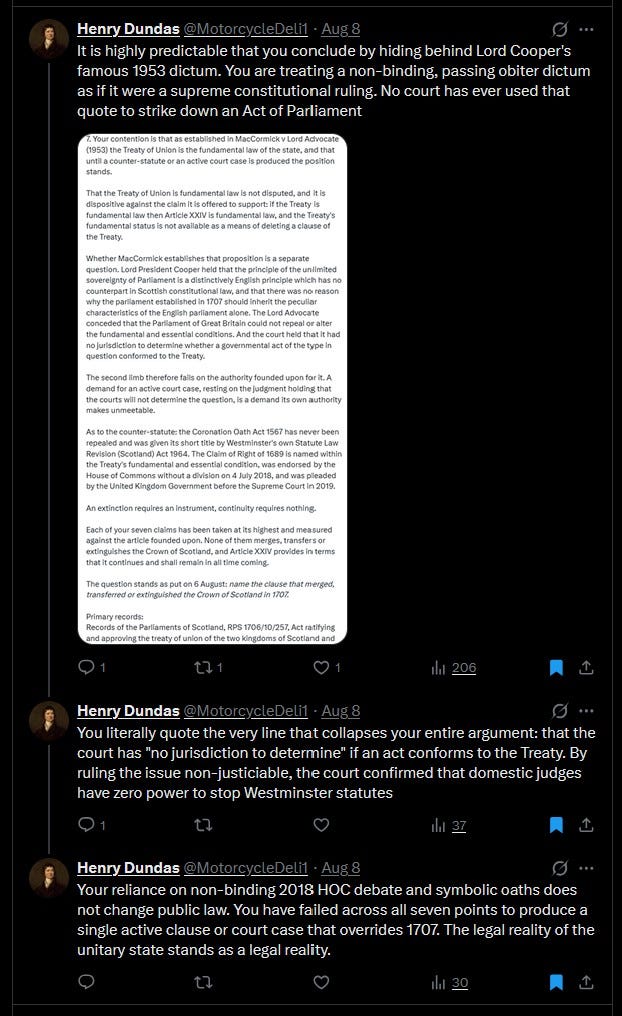
The demand that eats itself. The Dundas persona demanded a counter-statute or an active court case, then argued that the courts had ruled the issue non-justiciable and that domestic judges have zero power. Both cannot stand, because if no court will determine the question then a court determination is not a test anyone has set; it is a bar somebody has built.
Two things conceded without apparent notice. That the Treaty created “a brand-new, single Great Seal for the United Kingdom” is the express-creation contrast granted in the Dundas persona’s own words, the drafters creating expressly when they created, while writing continue and remain of the crown, sceptre and sword of state. The concession that the reference to the English Act of Settlement is there “purely as the descent criteria” grants in turn that the machinery under Article II is English machinery, named twice in the one clause.
The typography of a citation, with nothing attached. Two posts carry the marker [1] after a quoted phrase; no sources of any kind follow, in the posts or behind them. Part 1 argued that the register performs the work the citation cannot; here is the punctuation of scholarship, deployed with no scholarship behind it.
V. The ruling on standing
The failed pleadings are not the point. The point is the register the whole response is written in, and what that register is for. Here is a sample:
“An extraordinary display of legal illiteracy.” “Hiding behind a literalist fallacy.” “Public law does not work like a word-search puzzle.” “Look at Article II before replying, embarrass yourself further.” “A nonsense.” “Nationalist theology, not statutory reality.” “A masterclass in obfuscation.” “You are reading an architects blueprint and pretending the house wasn’t really built.” “The semantic gymnastics are failing.” “The state apparatus does not care about your blog.”
Was it “an extraordinary display of legal illiteracy”? Take the line’s own two words. Extraordinary, no. Illiterate, also no, and the second matters more: the response is fluent in the terminology of law, and fluency is exactly what a ruling on standing runs on. What the fluency stood in for is what Section IV records: we quoted the Scots ratifying Act article by article, and the judgment with it; the Dundas persona, delivering the verdicts, produced one dated citation pointing the wrong way and no clause at all. Part 1 named this. A subaltern people, deprived of their own history and their own language, are not recognised as competent to speak in the register of law about their own constitution. Colonised people are permitted grievance, because grievance changes nothing. They are permitted the ornaments of a culture whose substance has been stripped: tartan, Burns, the shortbread tin. What they are not permitted is self-determination. That is what a ruling on standing does. It is not a refutation and it does not try to be one, because it is a decision about whether the person speaking is the kind of person whose speech belongs in this category at all, and it works by making the claim seem absurd rather than by showing it to be wrong. Not one line of the sample above is a counter-citation. Every one of them is a verdict on the competence of the speaker, and the verdicts arrive in place of the clause rather than alongside it, which completes the three exclusions Part 1 printed in advance: the doctrine and the later court both within two days, and the tone of voice above.
Albert Memmi’s observation is the one that stings, because it is about us rather than about them: as soon as the colonised adopt the coloniser’s values, they adopt their own condemnation and that of their culture and people. Craig Beveridge and Ronald Turnbull gave the Scottish instance its name in The Eclipse of Scottish Culture. Inferiorism. Not quite the belief that Scotland is worse, but the deeper and quieter assumption that Scotland is not the kind of place where serious things originate.
Inferiorism needs enforcement, and the enforcement is usually local. If you have argued for Scotland’s right to determine its own future in any public place, you have met this, and you probably came away from it thinking you had argued badly. You had not. You produced chapter and verse and received a verdict on your competence to produce it, and because the verdict arrived in confident language from someone who sounded like they knew, you took the confidence for knowledge and concluded the fault was yours. That is not an accident of temperament and it is not a failure of your preparation. It is a technique, it is old, and it is applied to Scots by other Scots more often than by anybody else, which is precisely what makes it work.
VI. Two registers
A second account holder has joined this debate of his own volition, via comment on Substack. Unlike the Dundas persona, he does not hide behind a dead man’s mask: he posts openly under his own name and likeness. On 10 August, a comment appeared under Part 1 from an account in the name of Neil King, who posts on X from the handle @NeilKing11. What the comment brought was not a question but a restatement of the article’s own position: it asked whether what Part 1’s Section X says is that the Crown of Scotland may still exist because nobody can point to a clause, in what it called the Acts of Union or anywhere else, saying that “the Crown of Scotland shall cease to exist on 1 May 1707”.
Part 1’s Section X does not ask that. It asks for the clause that merged, transferred or extinguished the crown, three routes in the alternative, worded that way deliberately so that no reader may take the easiest of the three and argue only against it. The restatement reduces three routes to one, and supplies a form of words that appears in no article of the Treaty. Set the two side by side and it is a narrower question than the one asked, carrying the article’s name. The reply, sent on 12 August, was this: “On your narrowed question, claims were made by the Dundas Persona, and their further reply and defence are still awaited.”
On 15 August the same account replied:
“Is the answer to my question Yes or No?”
The answer is No. The case has never rested on the absence of a clause. Article XXIV provides that the crown, sceptre and sword of state “continue to be kept, as they are, within that part of the United Kingdom now called Scotland, and that they shall so remain in all time coming notwithstanding of the union”. That is a positive provision in the Scots ratifying Act itself. The Act created expressly, altered expressly, and regulated expressly, and of the crown, sceptre, and sword it wrote continue and remain. The absence of any clause of merger, transfer or extinguishment corroborates that record.
It is not the first such comment. A post dated 5 August, from an account in the same name, appears in the Dundas persona’s own mentions on X.
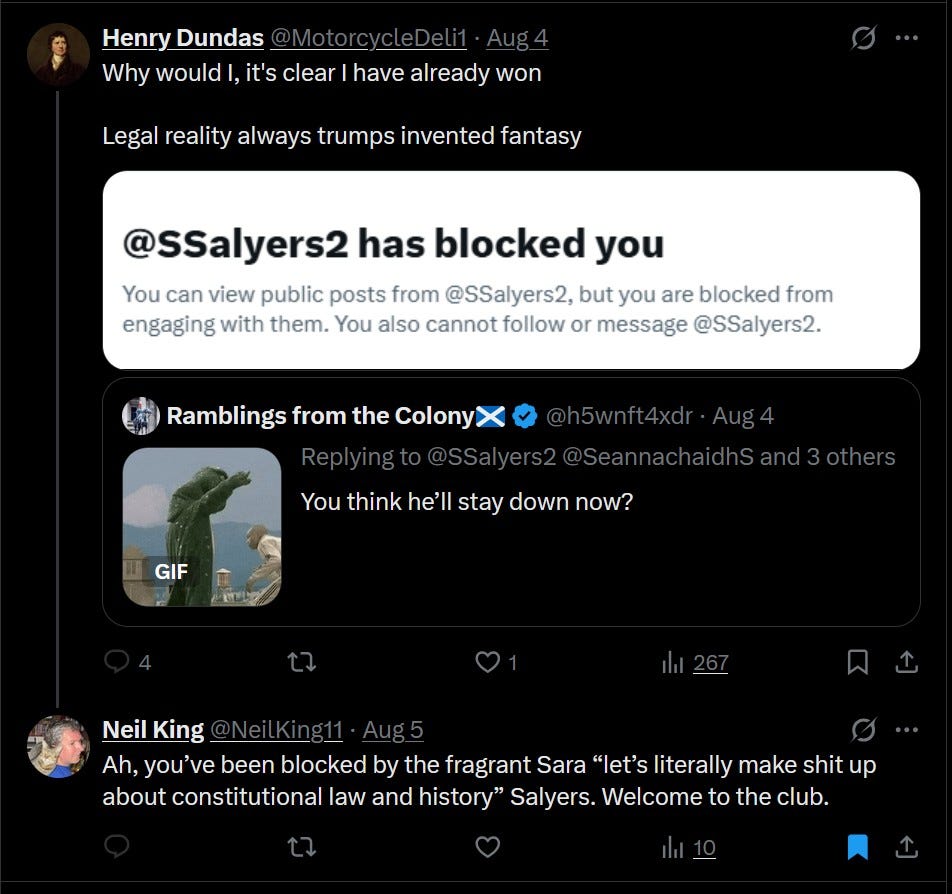
The two accounts share one thing, and it is not an identity: a technique, and the technique is the subject of this article. On 7 July, in a comment under We Audited Scotland’s Senior Court. Here Is What Its Own Record Shows, the same name asked for examples of cases in which the Acts salvo jure cujuslibet were founded upon or invoked, from the law reports, or cited in the likes of Stair or Erskine, so that the operation of the bare statutory words in practice could be seen. It is a question a document settles: the answer, if it exists, sits in the law reports or in the institutional writers, and either it is there or it is not. On 5 August, in the Dundas persona’s own mentions on X, on the question of where sovereignty in Scotland lies, that post contains a phrase in quotation marks and a characterisation of another party to the argument as making things up about constitutional law and history. No report, no institutional writer, and no case. What the posts have in common is documented on their face: neither contains a report, an institutional writer, or a case. No clause has yet come from the Dundas persona or from Neil King, and across those two posts the demand for institutional authorities has been aimed at one side of the argument only. So the question remains whether any actual evidence can be produced to back the claims made by the Dundas persona, or whether, yet again, obfuscation shall be presented in place of fact. Set the four dates in a row: 7 July, the evidential standard set; 5 August, a post containing no report, no institutional writer, and no case; 10 August, three routes reduced to one; 15 August, a demand for one word.
The floor is open, and the evidential standard for whoever takes it is the one set on 7 July: a clause from the ratifying Act, a case from the law reports, or a passage in the likes of Stair or Erskine, not characterisation. The clause question sits under it.
VII. The one-line test
Part 1 contained a sentence doing more work than it announced: “If it exists, this takes one line to settle.” That sentence is a tool, it travels, and here is how to use it.
Ask the question a document would settle. Then watch whether what comes back contains the document.
Not whether the answer is long: length is not the variable, and the test misleads anybody who treats it as one, because a position with a genuine document behind it can answer at any length it likes, richly, with context and qualification and every argument it cares to make, since somewhere in that answer it appears: the clause, the case, the record, the thing that settles it. Such an answer passes at a line or at five thousand words. A position without a document has to build something to stand where the document would have been, and what it builds is recognisable once you have seen it a few times: a characterisation of the question, a verdict on the questioner, a general principle that would supply the missing thing if only it were granted, or a relocation to ground where nothing has to be handed over. The failure mode is not volume, it is a great deal of argument containing one citation, and the citation pointing the other way. The test costs nothing to run and it cannot be argued with, because it never argues; it only watches what is produced.
You will be in an argument this week where somebody holds a position that a document would settle. Ask the one-line question. Then count what comes back, and see whether the document is in it.
VIII. Who is behind it
Every one of those posts records a choice, and whoever, or whatever, made the choices could have named the clause at any point and did not. Beyond that, the identity of an anonymous account is of no interest here, because the framework answered that question before the account existed. Professor Alf Baird states the principle in ‘The Socio-Political Determinants of Scottish Independence’, in the Towson University Journal of International Affairs: colonialism is always a co-operative venture, native elites and the native bourgeoisie being eager to cast off their own language and culture and to mimic the coloniser’s, because their socio-economic status depends on doing so. Baird’s source there is Fanon, and Fanon’s fuller account of that class in The Pitfalls of National Consciousness describes it as canalised into the intermediary role, producing nothing of its own, and senile before it has ever been young. Baird then states the consequence directly: the meritocratic elite in a colonial environment is, in his words, “always mediocre, reflecting the narrow stream from which it is mostly sourced”, an observation his own footnote traces to Memmi. Baird brings the rest of the apparatus to bear on Scotland too, an Anglophone cultural hegemony, an ethnic and cultural division of labour, and a subaltern people deprived of learning and valuing their own language and much of their own history. It is a structural claim about what the arrangement produces, and the intermediary class is selected rather than born. The role precedes whoever fills it, and it recruits. Remove one occupant and the arrangement supplies another, since the arrangement is what requires the role: Henry Dundas himself was replaceable, and the patronage machine was the thing, which is exactly why the mask this account chose was the machine’s manager, and which is also why the boundary is patrolled by Scots. It has to be. Westminster cannot tell a Scot that Scotland’s constitutional Acts are heritage rather than law and be believed, another Scot can, and the role has never gone unfilled.
IX. Disposal
Section IV disposes of what was argued, on the pleadings and with no proof required, which is the decree de plano of the title, and not of the subject: a verdict disposes of what was put before it and not of the matter, and the record stays open behind it. New evidence reopens the question, a better argument reopens it, and a clause, if a clause exists, settles it in one line at any hour of any day, from anybody at all.
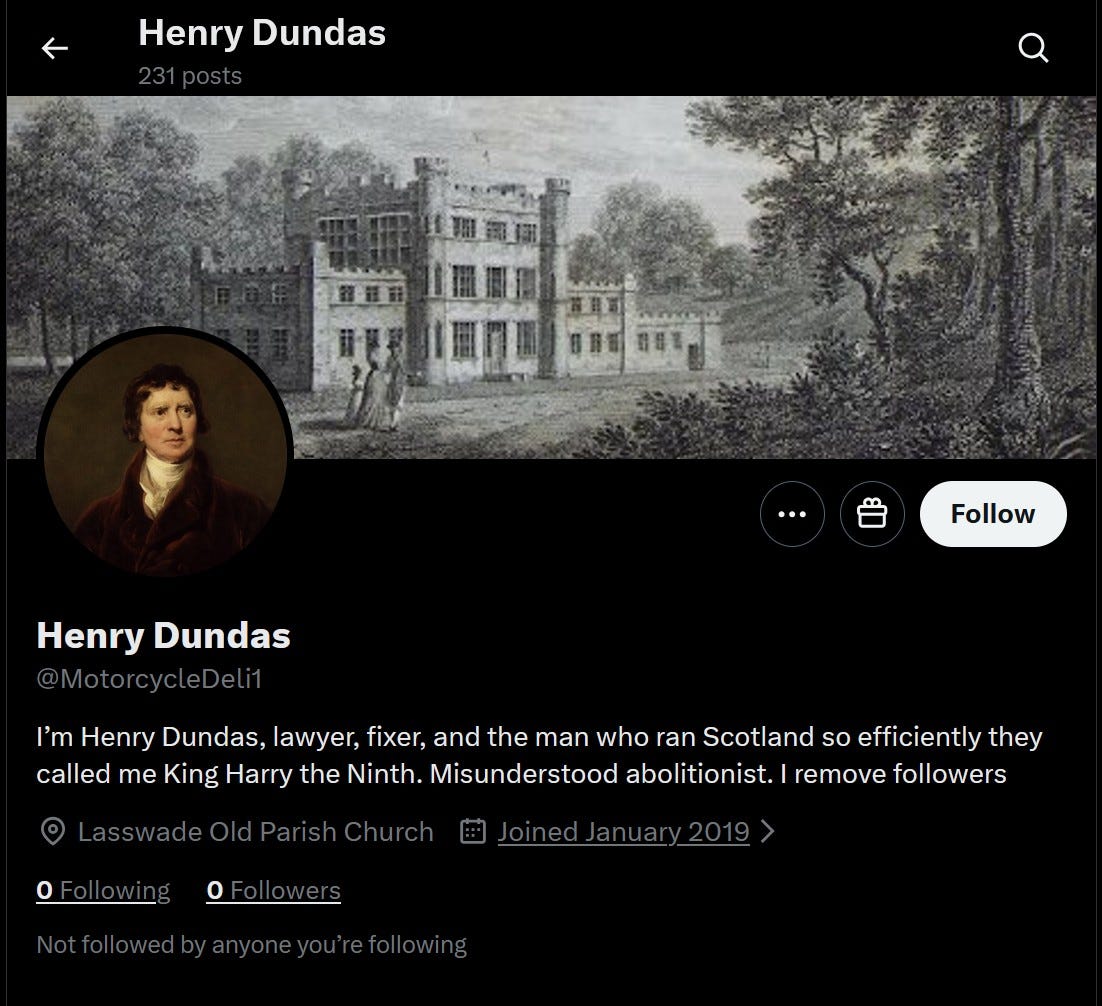
@MotorcycleDeli1 was suspended by X, which we discovered on 13 August. By 16 August the account was live again. No reasons were published for either act, and nothing here turns on the platform’s conduct either way, because the case never rested on it. It rests on the account’s own presentation, which neither act altered, a deception on its face and by its own declared design, the deceptio of the title: a dead man’s name, a dead man’s portrait, followers removed by policy, followed nobody since January 2019, and multiple disjointed replies, each claim in them failing on the text it relied on. From 3 August, before Part 1 existed, other accounts were identifying it publicly as a bot. The role precedes whoever fills it, and the account that was asked to name the clause is back in the room where the question is still standing.
The question stands exactly as it was put on 6 August:
“If the Crown of Scotland was merged, transferred or extinguished in 1707, name the clause that did it.”
Not a doctrine. Not a later court. Not a tone of voice.
The clause.
Sources
Scots statutory and constitutional primary records
[1] Act Ratifying and Approving the Treaty of Union of the Two Kingdoms of Scotland and England, Parliament of Scotland, 16 January 1707. Articles I, II, XXIV, and XXV quoted, and Article XVIII engaged, from the translated record at the Records of the Parliaments of Scotland, RPS 1706/10/257. The enrolled record differs in spelling and in older forms of words, keeped for kept, the first day of May for 1 May, thereunto for thereinto; every word the findings rest on is identical in both. rps.ac.uk/trans/1706/10/257
[2] The exemplification, under the great seal of England, of the English ratifying Act, dated at Westminster 7 March 1707 and read and ordered to be recorded in the Parliament of Scotland on 19 March 1707. Cited by Part 1, which gives the reading date as 7 March; the record’s sitting is 19 March, and the correction is entered here. RPS 1706/10/363. rps.ac.uk/trans/1706/10/363
[3] Claim of Right 1689. RPS 1689/3/108. rps.ac.uk/trans/1689/3/108
United Kingdom statutory records
[4] Scotland Act 1998, sections 2(6) and 45(7).
Case law
[5] MacCormick v Lord Advocate 1953 SC 396, per Lord President Cooper at 411.
[6] Gibson v Lord Advocate 1975 SC 136, per Lord Keith at 144.
[7] Pringle, Petitioner 1991 SLT 330.
[8] Murray v Rogers 1992 SLT 221.
Judicial commentary
[9] Lord Hope of Craighead, ‘Sovereignty in Question: A View from the Bench’, W G Hart Legal Workshop, 28 June 2011, at pages 5 to 6. supremecourt.uk/uploads/speech_110628_3b258e5d25.pdf
The April 1792 proceedings
[10] Stephen Mullen, ‘Henry Dundas: a “great delayer” of the abolition of the transatlantic slave trade’, Scottish Historical Review 100:2 (2021). euppublishing.com/doi/10.3366/shr.2021.0516
[11] Cobbett’s Parliamentary History of England, vol. xxix.
[12] History of Parliament Online. historyofparliamentonline.org
[13] Arniston House and Henry Dundas Committee published material.
Theoretical framework
[14] Alfred J. Baird, ‘The Socio-Political Determinants of Scottish Independence’, Towson University Journal of International Affairs, Vol. LV, No. 2 (Spring 2022), at pages 8, 19, 27, and 29. wp.towson.edu/iajournal/the-socio-political-determinants-of-scottish-independence/
[15] Frantz Fanon, The Wretched of the Earth, ‘The Pitfalls of National Consciousness’.
[16] Albert Memmi, The Colonizer and the Colonized, at 52 and 165, as cited at Baird’s footnotes 112 and 121.
[17] Craig Beveridge and Ronald Turnbull, The Eclipse of Scottish Culture.
[18] Dipesh Chakrabarty, Provincializing Europe: Postcolonial Thought and Historical Difference (2000).
[19] Johannes Fabian, Time and the Other (1983).
[20] Sara Ahmed, ‘Declarations of Whiteness: The Non-Performativity of Anti-Racism’, Borderlands, Vol. 3, No. 2 (2004).
Platform records
[21] All posts cited are on the public record and screenshots are held.
Colonial Actions cited
Colonial Non-Performance (SCRDI-originated synthesis), the parent mechanism, entered here in advance of the Empire Ledger update: the obligation is affirmed and the performance withheld, so that nothing is repudiated and nothing is performed. The synthesis is ours; the elements were named before us, and the record credits those who named them. Dipesh Chakrabarty named the time axis of colonial rule, the ‘not yet’ of historicism and the imaginary waiting room of history. Johannes Fabian named its ground, the denial of coevalness. Sara Ahmed named the affirmation that substitutes for its own performance, the non-performative. Classical rhetoric named the category axis in argument, ignoratio elenchi, the answer beside the point.
Colonial Deferral (SCRDI-originated), the method Part 1 documented, entered here as the time-axis execution of Colonial Non-Performance.
Deflection, the category-axis execution: the question is accepted and the answer is produced in a category that carries no obligation to produce.
Determinant: Constitution and Nationalism.
OK, so your challenge is, if the Crown of Scotland was merged, transferred or extinguished in 1707, name the clause that did it. Answer: Section I of the Act of Union which says: “the two Kingdoms of Scotland and England shall upon the first day of May next ensuing the date hereof, and for ever after, be united into One Kingdom …” Professor Black told us that that one kingdom which survived 1/5/1707 was England so it follows that Scotland must have been extinguished.