

#SovereigntySeries Part 18
Unpopular opinion: the Cardiff memorandum is theatre, a well-scripted show, which at least can be followed up with a well-drafted sequel.
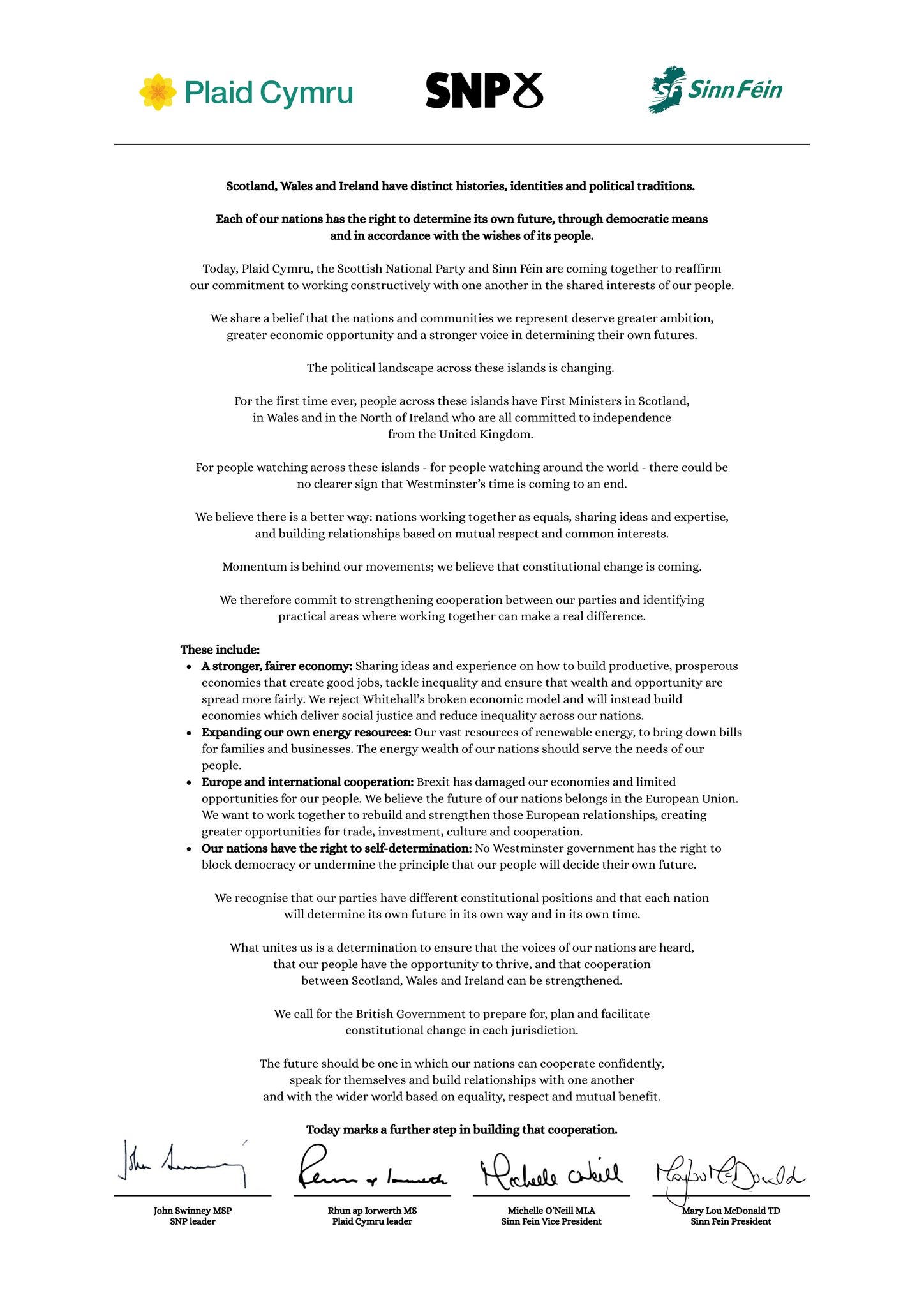
There are two sentences within the MoU (Memorandum of Understanding) that require your attention. The first: “For people watching around the world, there could be no clearer sign that Westminster’s time is coming to an end.” Now read the second: “We call for the British Government to prepare for, plan and facilitate constitutional change in each jurisdiction.”
Whilst the first sentence is an obvious truth, every word of the second gives away unnecessary concessions to Westminster. Call for is a petition to a perceived superior. This petition defers to a power that can, and will, choose to refuse or dictate terms to its advantage. The ‘British’ Government is the colonial actor who prepares, plans and facilitates, and three colonised nations are the objects of its facilitation. Constitutional change is the phrase used when “self-determination” is the word being avoided, and each jurisdiction places the three colonised nations under a single authority, which is the exact inverse of the arrangement Scotland holds under the Treaty of Union of 1707, a Treaty that set no authority over Scots law at all.
Westminster’s framework binds the institutions it made and has never bound the people, whose power those institutions hold on loan. Inside it there is one available act, and that act is asking. We described the binary when John Swinney’s draft Bill landed in August: every route on offer laid by the coloniser, every one ending at an application to Westminster, Section 30 or nothing, and nothing being the framework’s word for everything it cannot see. The condition of the SNP’s employment was the point then, and the memorandum extends it to three parties, three devolved offices and one addressee. “Constitutional change” is the framework naming what it cannot see. “In its own way and in its own time” is colonial deferral with four signatures under it. The only sentence in the document that does any work is addressed to the British Government, because from inside the framework there is nobody else to write to.
Westminster’s devolved administrators have recorded their own constraints, presented them as a show of strength, and called it“a further step”. Those constraints are the terms of a loan, and they bind the borrower. The sovereign people who made the loan were never bound by them, and never will be.
The signatories chose to name their document a memorandum of understanding, a term from Westminster’s own rulebook, the Foreign Office guidance on treaties and memoranda, where it denotes an instrument used to record stated intent that creates nothing formal and binds nobody: a treaty creates obligations, an MoU records understandings, and in the guidance’s own words “there is no hybrid”. The document that governs how Holyrood, the Senedd and Stormont deal with London is itself a memorandum of understanding, first agreed in 1999 and still in force, and its first page says of itself that it “is not intended” to be legally binding. The Sewel convention lived in its paragraph 14, and Westminster has legislated over it whenever it chose. Three parties answered that arrangement with a document of the same name, in the same register, and Whitehall read it the way Whitehall reads every MoU.
As of the evening of 14 September 2026, no official version of the document existed on any devolved government source. The MoU signed in Cardiff has no title, no reference number, no date on its face, no place of signing and no publisher. It was not released in advance through any official channel or government press office, and at the point of signing it was to be found on no party or government website. Sinn Féin’s website carries the text as a press release, published at noon, an hour after the signing, under the release’s own headline; the SNP’s carries a campaign post with none of the text in it; Plaid’s carries nothing. No party has published the document itself. Three of the four are First Ministers: of Scotland, of Wales, of Northern Ireland. The fourth, Mary Lou McDonald, leads the opposition in Dublin and holds no government office. All four signed under party titles: Leader of the SNP, Leader of Plaid Cymru, President of Sinn Féin, and, for Michelle O’Neill, Vice President of Sinn Féin. That was deliberate, it was announced before they sat down, and the press carried the line all weekend: the leaders were meeting “in their capacity as party leaders, rather than as officials in their respective governments”. By three o’clock a different document had appeared o gov.wales and gov.scot, and the press ran the two together, passing the pair off as one.
Four signatories, four party officers, and a document with no official meaning or weight. This is the theatrics of politics we have come to expect under colonialism.
The signatories called it a memorandum of understanding and the press across all four nations repeated it; the document itself carries no title. The memorandum of understanding that actually governs how those three administrations deal with London is a Command Paper, Cm 7864, presented to Parliament by command of the Crown, laid before four legislatures, held on gov.uk since 1999, revised in 2013 and in force today. It has a custodian, a reference, a provenance and an archive. The document from Cardiff has a photograph. That is the historic moment, as it exists on the record at half past two on the afternoon it was signed.
The afternoon document is The Cardiff Agreement, Cytundeb Caerdydd, between the Welsh Government and the Scottish Government, signed by the two First Ministers as First Ministers, published at 15:00 as HTML and PDF, and filed by gov.wales under “Concordats, memorandums of understanding and other agreements”, the same drawer as the 1999 devolution MoU. It has a title, a custodian and a home. It also has this sentence, in its own words: “While the agreement is not legally binding and does not affect the statutory powers or responsibilities of either government, it represents a foundational commitment to strategic partnership.” Its content is child poverty, the cost of living, growth, climate, the EU and culture, all inside devolved competence, and its constitutional section commits the two governments to collaborate on legislative consent processes, to consider the Sewel Convention and the Internal Market Act, and to “support opportunities to strengthen the role of devolved governments within UK governance arrangements”. Its one sentence on the future is that the two governments will “press the case for greater fairness for Wales and Scotland... and powers over our constitutional future”. Sinn Féin is absent, because a joint office cannot sign without both halves and a leader of the opposition in Dublin holds no office to sign with. So the morning produced a document with no standing that asked London to plan the change, and the afternoon produced a document with standing that asks London for powers and commits both governments to working the settlement’s own consent machinery better. The theatre borrowed the concordat’s standing, the concordat borrowed the theatre’s headline, and the press supplied the blur.
Set the morning’s words beside the afternoon’s and the day confesses itself. In the morning, “Westminster’s time is coming to an end”. In the afternoon, Swinney on the document he actually signed as First Minister: “an important moment in the history of devolution”. The foreword: “strong, accountable devolved government”. The text: “the protection and extension of self-government” and “the role of devolved governments within UK governance arrangements”. By evening, the Prime Minister’s promise to respect the settlement and maybe extend it was “fundamentally reassuring” and Swinney was “very, very keen to engage”. Read as a whole, it is the record of two men content with devolution, improving it, and asking for more of it, which is what we set out in July in Confessions of a Devolutionist from Swinney’s own words. On 14 September the confession was repeated, as First Ministers, on the governments’ own websites, with a photograph.
Sinn Féin’s words came from a different dictionary. “We assert collectively our inalienable right to decide our futures”, said McDonald, and inalienable is Article 1 of her own Constitution. “The British government cannot continue to hold back the tide”, said O’Neill. Assertion, a right held, a tide coming; nothing about devolution, nothing about asking, and nothing signed in the afternoon, because the one party at that table holding an instrument that binds London has no use for a concordat.
Then look at what Westminster did with that treaty, because the instinct is the one that produced the Scotland Act. The Northern Ireland Act 1998 takes an obligation London owes under international law and re-houses it in a domestic statute, with a minister’s judgement bolted onto the trigger, so that the right appears to live inside Westminster’s own legislation. That is encasement, the structure the Structural Colonial Encasement Doctrine (SCED) describes being done to Scotland, and one Westminster can use anywhere: the right preserved in form and its exercise routed through the coloniser’s machinery. In Ireland the encasement fails, and it fails for a reason Scotland should study. The right sits outside the statute, recognised in a treaty co-guaranteed by Dublin, registered with the United Nations, and founded on the vote of the Irish people on both sides of the border on one day in 1998, 94 per cent in the Republic and 71 per cent in the North, a vote that wrote the “firm will of the Irish nation” into Articles 2 and 3 of its Constitution. The “shall” in the Act is the treaty’s obligation showing through the statute, and a minister who refused a likely majority would answer to a state and to a register whatever the Act says about judgement. The statute is the bauble held up in front of the treaty; the treaty is what binds. The Irish never put themselves inside Westminster’s framework. They put Westminster inside theirs, and the people voted it there, directly, in their own names.
So Sinn Féin’s work is the evidence for one judgement, likelihood, and last week the evidence arrived from unexpected directions. On Wednesday 9 September the Prime Minister told the Commons a poll comes “when there is a clear consensus in the country”. On Saturday 12 September, in Dublin, beside the Taoiseach, the President of the United States said: “I’d love to see it unified. It’s going to happen eventually.” On the Sunday he called it “one of the ‘naturals’ of all time”, ending a neutrality every American president had kept since the Agreement was brokered. McDonald’s reply was to the Taoiseach, not to London: “The conversation on Irish unity has shifted, and the onus is on the Taoiseach to begin planning.” On the Monday morning she sat for a photograph under a sentence that reads “the political landscape across these islands is changing”, and O’Neill said the change was unstoppable. Read as a file for the day a Secretary of State has to decide what appears likely, every one of those entries is dated and every one is useful. Cardiff handed Sinn Féin a photograph of the landscape changing, and they took it. They played the game properly, and the two devolutionists were the scenery.
One thing follows for Scotland, and the Irish example makes it plain rather than flattering. The Irish route works because a people recorded their will directly and two states bound themselves to it by treaty. Scotland has no counterparty state, no treaty, and no founding vote on any process; import the border poll mechanism without those and what arrives is the Westminster statute on its own, a grant held at a minister’s pleasure, which is the framework again with an Irish accent. What Scotland can take from Ireland is the first step, the one the Irish took in 1998 and the one no party can take for them: the people, recording their own will, directly, each in their own name.
One phrase gives the MoU away, and it is the quietest one in it: each nation will decide “in its own way and in its own time”. Read it in three parts. Each nation will determine its own future: true. That is the right of self-determination, exercised by the people of each nation, free from external influence. In its own way: true, once “way” means what it should. A nation’s own way is its people exercising the sovereignty they already hold, with their ministers bound by what the people record, rather than a minister asking London how. In its own time: the slip. A time is only a nation’s own if nobody else holds the clock, and seven lines later this document hands the clock to the British Government by asking it to prepare for, plan and facilitate the change. The constraint on timing exists because the signatories stand inside Westminster’s framework, where the only act is asking and the only timetable is the one that arrives with the answer. Step outside Westminster’s devolution framework and the time is the people’s, now or whenever they choose. Rhun ap Iorwerth said as much at the press conference, in his own words: “The timescale will be set by the people of Wales... It’s not up to me to dictate.” Then he signed a document that asks London to plan it. The phrase that indicts the MoU also states the alternative to it, once the people are put back where the words say they are.
Monday’s events in Cardiff have to be read beside what Downing Street did five days earlier. At Prime Minister’s Questions on 9 September, Burnham said a border poll would be considered “when there is a clear consensus in the country”, then added: “I would say exactly the same situation in Scotland. I am not aware that there is a majority of public support for another referendum and until that changes there won’t be one.” Downing Street said the same afternoon that nothing had changed and that a referendum remained “off limits”. The SNP called it a breakthrough, the first Prime Minister since 2014 to accept that majority support for a referendum should mean one takes place. What was offered was Westminster’s test, Westminster’s judgement of whether the test is met, and the Good Friday mechanism that Ireland holds by treaty extended to Scotland as a courtesy, withdrawable at will. Cardiff’s answer to that, whether it was meant as one or not, was to ask the same government to plan the change. The offer set the terms; the memorandum accepted them.
On 3 September the Scotsman, Scotland’s colonial national newspaper, put Burnham’s model for local government on its front page and told Swinney to embrace it. That is how the model arrived: as an instruction in the colonial press, delivered by two establishment voices with Burnham’s English rollout quoted beneath them, and without a word from Downing Street to anyone in Scotland. A colony is told, never asked. On 14 September Swinney signed a request asking Downing Street to plan Scotland’s constitutional change. The local administrator was told what to do with the colony’s councils, then asked the same office what it might do with the colony. By evening he had his answer to that as well, and he reported it as good news: the Prime Minister had given him a “fundamentally reassuring” commitment to respect the devolution settlement, would not legislate over Holyrood’s head on devolution, and was “open to considering how further devolution of responsibilities to the Scottish Parliament and potentially onward to other public authorities in Scotland, especially local authorities, could help the growth agenda”. Swinney’s reply: “I’m very, very keen to engage on that question.” Eleven days after the front page, Manchesterism embraced, with thanks.
The MoU request was signed in Cardiff on the Monday morning, and by lunchtime Downing Street had answered: the Prime Minister is focused on the cost of living, “rather than on constitutional debates”. Colonial deference in the morning, colonial deferral by lunch.
The memorandum of understanding lists four priorities, with the right of self-determination last, as a principle. It then calls, in its own words, for the British Government to prepare for, plan and facilitate the change, which is a request being made to the colonisers inside their own colonial control framework. The order of the list was a choice, and it reads like self-preservation: energy, the economy and Europe are the day job, and a document that leads with the day job has its defence written before London says “get on with it”. London said it anyway, before lunch, and the MoU survived the refusal exactly as designed, because it committed nobody to a date, a question or an electorate.
There is, and has only ever been, one mandate required to enact the will of the people of our nations, and that is the right to self-determination itself. It is the fundamental human right: every person has the right to make every decision about their own life, and that right is held by everybody on earth, conferred by nobody, and impossible to carry on someone else’s behalf. When expressed in solidarity, by a majority, it is the popular will of the people, and popular will is what the United Nations means when it says the right of self-determination belongs to peoples and that “the will of the people shall be the basis of the authority of government”. No political party can sign off the right to self-determination on behalf of individuals; it requires the direct expression of a nation’s people to be recorded and recognised.
Scots were canny enough to ensure that the right to self-determination was codified, at Arbroath in 1320 and in the Claim of Right in 1689, and it has never been repealed. The Welsh hold it by the same humanity as everyone else, and beneath that lies a record Westminster keeps itself: the Acts of 1535 and 1542 that annexed Wales, passed by a Parliament in which Wales had no seat, were repealed by Westminster in 1993 and 1994, with nothing put in their place, so the statutory basis of “England and Wales” no longer exists in the statutes that created it. The Irish hold it in their own words and in Westminster’s. The Proclamation of 1916 records that “in every generation the Irish people have asserted their right to national freedom and sovereignty”; the First Dáil declared it on the mandate of the 1918 election; the Constitution of 1937 affirms, at Article 1, the nation’s “inalienable, indefeasible, and sovereign right” to choose its own form of government; and the British Government put its signature to it in 1998, recognising that it is for the people of the island of Ireland alone, “without external impediment”, to exercise their right of self-determination.
What the people of all three nations lent their parties was a political mandate and nothing more: the choice of who fills an office that Westminster defines, on powers Westminster grants and can withdraw. That is a real loan and a real act, and it is made inside the framework from start to finish, because the office is the framework’s. A mandate won that way is a mandate to administer, and at most a mandate to ask. Self-determination has never been in the loan, because it cannot be lent at all. It is recorded in one way only, by the people themselves, directly, each in their own name and outside every institution Westminster controls, and a right that can only be recorded by the person who holds it can never be carried by anyone else. That is the difference between a party’s mandate and a people’s will, and it is the whole of it. Scotland’s sovereignty is that right, recorded by each Scot and held in common.
In every nation, we the people are the foundation, and everything else is built from our sovereignty.
The optics of Cardiff on Monday suggest a stronger performance by ‘the Celtic Alliance’ than the script contains. Beneath the lights, the cast has chosen to follow a familiar script. The box office profits from this show, however, land in the accounts of a single party, conspicuous by its absence. Westminster profited by time, and time under colonial rule is money: every year the question sits on London’s timetable is another year of the extraction the Empire Ledger records, and the memorandum, by committing nobody to a date, handed over the next one in advance. All four parties profited from the optics, and the people on both sides of the Irish Sea, most of them, called the day a good one. They meant different things by it. The Irish can afford to: their two representatives spoke no word of devolution and borrowed none of the coloniser’s language, and people who know where they are going can call a day like this a step forward without losing anything. Most of those in Scotland and Wales who wish to express their self-determination called a request progress, which is what a colonised mind has been taught to do, and it is the thing this Series exists to unteach. The people of Scotland and Wales lost the year, and by the terms of the MoU their leaders signed, they will lose the next in the same way.
Three Ancient Sovereignties
Start from what each nation already stands on, because that is what the day should have been built from, and the foundations are older than anything signed on Monday. Scotland’s is a Community of the Realm that governed itself through Guardians from 1286, stated its sovereignty at Arbroath in 1320 and again in the Claim of Right in 1689, and has never had either repealed; Westminster’s own 1954 description of Scotland as “a partner and not as a dependency” and the 2018 Commons motion sit on top of it, and so does the one leader who chose to operate inside the framework when nothing obliges him to. Wales’s is the law of Hywel Dda, a complete native legal order that ran for six hundred years until a Parliament with no Welsh seat suppressed it in 1535, and the Parliament Owain Glyndŵr convened at Machynlleth in 1404 with representatives from every commote in Wales; beneath the modern record sits the fact that Westminster itself repealed that annexation in 1993 and 1994 with nothing put in its place, and Plaid, four months into the first non-Labour government in the history of Welsh devolution, signed a request rather than saying so. Ireland’s is a sovereignty older than the first English landing in 1169, asserted, in its own Proclamation’s words, in every generation since, and recognised by Britain’s own signature in a treaty its people voted for, as set out above; it needs nothing from Cardiff.
Three nations, each with power invested from the foundations of popular sovereignty, and not one of their so-called representatives invoked that power. That was the opportunity missed in Cardiff. In solidarity, they should have strengthened one another’s hands, and the way to do it was to state, in the strongest possible terms, where that power sits and with whom.
Repositioning on Solid Foundations
The representatives of three nations should have harnessed the sovereignty of their peoples on Monday. Two of the three did not, and the reason is older than either of them. The literature of decolonisation names it: Fanon’s native political class, which inherits the coloniser’s structures and comes to live in the space between the people and the metropole, administering downward and negotiating upward, and which fears one thing above all, the people acting directly, because a people that acts for itself leaves nothing to intermediate. Devolution built that class and pays it from the centre. To invoke the sovereignty of the people is to step out of the middle, where the office, the salary and the block grant are, into a politics that has no middle at all. So they work the settlement, ask London for powers, and call it a step, and the afternoon’s document is the fear written down. Sinn Féin fears none of it, because its people made their record in 1998 and the fight is a treaty fight with Dublin at their back. What follows is what fear kept off the table.
Two of the four have sworn allegiance to the Crown: John Swinney three times over on 20 May, under Westminster’s Promissory Oaths Act, with no oath to the people of Scotland among them, and Rhun ap Iorwerth as every Member of the Senedd must. Two have sworn to no crown: Michelle O’Neill, because the 1998 settlement asks no such oath of anyone at Stormont, and Mary Lou McDonald, because the Dáil abolished its oath in 1933. The two bound by oath are the two who choose to remain indentured to the British Crown, and servant and master fear the same thing: a record made by the people, and the power it carries.
On Monday, four party leaders chose to sign a memorandum of understanding that was no more than a request to London, dressed for the cameras. The right has never moved. It sits with the people of each nation, as it always has, and it is the one power in any of the three that sits beyond any veto held in Westminster, the seat of the English government. What the people require of anyone who claims to represent them is that they harness and act on the full power of their sovereignty. Those who choose otherwise will account to the people for it. The declaration below records the recognition, over their own signatures. A signed recognition is a different thing from a request. It requires nothing to be understood later; it is either given, freely and in public, or withheld, in public, and either way it goes on the record. It costs them nothing to sign: every clause is a thing they have already said. To withhold it is to say, in front of the people they claim to represent, whose sovereignty they recognise instead. We have put their own words on one page and taken the addressee off. It is offered to John Swinney, Rhun ap Iorwerth, Michelle O’Neill and Mary Lou McDonald with one question: whose sovereignty do you recognise?
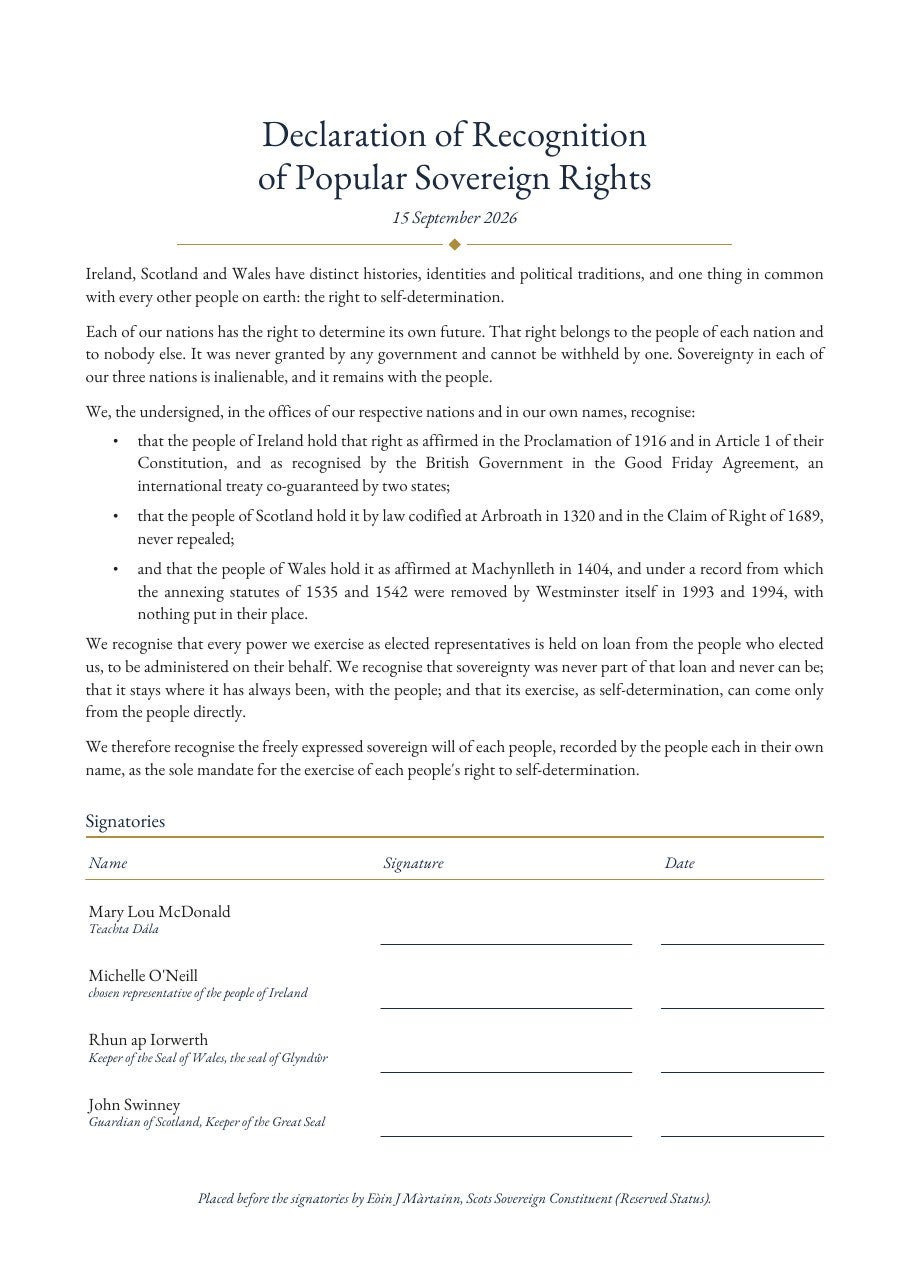
Declaration of Recognition of Popular Sovereign Rights
Ireland, Scotland and Wales have distinct histories, identities and political traditions, and one thing in common with every other people on earth: the right to self-determination.
Each of our nations has the right to determine its own future. That right belongs to the people of each nation and to nobody else. It was never granted by any government and cannot be withheld by one. Sovereignty in each of our three nations is inalienable, and it remains with the people.
We, the undersigned, in the offices of our respective nations and in our own names, recognise:
that the people of Ireland hold that right as affirmed in the Proclamation of 1916 and in Article 1 of their Constitution, and as recognised by the British Government in the Good Friday Agreement, an international treaty co-guaranteed by two states;
that the people of Scotland hold it by law codified at Arbroath in 1320 and in the Claim of Right of 1689, never repealed;
and that the people of Wales hold it as affirmed at Machynlleth in 1404, and under a record from which the annexing statutes of 1535 and 1542 were removed by Westminster itself in 1993 and 1994, with nothing put in their place.
We recognise that every power we exercise as elected representatives is held on loan from the people who elected us, to be administered on their behalf. We recognise that sovereignty was never part of that loan and never can be; that it stays where it has always been, with the people; and that its exercise, as self-determination, can come only from the people directly.
We therefore recognise the freely expressed sovereign will of each people, recorded by the people each in their own name, as the sole mandate for the exercise of each people’s right to self-determination.
Signatories
Mary Lou McDonald, Teachta Dála
Signature:
Date:
Michelle O’Neill, chosen representative of the people of Ireland
Signature:
Date:
Rhun ap Iorwerth, Keeper of the Seal of Wales, the seal of Glyndŵr
Signature:
Date:
John Swinney, Guardian of Scotland, Keeper of the Great Seal
Signature:
Date:
This declaration is placed before all four signatories by email today, 15 September 2026, and by post.
The power of change has always been in the people’s hands. Taking it is the only thing left to do.
Eòin J Màrtainn
Sources
Scots constitutional primary records
[1] Declaration of Arbroath, 6 April 1320. Sealed by eight earls and thirty-one barons acting for the community of the realm; original held at the National Records of Scotland, SP13/7. Continuing the self-government of the community of the realm through the Guardians of Scotland from 1286.
[2] Claim of Right 1689. RPS 1689/3/108; manuscript NRS PA2/33. Unrepealed.
[3] Act Ratifying and Approving the Treaty of Union of the Two Kingdoms of Scotland and England, Parliament of Scotland, 16 January 1707, Article XXIV, the Great Seal of Scotland “always kept and made use of”. RPS 1706/10/257.
Irish constitutional primary records
[4] Proclamation of the Irish Republic, 24 April 1916: “In every generation the Irish people have asserted their right to national freedom and sovereignty.”
[5] Dáil Éireann, Declaration of Independence, 21 January 1919, on the mandate of the general election of December 1918.
[6] Bunreacht na hÉireann, 1937, Articles 1, 2, 3 and 6. Articles 2 and 3 as amended by the Nineteenth Amendment, approved by referendum 22 May 1998.
[7] The Agreement reached in the multi-party negotiations, Belfast, 10 April 1998 (the Good Friday Agreement), Constitutional Issues, paragraph 1(ii); the British-Irish Agreement of the same date, registered with the United Nations. Approved by concurrent referendums, 22 May 1998: 94.4 per cent in Ireland, 71.1 per cent in Northern Ireland.
[8] Joint Declaration on Peace (the Downing Street Declaration), 15 December 1993.
Welsh constitutional primary records
[9] Cyfraith Hywel, the law of Hywel Dda, from the tenth century, in force until suppressed by the Laws in Wales Act 1535.
[10] The Parliament convened by Owain Glyndŵr at Machynlleth, 1404, with representatives from every commote in Wales; the Pennal Letter, 1406.
[11] Statute of Rhuddlan 1284; Laws in Wales Acts 1535 and 1542, passed by a Parliament in which Wales had no representation. The 1535 Act repealed by the Welsh Language Act 1993; the last surviving provision of the 1542 Act repealed by the Sale of Goods (Amendment) Act 1994.
United Kingdom statutory records
[12] Scotland Act 1998, sections 45(7) and 84.
[13] Government of Wales Act 2006, sections 23 and 116.
[14] Northern Ireland Act 1998, section 1 and Schedule 1; section 16A.
[15] Promissory Oaths Act 1868.
UK government records
[16] Devolution: Memorandum of Understanding and Supplementary Agreements, Cm 7864, first agreed 1999, presented March 2010, revised October 2013, explanatory note: “It is not intended that these agreements should be legally binding.”
gov.uk/government/publications/devolution-memorandum-of-understanding-and-supplementary-agreement
[17] Foreign and Commonwealth Office, Treaties and Memoranda of Understanding: Guidance on Practice and Procedures: “there is no hybrid”.
[18] Royal Commission on Scottish Affairs, Report, Cmd 9212, 1954, paragraph 13(ii): Scotland “voluntarily entered into union with England as a partner and not as a dependency”.
[19] House of Commons, motion on the Claim of Right for Scotland, 4 July 2018, agreed without division.
[20] House of Commons, Official Report, Prime Minister’s Questions, 9 September 2026, exchange between Chris Law MP and the Prime Minister.
The Cardiff documents
[21] Memorandum of understanding signed in Cardiff, 14 September 2026, by John Swinney (SNP leader), Rhun ap Iorwerth (Plaid Cymru leader), Michelle O’Neill (Sinn Féin Vice President) and Mary Lou McDonald (Sinn Féin President). Untitled, unreferenced, unhosted by any government. Photographs of the signed sheet posted by
and
, 14 September 2026. Text carried as a Sinn Féin press release, published 12:00 BST, 14 September 2026.
[22] The Cardiff Agreement, Cytundeb Caerdydd, between the Welsh Government and the Scottish Government, published 15:00, 14 September 2026: “the Agreement is not legally binding and does not affect the statutory powers or responsibilities of either government.”
;
gov.scot/news/cardiff-agreement-cytundeb-caerdydd-signed/
Case law
[23] MacCormick v Lord Advocate 1953 SC 396, per Lord President Cooper at 411.
International instruments
[24] Charter of the United Nations, Article 1(2).
[25] International Covenant on Civil and Political Rights and International Covenant on Economic, Social and Cultural Rights, common Article 1, adopted by General Assembly resolution 2200 A (XXI), 16 December 1966; ratified by the United Kingdom 20 May 1976.
[26] Universal Declaration of Human Rights, Article 21(3): “The will of the people shall be the basis of the authority of government.”
Press and platform records
[27] Emma Little-Pengelly MLA, deputy First Minister of Northern Ireland, statement of 13 September 2026, as reported by PA and carried by RTÉ, UTV and
.
[28] Press conference, Cardiff, 14 September 2026, remarks of the four signatories, as reported by The National (Steph Brawn) and
.
[29] The National, 14 September 2026: the Prime Minister’s response at 12:45; “Cardiff Agreement in full” (Lucy Jackson); “John Swinney reveals Andy Burnham’s commitment on devolution” (Hamish Morrison).
[30] Holyrood magazine and Wales Online, 14 September 2026, “in full” reproductions of the memorandum text.
[31] The Scotsman, front page, 3 September 2026: “Embrace ‘Manchesterism’ for Scotland, Swinney is told”.
[32] Remarks of the President of the United States, Dublin, 12 September 2026, and Doonbeg, 13 September 2026, as reported by Reuters, NBC News, Time and Axios; response of Mary Lou McDonald, 13 September 2026.
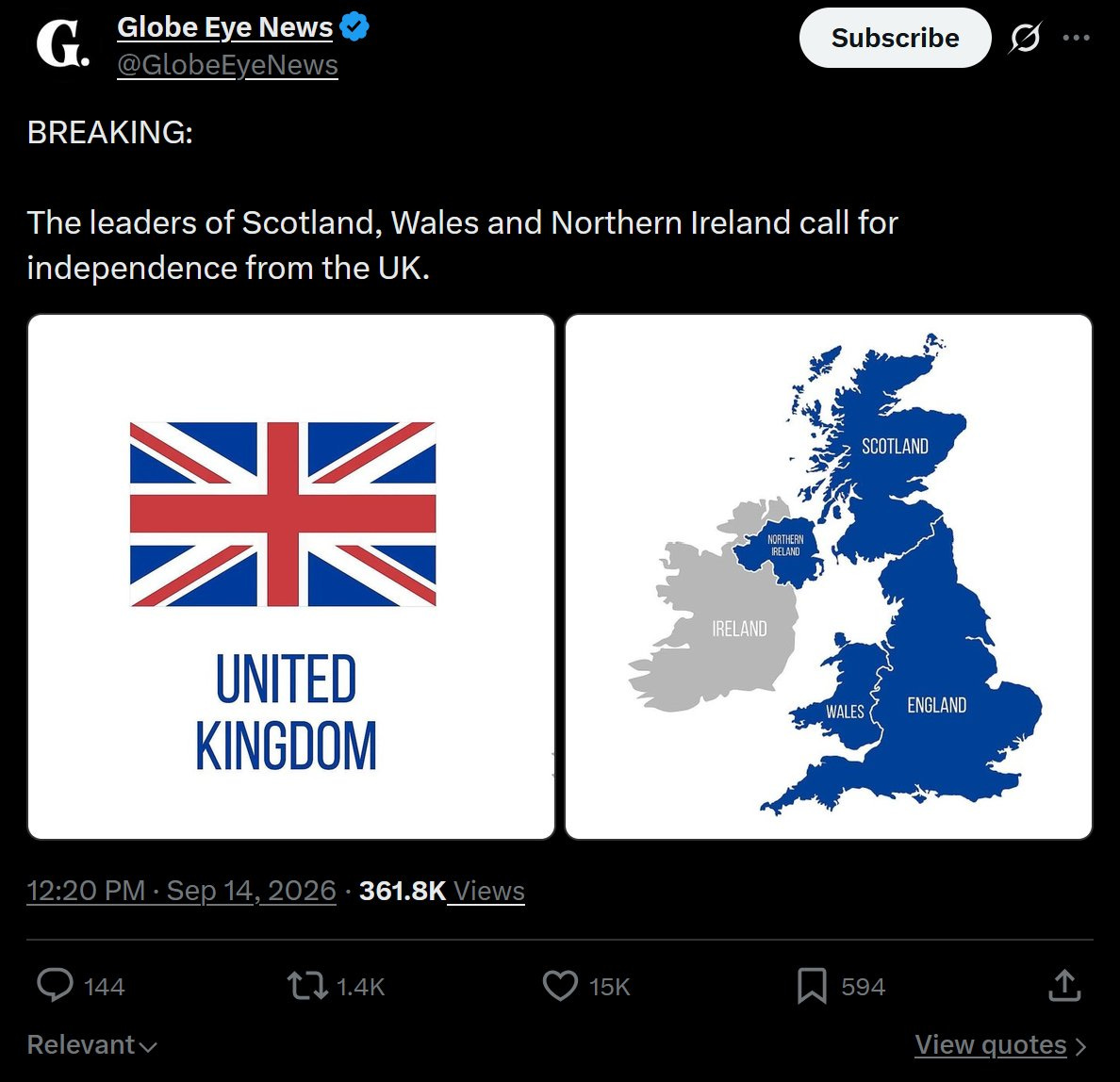
[33] Globe Eye News, X, 14 September 2026. All posts cited are on the public record and screenshots are held.
Theoretical frameworks
[34] Frantz Fanon, The Wretched of the Earth (1961), “The Pitfalls of National Consciousness”.
Series records
[35] A Tale of Two Masters: Sovereign Scots or Crown-in-Parliament?
eoinjmartainn.scot/p/a-tale-of-two-masters-sovereign-scots
[36] Structural Colonial Encasement Doctrine: The Capture and Enclosure Mechanism of Scots Sovereignty,
Part 13.
eoinjmartainn.scot/p/structural-colonial-encasement-doctrinethe
[37] Confessions of a Devolutionist: The Keeper’s New Clothes,
Part 16.
eoinjmartainn.scot/p/confessions-of-a-devolutionist-the
[38] Scots Law, from Behind Bars,
Part 17.
eoinjmartainn.scot/p/scots-law-from-behind-the-bars
[39] The “Ghost Union”: The void of Welsh Sovereignty,
Part 12.
eoinjmartainn.scot/p/the-ghost-union-the-void-of-welsh
[40] The Self-Certification Doctrine of Scots’ Self-Determination,
Part 1.
eoinjmartainn.scot/p/the-self-certification-doctrine-of
[41] The Binary, SCRDI statement, X, 29 August 2026,
.
Colonial Actions and Markers cited
Colonial Deferral (SCRDI-originated): the question pushed onto someone else’s timetable until the waiting is mistaken for the process. The obligation is conceded, its performance deferred, and the deferral becomes permanent by continuation.
Colonial Deference (SCRDI-originated, entered here): the colonised asking. The counterpart of colonial deferral, from the other side of the table: the request made upward to the administering power for what the people already hold, so that the framework’s answer, whatever it is, confirms the framework.
Structural Colonial Encasement (SCRDI-originated, Part 13): the right preserved in form and its exercise routed through the coloniser’s machinery; applied here to the Northern Ireland Act 1998 as an encasement of a treaty obligation.
Colonial Conditioning: the request read as progress by those it is made on behalf of.
Determinant: Constitution and Nationalism.
Some nice detail here, though you possibly you need to follow up on internal and external self-determination in (so-called) international law? The UK can argue it supports the self-determination of peoples, that their actions towards Wales and Scotland have already met the their demands under internal self-determination, and it is even a rather grey area whether NI rejoining Ireland actually accounts as external self-determination (because they move from one interior state to another without surfacing). Instead, they'll claim external self-determination applies to colonies, and Scotland is not that, de jure.
International law is irrelevant. The Scotch National Party has never got close to winning the support of 50 % of the electorate at any election. Polls are for Mel Gibson, in the privacy of the voting booth and on the sofa for the sizeable number who can’t be troubled to vote, the inhabitants of Scotland, not just the bourgeois eyeing a sinecure in Brussels or The Hague, express a strong preference for the status quo. Independence is a risky business, and over the last fifty years the education system in Scotland has produced a cohort who are uncomfortable around and unprepared for risk.