

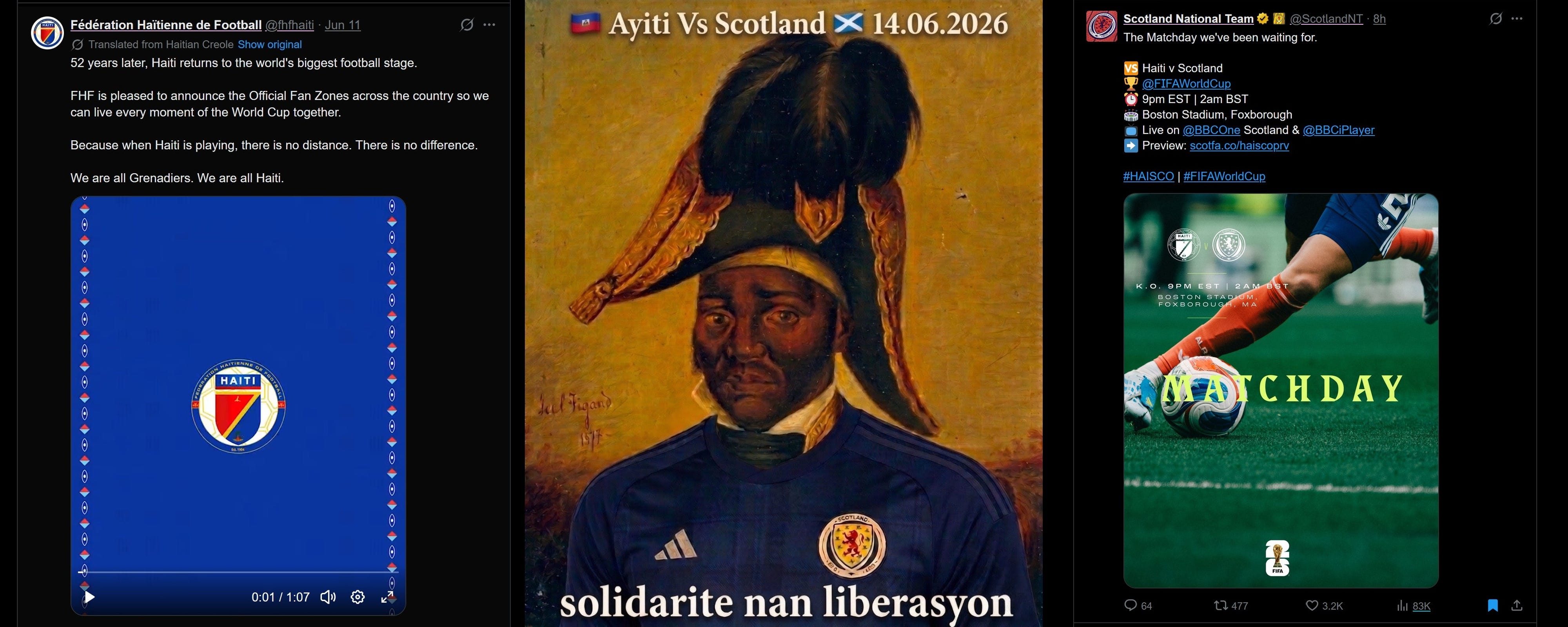
Solidarity in Liberation - World Cup 2026 - Haiti vs Scotland - 14 June
#SovereigntySeries Part 11 (first posted on X 14th June 2026)
At 2 a.m. BST tomorrow, in Foxborough, Massachusetts, Ayiti (Haiti) will play Scotland in their opening World Cup 2026 match. This will be Scotland’s first World Cup in twenty-eight years and Ayiti’s first in fifty-two.These are two sides the bookies barely rate, both small nations who have endured with their sovereignty intact despite incredible external pressures.
Whilst the media focus is about a football match, this is no ordinary encounter between two national football teams. This is the meeting of two wee nations bound by historical detail and a desire for self-determination, with one nation achieving what many would today consider impossible: the defeat of two of the world’s most powerful colonial empires.
As Scots, we have to be honest about the last time Scots turned up en masse to meet them, which was not a ‘friendly’ on their own shores.
Ayiti did not just suffer at the hands of empires, the Ayisyens defeated them. From 1791 the enslaved people of Ayiti rose, and fought spectacularly, freeing themselves from French Colonial rule and beating back an attempted ‘British’ takeover. By 1804 they had secured their freedom and created the first free black republic on earth, one of thew few peoples in history to throw off the slavery of a nation by their own hand. The Ayisyens were then punished for it, the way powerful Elites have throughout history punished those who have stood up to themselves. France sent the warships and demanded a ransom, seeking payment for the loss of slavery income threatening to return to take it unless paid.
Ayiti met their demands and the subsequent debt crippled them and ran on with interest until 1947. Near enough a century and a half paying France for the crime of being free. Ever since, the world has called Ayiti ‘the poorest country in the hemisphere’, as if a fact of nature, instead of a bill handed to them by their oppressor, for seeking their own liberation.
Scotland was never sold by the Scots population in 1707, it was signed away by an Elite group of Scotsmen who did not own what they were selling and were paid handsomely by England for doing so, over the heads of folk who were given no say.
Whilst our fight today is not the same as the Ayisyens, who fought a slave revolution as captives on an island, both nations have suffered at the hands of colonial empires. The modern day danger to Scots, whilst different, remains deadly to our survival as a nation, against the backdrop of a prolonged cleansing of Scots culture for over three centuries. Scotland being worn down into a region with a quaint accent, the auld words of our languages failing to roll off the tongues of our bairns. Scots, treated as bad English instead of a language in its own right. We are slowly being erased from the map, with each passing year. That is the front line we as Scots actually stand on.
Before we immerse ourselves in the spirit of the beautiful game tomorrow, it is important to recognise the truth behind the last time Scots faced Ayisyens in numbers, when the meeting was one of attempted colonial subjugation.
In 1793 ‘Britain’ (England) launched one of the most expensive wars of the age to tear ‘Saint-Domingue’ (Ayiti), the richest slave colony on earth, away from France, forcing its people back into bondage just as they were breaking free. The man who made that his central aim was an arch unionist collaborator, Henry Dundas, the uncrowned king of Scotland who sat at the very heart of the English government in London.
Around forty thousand ‘British’ troops died or were invalided across the Caribbean trying to achieve the Westminster government’s colonial aims, and the army of the very people they had come to re-enslave, led by Toussaint Louverture, were the just victors. Historians have called it the ‘British’ empire’s Vietnam and by 1798 the British were beaten and gone.
It was England’s Crown-In-Parliament that was behind Dundas, not the nation of ordinary Scots. Granted, amongst them were Scots planters, overseers, merchants and fortune-hunters who sailed for the Caribbean on behalf of England’s extraction empire. Around a third of the plantations across the Caribbean were owned by Scots. The Elite class in Westminster held the whip, kept the books that counted human beings as a commodity, and shipped the currency of sugar home to the coffers of empire. No excuses for any of those who partook under the direction of the man who would be king. The Scots who died carrying out their war were a class drawn predominantly from the poverty of the central belt between Glasgow and Edinburgh, recruited as often as not into what they took to be home service and never a foreign war at all. The ordinary Scots, as has often been the case throughout our colonised history, were, along with the working classes of many other nations, the cannon fodder of England’s Crown-In-Parliament extraction machine.
This is a story found everywhere that empires have gone. Empire’s insidious nature is to capture the very being of its subjugated peoples, distorting them until some of the abused become the abusers, serving in the very armies of their own people’s oppression. The Scots were no different.
For there is a thread that ties every empire’s masters together. The British elite who came to seize Ayiti and the French elite who drew up its ransom were one and the same animal, and across the whole of our colonised history the minority elite has been the one class to hold its power internationally, over all of us alike. To them we have only ever been beasts of burden, fuel for the extraction machine.
There is however another thread that weaves its way through our history, one thing that the elite classes try to take from us, the thing that they fear the most yet one they ultimately have zero power to control;
the power of community and class unity.
Once again we are now witnessing this power being expressed through the beautiful game across the globe, albeit subject to the manipulation of the corporate greed of the Elites of the host nation and the games governing body.
The world’s first international was Scotland against England in 1872 and the oldest football association on earth is Scotland’s founded in 1873. It is then perhaps no coincidence that the spirit of unity that has held Scottish culture together for over three centuries, in the face of systematic colonial oppression can be found at a fundamental level across the footballing world. Not a result thereof but as light shining on humanity’s common ground.
Indeed it might be argued that whilst it was Scots who introduced modern football to the world, it’s our ability to recognise ourselves in others that makes our Tartan Army universally welcomed across the globe.
The last time Ayiti stood on the World Cup stage was 1974, fifty-two long years ago, and that summer Emmanuel Sanon scored against Italy and ended one of the longest runs without conceding the game the world had ever witnessed. A wee island nation, written off before a ball was kicked, putting one past one of the giants of the game. On Sunday they are back, and they have earned every inch of the road that took them there.
So aye, come 2 a.m. we want Scotland tae win the match, of course we do. But now when the whistle blows fir kick-off and the
take on the descendants of men and women who overcame great odds to secure their freedom, perhaps hauding the truth of both nations being present in the moment will hit differently.
On the field we are all equals, no matter the result. Ayisyen history is proof that people power can win despite all odds. That is what Scots should take from this as a victory, win, lose or draw ✊
We stand as equals, in solidarity with aw o Jock Tamson’s bairns.
Solidarité nan liberasyon. 🇭🇹 ✊🏴