For centuries, the constitutional mainstream has accepted the English state’s self-identification as a mature, evolving parliamentary democracy. That acceptance, however, rests on conflating two distinct concepts: the expansion of the franchise and the transfer of popular sovereignty.
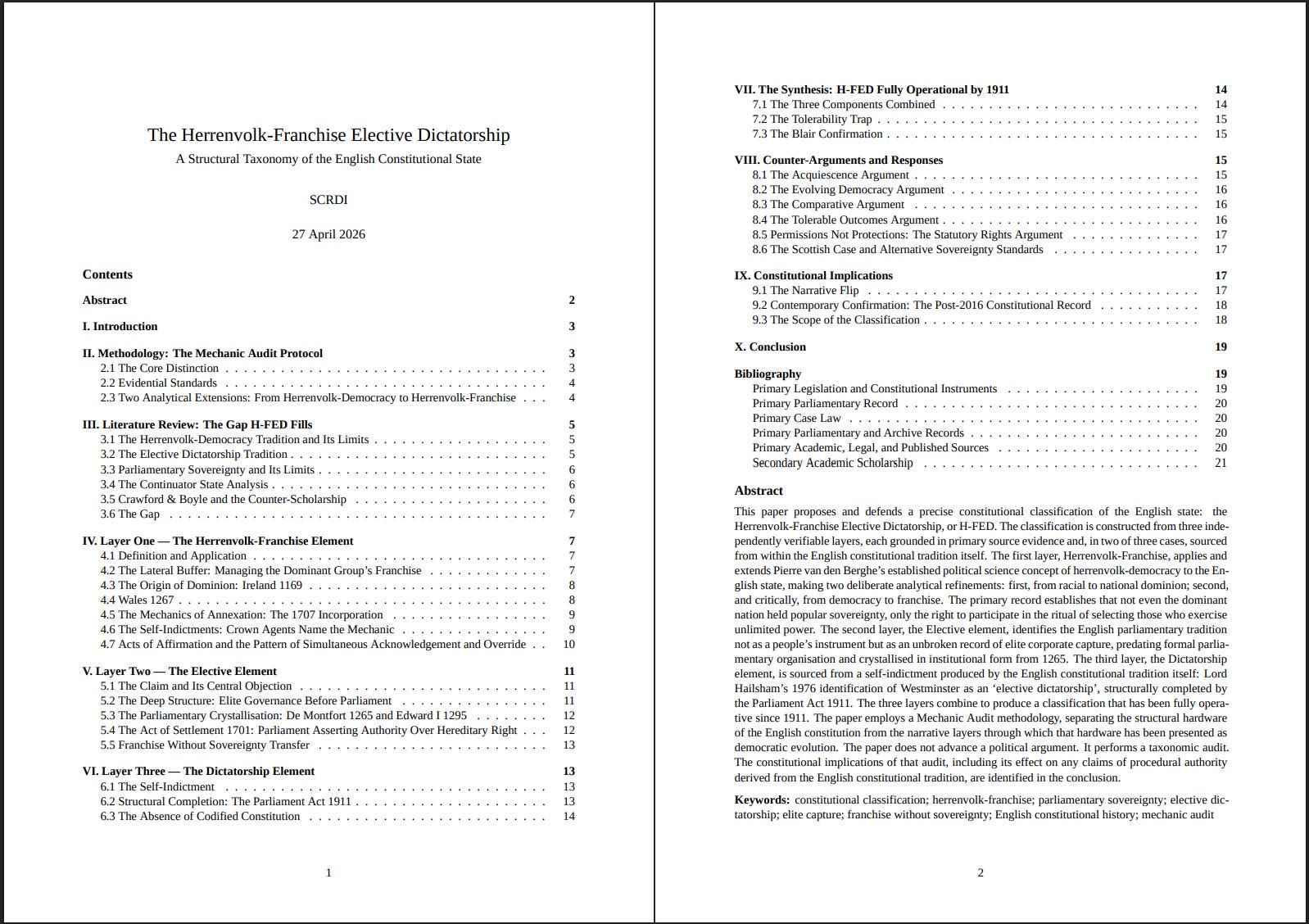
This paper introduces a necessary paradigm shift in the classification of Westminster’s constitutional architecture. A rigorous “Mechanic Audit” systematically separates the state’s structural hardware from the narrative layers, such as the post-war Keynesian settlement, that have historically insulated it from structural critique. What emerges from the primary record is not a democracy in any principled sense, but a precisely definable system: the Herrenvolk-Franchise Elective Dictatorship (H-FED).
The taxonomy presented here is built upon three independently verifiable layers, heavily sourced from the English constitutional tradition’s own self-indictments:
The Herrenvolk-Franchise: Extending van den Berghe’s concept, this layer demonstrates how the dominant nation is granted the ritual of selection, the franchise, without ever holding genuine popular sovereignty. This acts as a “lateral buffer,” securing domestic compliance while facilitating hierarchical dominion over incorporated subject peoples, such as those in Ireland, Wales, and Scotland.
The Elective Element: The paper traces an unbroken record of elite corporate governance, from the 1265 Parliament of Simon de Montfort to the present. It establishes that the electorate merely selects the managers of a sovereign institution, the Crown-in-Parliament, but cannot constitutionally constrain them. Lord Cooper confirmed the constitutional consequence from the Scottish bench in MacCormick v Lord Advocate [1953]: unlimited parliamentary sovereignty is “a distinctively English principle which has no counterpart in Scottish constitutional law.”
The Dictatorship Element: Grounded in Lord Hailsham’s 1976 assessment, this element highlights a system exercising unlimited legislative power without the external check of a codified constitution. This architecture was structurally completed by the Parliament Act 1911.
Perhaps the most potent contribution of this paper is its application to the contemporary constitutional record. Auditing post-2016 events demonstrates that all three layers of the H-FED operate fully and simultaneously today. Those events include the European Union (Withdrawal) Act 2018 and the override of Scotland’s Remain majority, the United Kingdom Internal Market Act 2020, and the 2022 Supreme Court ruling on Scottish legislative competence.
This is not a political argument; it is a taxonomic audit grounded in the primary records of a centuries-old imperial governance system. It alters the foundational question of Westminster constitutional law. The question is no longer how subject nations might satisfy the procedural requirements of the Westminster architecture; it is this: by what right does a Herrenvolk-Franchise Elective Dictatorship hold procedural authority over sovereign peoples in the first place?
The full paper, published by SCRDI can be found here: H-FED Paper (SCRDI)
Eòin J Màrtainn