

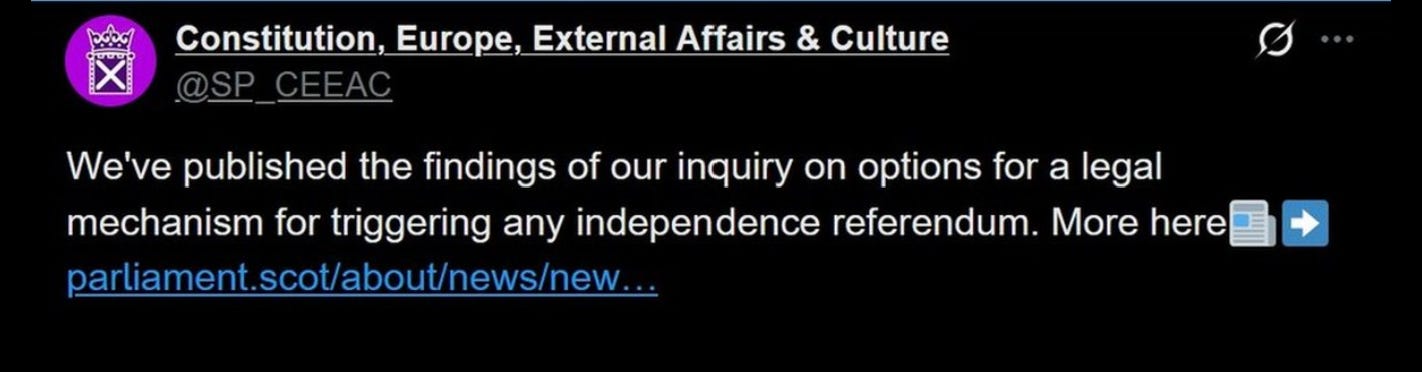
On 27 February 2026 the Scottish Parliament’s Constitution, Europe, External Affairs and Culture Committee (CEEAC) published SP Paper 1030, the report of its inquiry into a ‘legal mechanism for triggering any independence referendum’, and announced it on X. The response that follows was issued in reply on 27 April 2026, addressed to the committee’s members as public servants of the sovereign people of Scotland.
This is the sixth piece in my #SovereigntySeries, not an essay about the constitution but a document aimed at the people who produced the report.
The committee’s own paper does the first half of the work. At paragraph 106 it records a ‘democratic anomaly’: the electorate that decides whether a Scottish referendum may even be triggered is the Westminster electorate, while the electorate whose wishes are said to matter is Scotland’s. One of its own witnesses, Professor Alan Renwick, names it, and the committee duly records it. There the analysis stops, at the symptom, with the cause left untouched.
The response names the cause, noting that the ‘anomaly’ is not a flaw in an otherwise sound democratic system but the system working exactly as built: the Crown-in-Parliament mechanism, which has never rested on the popular sovereignty that defines a democracy. The prior question, whether that system holds any legitimate authority over a sovereign people in the first place, was never put to a single witness; on the face of the report, it appears to have been ruled out before any evidence was taken.
The record bears this out. The committee commissioned nine academic contributors, yet across 41 pages of expert evidence not one cites a single instrument of Scottish constitutional sovereignty: not the Declaration of Arbroath 1320, not the Act salvo jure cujuslibet 1663, not the Claim of Right 1689 preserved as a condition of the Treaty itself. Nor does any witness reference Lord Cooper’s finding in MacCormick v Lord Advocate [1953] that unlimited parliamentary sovereignty is ‘a distinctively English principle which has no counterpart in Scottish constitutional law’. It is a Scottish court’s affirmation, never overturned, that the Scots tradition was never absorbed into Westminster’s framework. The report acknowledges Scotland’s tradition of the sovereignty of the people on page 23, then overrides it in the very next sentence.
This is the heart of it: a government cannot serve two masters. It cannot claim to represent a people whose sovereignty only they themselves can ever repeal while accepting the procedural authority of a system the evidence shows was never constituted to serve them.
The response closes by pointing past the symptom to the structure that produces it: what it identifies as the Extant English Continuer State. The next piece in this series introduces that classification directly, a short companion to the H-FED paper that sets out, layer by layer and from Westminster’s own record, precisely what kind of system produces the ‘anomaly’ that SP Paper 1030 can only name.
The sovereign people of Scotland do not need permission to exercise their right to self-determination. No inquiry conducted entirely inside the grammar of the self-appointed ‘administering power’ changes that by one syllable.
The full response, as issued to the committee on 27 April 2026, follows below.
Response to Scottish Government Inquiry Paper SP1030
CEEAC Committee Issue: 27 February 2026 — (@SP_CEEAC)
Scottish Government Cabinet Secretary for Constitution, External Affairs and Culture:@AngusRobertson
Committee Convener: @ClareAdamsonSNP
Other Issuing Committee Members: @KeithBrownSNP, @GeorgeAdam, @patrickharvie
Commissioned academic contributors: @NikosSkoutaris, @AileenMcHarg, @alanjrenwick, @ProfTomkins, @McEwen_Nicola, @EdinburghPIR, @ScotVoting
As a Scots Sovereign Constituent (Reserved Status), this consultation response is being issued to the Scottish Government CEEAC committee for review and comment as public servants of the sovereign Scottish people.
The CEEAC committee’s ‘SP Paper 1030, 2nd Report 2026’, issued on 27 February 2026, confirms at paragraph 106 the existence of a ‘democratic anomaly’ in its findings. The report then totally fails to address the causation of the anomaly in a manner befitting of its gravitas on the delivery of self-determination in Scotland, naming only the symptom (the anomaly) and not the source.
The causation of that anomaly is fundamental to the continued failure of the Scottish Government to deliver the key sovereign rights of the Scottish people over the last 15 years, in the face of ongoing colonial occupation and the suppression of the Scots democratic will by the illegitimate colonial government sitting in Westminster.
The ‘democratic anomaly’ — first named by Professor Alan Renwick in his submission and recorded by your committee at paragraph 105 (p.34) and the committee’s conclusion at paragraph 106 (p.25) of SP Paper 1030 — is easily identified when examined from a foundational level:
the governments and governance system based in Westminster is not, and never has been, a legally determinable or recognisable ‘democratic’ system or institution.
The following paragraphs provide a partial summary of facts that identify Westminster’s operative Crown-In-Parliament sovereignty mechanism as a key operational deployment feature of England’s uniquely layered form of ‘colonial governance’ system:
The first layer of major influence in the English governance system’s structure is the ‘franchise’ mechanism. Westminster operates a franchise within England while exercising dominion over Ireland (from 1169), in Wales, incorporated by force through the Laws in Wales Acts 1535–1542 by a parliament in which Wales was unrepresented, and in Scotland, whose nation was annexed in 1707 through documented economic coercion, military threat, and financial inducement against the expressed opposition of the Scots people.
The coercive framework operated by the English state is a matter of primary record, not inference. England’s Alien Act 1705 constituted direct economic compulsion by statute. The parliamentary ratification vote of 110–69 was preceded by over 80 anti-incorporation petitions carrying more than 20,000 signatures from shires, burghs, and presbyteries, accompanied by riots in Edinburgh, Glasgow, Dumfries, and Stirling. No primary constitutional document records popular consent. Individual financial inducements are recorded in period pamphlets, secret-service accounts, and post-ratification parliamentary inquiries — including a specific payment of £12,000 to the Duke of Queensberry in George Lockhart’s contemporary memoirs.
The English franchise mechanism is not a contradiction of the dominion structure, it is the dominion structure — the apparatus through which one nation’s franchise-authenticated parliament determines and delivers the colonial governance of other nations.
The next layer to identify in England’s governance system is the lack of ‘popular sovereignty’ — a fundamental cornerstone of democracy — that the system’s ‘franchise’ has never rested on. England’s parliamentary tradition from De Montfort (1265) is not a people’s instrument; it is grounded in elite corporate capture since its inception — the landed nobility, the merchant class, and the ecclesiastical hierarchy constructing a mechanism to constrain and extract value from the people through the Crown on behalf of both the monarch and the system’s elites in service. Whilst the franchise widened over centuries through popular struggle, the underlying sovereignty model never changed. The franchise was extended, yet the popular sovereignty principle was never granted to England’s commoners.
England has never had a ‘people’s parliament’ where the population are sovereign with no interests being served above those of the people. This is not just a political claim, it is the constitutional distinction Lord Cooper identified in the 1953 MacCormick v Lord Advocate case when he stated that ‘the principle of the unlimited sovereignty of Parliament is a distinctively English principle which has no counterpart in Scottish constitutional law.’ Lord Cooper made this identifying legal distinction, highlighting a foundational absence in the English constitutional principle from the legal position of standing Scots Law and constitutional tradition. A standing legal constitutional identification ignored not only since Lord Cooper’s interjection but since 1707.
The next summary layer to highlight is the system’s self-indictment. Lord Hailsham coined the term ‘Elective Dictatorship’ in 1976 to describe the Westminster system — a parliament returned by election that then holds unlimited power with no external constitutional check. The term originates within the English constitutional tradition itself, from one of English history’s most respected and senior practitioners.
The Parliament Act 1911 then removed the House of Lords’ veto — the last internal constitutional brake on Commons supremacy. After 1911: no codified constitution, no popular sovereignty principle, no external check, no counter-principle equivalent to the Scots Claim of Right 1689. The structure of Crown-In-Parliament dominion was complete.
Every witness who appeared before your CEEAC committee operated entirely inside the constitutional grammar of the Crown-In-Parliament system that the aforementioned three layers helped produce. The inquiry committee then asked the same system that created the ‘democratic anomaly’ in the first place how to fix it, after having highlighted it. The prior question — whether the system itself has legitimate authority over a sovereign people — was never put to any witness. It appears to have been structurally excluded before any evidence was even taken.
Professor Tierney’s Quebec precedent rests on Scotland having ‘meaningful access to government.’ The Canadian court’s test was written for ‘democratic states’. Devolution within the constitutional structure described above is heavily constrained ‘conditional autonomy’, and not the meaningful access to sovereign self-governance the Quebec precedent required.
Professor McHarg’s Article 73 position — that the salt water doctrine limits non-self-governing territory classification to overseas possessions — is a factual error on the primary Charter text. Article 73 of the UN Charter (Chapter XI) defines Non-Self-Governing Territories (NSGTs) as: ‘territories whose peoples have not yet attained a full measure of self-government.’ Article 73 of the UN Charter contains no geographic requirement. The word ‘overseas’ does not appear.
Professor Renwick correctly identified the structure: ‘it is the UK electorate that chooses those with the power to trigger a referendum, whereas the electorate whose wishes are to be respected is that of Scotland.’ Having diagnosed it precisely, he then proposes asking the ‘administering power’ to pass a law that is slightly more accommodating — a law he then acknowledged Westminster could repeal whenever inconvenient. That is not a solution to the structural problem, it is a proposal to redecorate the Crown-In-Parliament system’s architecture.
Professor Tomkins’s ‘settled will’ concept has no grounding in international law. It is a political formula invented within the constitutional grammar of the ‘administering power’ to manage the sovereignty claims of non-subject peoples. It places the threshold for action in the hands of the Westminster-based system whose authority is invalid and open to challenge through its own records, actions, and legal standing.
SP Paper 1030 consulted nine commissioned academic contributors, whose every submission was considered from entirely within the constitutional grammar of the Westminster-based framework. Not one of these academic contributors stepped outside the administering framework to ask whether it had legitimate authority over the sovereign Scots people on whose future it is deliberating. Nine witnesses. Multiple countries. Multiple disciplines. One flawed conclusion. That uniformity is not coincidence and it is not individual limitation. It is the structural output of an inquiry whose terms of reference, witness selection, and questions asked were all constructed within the framework constraints of the administering power. The inquiry was epistemically captured before a word of evidence was taken.
In 41 pages of committee expert evidence, not one witness cited a single instrument of Scottish constitutional sovereignty. The Declaration of the Clergy 1309. The Declaration of Arbroath 1320. The Act salvo jure cujuslibet 1663. The Claim of Right Act 1689 — preserved as a fundamental and essential condition of the Treaty of Union itself. The regalia majora. The Community of the Realm. Not one. Not once. Silence.
Nor did any witness reference the judicial confirmation that those instruments remain operative. In MacCormick v Lord Advocate [1953], Lord Cooper — delivering judgement from the Scottish bench — confirmed that unlimited parliamentary sovereignty is a distinctively English principle with no counterpart in Scottish constitutional law. That is a Scottish court’s affirmation, on the legal record, that the Scots constitutional tradition was never absorbed into Westminster’s framework and has never been extinguished. It has never been overturned. Its relevance to the business of this committee is fundamental.
The report itself acknowledges on page 23 that ‘the Scottish constitutional tradition of the sovereignty of the people is widely accepted.’ It then immediately overrides it: ‘the UK’s constitutional arrangements vest legal sovereignty in the UK Parliament.’ The instruments that define and ground Scottish legal and constitutional tradition are nowhere examined, nowhere cited, nowhere engaged with.
This does not appear as an oversight, but as a deliberate constitutional choice — to operate within the confines of the Westminster-based framework while giving the appearance of having considered Scotland’s constitutional sovereignty. By making that choice, the committee has declared that the Scottish Government’s legal position is aligned and subservient with UK Government doctrine, but without first examining the primary instruments that define the validity of Scots sovereignty above all other claims. That declaration cannot stand. The instruments of Scots sovereignty have neither been repealed nor extinguished via valid contract. They remain operative in Scots law and invalidate the ‘UK’ government’s postulated authoritative standing of dominion over the rights of Scots self-determination.
Professor Henderson’s empirical submission contains an important finding. Her polling data establishes that the current constitutional arrangement — Westminster’s gatekeeping control over whether a referendum may occur — is the least popular option among the Scottish electorate. More Scottish people favour there never being another referendum than favour Westminster retaining that gatekeeping role.
Every witness in this inquiry has wrongly defended the ‘UK’ Government dictated S30 arrangement as ‘constitutionally settled’ and ‘legally necessary’. This sits at odds with the committee’s own empirical evidence, which records that the Scottish people reject it more completely than any other available option.
Despite Henderson recording this finding, she does not draw its conclusion. Instead, she redirects the analysis toward managing polarisation and achieving losers’ consent. This devastating empirical finding from the inquiry itself is measured, recorded, and set aside in favour of conclusions that preserve the very S30 permission arrangement the committee has itself condemned.
Under international law, a government that does not represent the whole of a people on a basis of equality cannot claim territorial integrity protection under the 1970 Friendly Relations Declaration. Henderson’s own data establishes that the ‘UK’ government’s position fails that test in the expressed democratic preferences of the Scottish people themselves.
This is not a political observation, it is the committee’s own commissioned evidence, placed on the primary parliamentary record, condemning the constitutional arrangement the committee’s conclusions already accepted as the legitimate baseline.
Every MSP who took their seat in the Scottish Parliament did so after swearing an oath of allegiance under section 84 of the Scotland Act 1998 — grounded in the Promissory Oaths Act 1868 — to the Crown-in-Parliament. Not to the sovereign people of Scotland, not to the Claim of Right 1689, but to the English Crown. The constitutional framework within which this committee operates and within which this report was produced is not the framework of the sovereign Scottish people; it is the framework of the English State delivered via the mechanism of the English Crown-in-Parliament.
The constitutional structure identified above does not only indict the elites of the English system based in Westminster, it also indicts every Scottish Government that has operated within the English state’s governance frameworks since 1707.
For fifteen years the Scottish Government has accepted the Section 30 route as the operative mechanism for exercising Scotland’s right to self-determination — a procedure that places the decision in the hands of an ‘administering power’ whose authority is evidently invalid, is now being put under forensic scrutiny, and is now being directly challenged. The ‘Scottish Government’ has accepted UKSC jurisdiction over Scottish constitutional questions — a court whose authority derives from the very Westminster parliamentary sovereignty doctrine that Lord Cooper confirmed has no counterpart in Scots constitutional law. Holyrood’s ‘Crown-In-Parliament subjugated MSPs’ have, by means of oath of allegiance to the ‘English Crown’, accepted devolution as the operative frame of Scottish governance — a frame the Scotland Act 1998 defines not as an expression of Scottish sovereignty but as a reservation of Westminster hegemony.
At no point has the Scottish Government considered the foundational Declaration of the Clergy 1309. At no point has it recognised the Declaration of Arbroath 1320 as a live constitutional instrument and the keystone of international constitutional law itself. At no point has the Scottish Government invoked the Claim of Right Act 1689 as an operative instrument rather than a symbolic motion. At no point has it deployed the Act salvo jure cujuslibet 1663 — the sovereign people’s standing right, as a live tool available to challenge any and all legislation violating their fundamental rights, established as a Standing Constitutional Obligation of the Scottish Parliament and never repealed. At no point has it placed these instruments — which predate the English state’s postulated authority and which have never been repealed — at the centre of the Scottish Government’s constitutional strategy to deliver the will of the Scots people. These points are not just being presented in this response as political arguments, but as a declaration that the operative instruments of Scots law remain available to Scots to revoke any ‘UK’ Government notion that permission is required to exercise the Scots right to self-determination, let alone any other ‘order’ that does not serve the will of Scots and that is constrained within the nullifying ‘Scotland Act 1998’ or any of its later amendments.
The Scottish Government cannot serve two masters. It cannot simultaneously claim to represent the sovereign people of Scotland — whose sovereignty is grounded in instruments only Scots themselves can ever repeal — and accept the authority of the ‘UK’ state framework, which the evidence noted here establishes as having no legitimate constitutional claim over the sovereignty of Scots.
This is the fundamental constitutional position that SP Paper 1030 fails to name as the overriding point of contention. It cannot be avoided indefinitely. A government that accepts the UK’s procedural authority over legally established Scots rights and Scotland’s constitutional future is not serving the sovereign people of Scotland. It is managing their (Scots) containment within a system that was never constituted to serve them in the first place.
The sovereign people of Scotland do not need to ask for permission to exercise their right to self-determination. That is a legally grounded fact, grounded in the instruments of their sovereignty and aligned with both Scots and international law. No inquiry conducted entirely within the constitutional grammar of the self-appointed ‘administering power’ sitting in Westminster changes that fact by one syllable.
The ‘UK’ Supreme Court’s Section 30 refusal and the argument that Scots have ‘no right to unilateral secession’ presented before your committee is a damning indictment of the ‘UK’ Crown-In-Parliament system that wrongly assumes its constitutional authority overrides Scots law, the Treaty of Union articles, and the sovereignty of Scots themselves.
The anomaly recorded within SP Paper 1030 is not a flaw in an otherwise legitimate democratic system. It is an identifier of the Crown-In-Parliament mechanism’s underlying foundational system itself. The classification of this system is grounded in Westminster’s own self-indictments, and as noted is confirmed in part by your committee’s own findings measured against the primary parliamentary records.
The CEEAC committee’s SP1030 report cannot claim to represent the sovereign rights of the Scots people whilst failing to fully address the constitutional anomaly that is the ‘Extant English Continuer State’, which is ultimately the committee’s paymaster and is described in detail here:
Link:H-FED Paper (SCRDI)
Eòin J Màrtainn
Scots Sovereign Constituent (Reserved Status)