

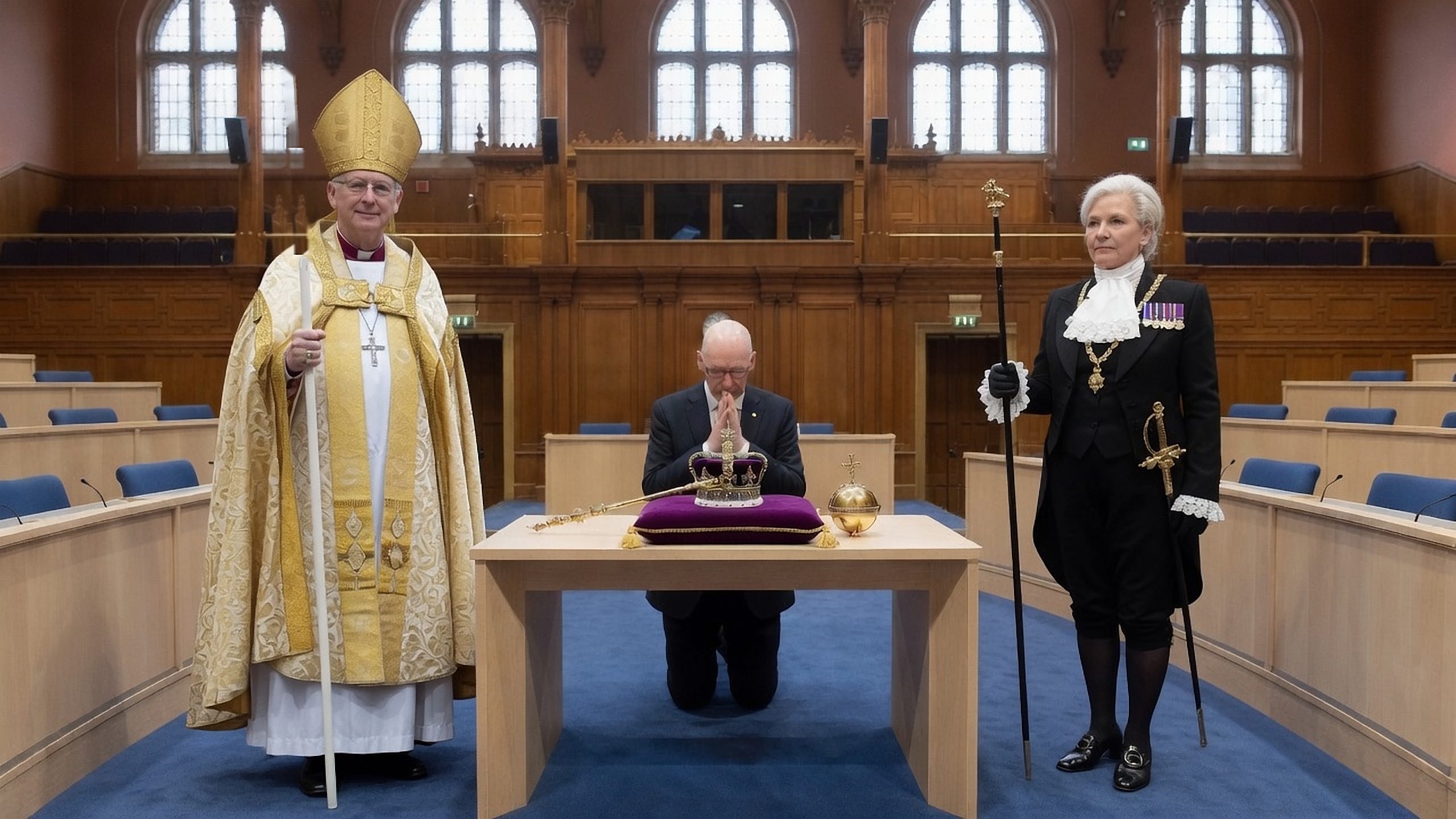
I. Sovereign Demand, Answerable Actions
On 18 May 2026, a formal salvo jure cujuslibet invocation was served upon John Swinney in his capacity as Keeper of the Great Seal of Scotland. Hand-delivered to the Scottish Parliament at Horse Wynd, sent by Royal Mail tracked delivery to Bute House and the First Minister’s official correspondence address, and emailed to the official First Ministerial address. The Scottish Government’s correspondence office acknowledged receipt under MiCase Reference 202600517396 on 20 May 2026. A written response under the same reference, issued by the Scottish Government’s Directorate for Constitution, followed on 18 June 2026. It is reproduced below and read in Section VI. The documentary record is on permanent public deposit at Internet Archive.
[Link: Salvo invocation as served — Internet Archive]
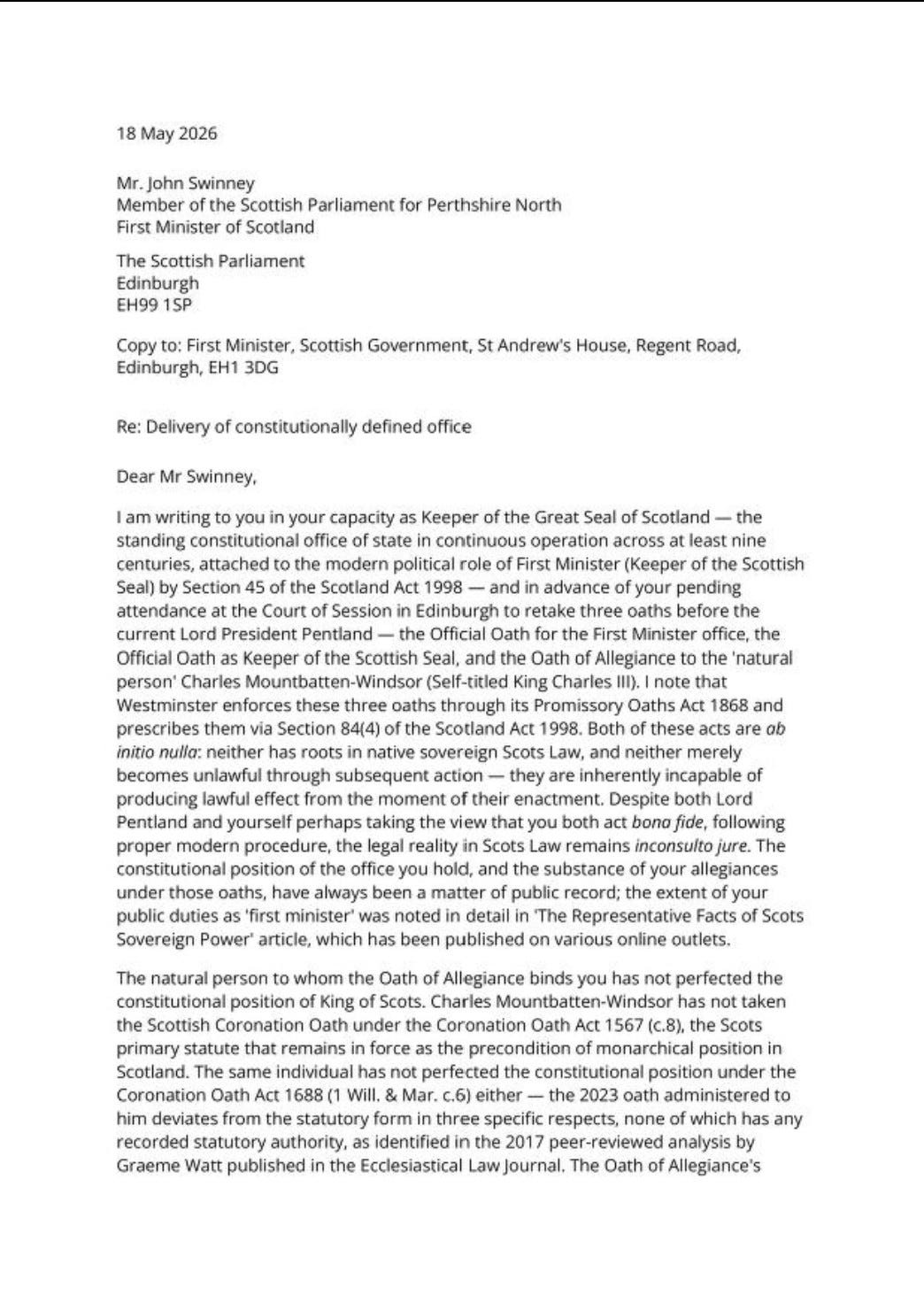
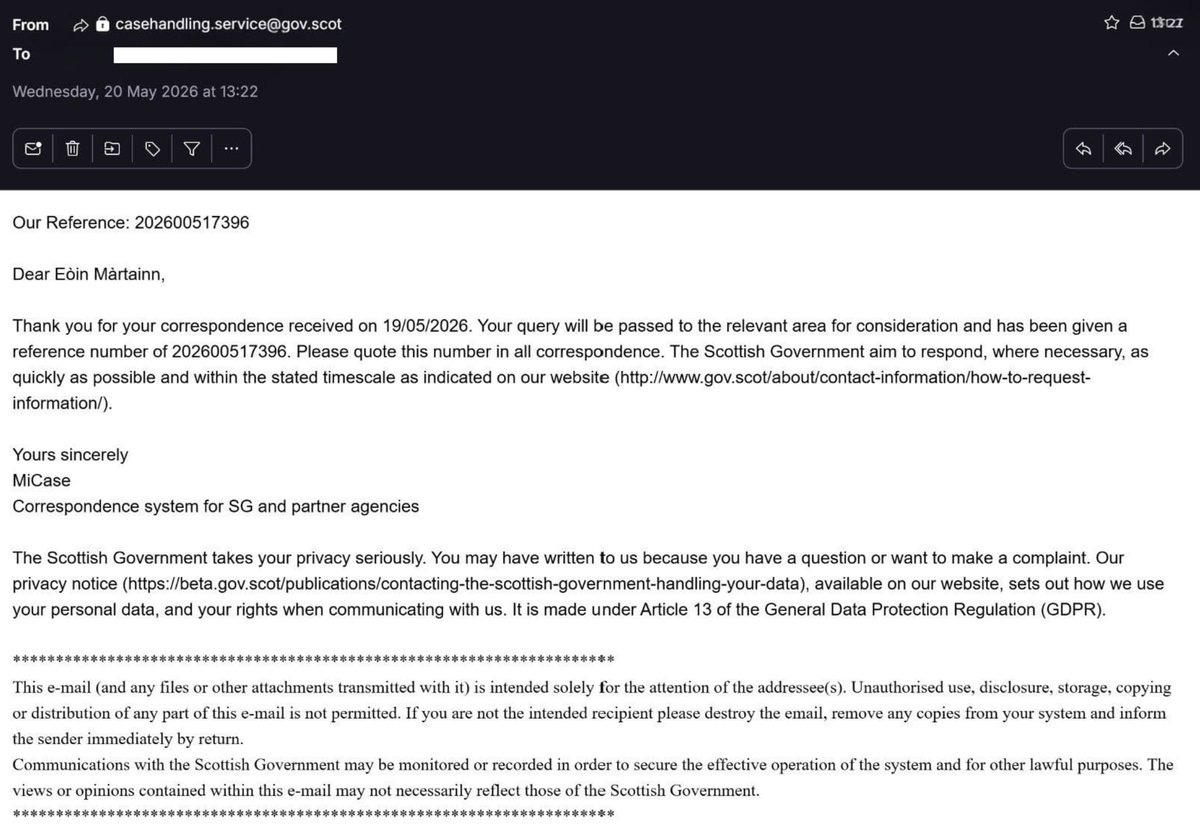
Two days after service, on the morning of 20 May 2026, Swinney attended the Court of Session in Edinburgh to take the three oaths required of the office of First Minister, including the Official Oath as Keeper of the Scottish Seal and the Oath of Allegiance to the natural person Charles Mountbatten-Windsor, none of which is rooted in Scots constitutional law. The constitutional question that ceremony raised was set out in detail in A Tale of Two Masters: Sovereign Scots or Crown-in-Parliament?, published live as the proceedings took place. The choice taken on the day was named as it happened: capture chosen, subordination accepted, five more years signed. The question, at the close, turned to the sovereign people.
This article reads what has happened in the weeks since.
II. The Oath at the Court of Session
Before he took those oaths, Swinney made the following statement on the public record:
“Before I take my oath, let me pledge that the primary loyalty of the Scottish National Party is to the people of Scotland, in line with the constitutional principle of the sovereignty of the people.”
Moments later, in the same proceeding, before the Lord President of the Court of Session, he swore that he would
“be faithful and bear true allegiance to His Majesty King Charles, his heirs and successors, according to law. So help me God.”
Two statements, the same morning, from the same person, before the same Court. The first invoked the constitutional principle of the sovereignty of the Scottish people. The second swore allegiance not to those people, nor to any Scottish constitutional instrument, but to the natural person Charles Mountbatten-Windsor.
What this article reads, in observation rather than editorial, is the gap between the two, and what the gap names.
III. The Form of Asking Is the Answer
What the gap between Swinney’s two statements names is not unique to him. It is the structure of post-1707 devolutionism itself, a confession built into the form.
Every petition for transferred powers is a confession that the petitioner accepts the transferring authority. Every Section 30 request is a confession that the request was needed. Every appeal for permission to hold a referendum is a confession that permission lies elsewhere. Every Crown’s Consent stamped at the gate of every Holyrood Bill is a confession that the Bill is conditional on a Crown that, in Scots constitutional law, has not perfected its position over Scotland since the last performance of the Scottish Coronation Oath by Queen Anne in 1702.
The devolutionist confesses this in the very act of asking. The form of asking is the answer. The supplicant register identifies the supplicant’s own constitutional position as subordinate to the addressee. Each request for transferred power names the addressee as the holder of the power being requested. Each refusal received and accepted ratifies the addressee’s authority to refuse.
Asking is not itself the confession. The Scots record holds centuries of institutions, the courts of the realm among them, placing questions before Scotland’s own sovereign authority and receiving declarations on the record. Asking is how Scots constitutional law was made. The confession is the addressee.
The post-1707 Scottish political class has not, by and large, been unaware of this. The vocabulary of “asking permission” has been openly used, on occasion lamented, frequently rationalised as strategic patience. The confession is made in public, on the record, in full constitutional view. It has simply not, in recent memory, been read for what it is.
This article reads it.
IV. The Position That Cannot Be Repealed
The constitutional position the devolutionist confession contradicts is not in dispute and is not advanced for the first time here. The standing record of Scots Law, the Coronation Oath Act 1567, the Claim of Right 1689, the Act salvo jure cujuslibet (1592 and 1663), Treaty of Union Articles XIX and XXIV, the Treason Act 1708, was laid down at length in The Representative Facts of Scots Sovereign Power and in The £414,000,000 Facade, both published in the Sovereignty Series earlier this year. The constitutional substance is on the public record.
The senior Scots civil court recorded the position, through the Lord President of the day, in MacCormick v Lord Advocate 1953 SC 396 at 411:
“The principle of the unlimited sovereignty of Parliament is a distinctively English principle which has no counterpart in Scottish constitutional law.”
That dictum has never been displaced. Scots Sovereignty was never repealed, and in our reading cannot be. The inalienability principle, the Vattelian condition of voluntary submission, and the Claim of Right’s identification of the Community of the Realm as the source of constitutional power in Scotland together place the right beyond the reach of any external instrument and arguably beyond the reach even of the sovereign people themselves.
The instruments through which Scots Sovereignty operates remain in play. They are operational, in continuous use, encased within a Westminster statutory framework that depends on their continued existence for its own claim to legitimate authority over Scotland. This series names that mechanism: the Structural Colonial Encasement Doctrine (SCED).
The doctrinal substance is the subject of those prior pieces. The contemporary reading is the subject of this one.
V. The Encasement in Operation
What the prior pieces traced as constitutional architecture, this piece reads as live political grammar.
The Crown’s Consent gate on every Holyrood Bill is the encasement architecture in operation. The Section 30 request that does not arrive is the encasement architecture in operation. The Section 30 request that is granted with stipulations is the encasement architecture in operation. The Oath of Allegiance sworn by every MSP at the door of the chamber, before the right to speak or vote is conferred, is the encasement architecture in operation. The Court of Session sitting under commissions issued through Section 95 of the Scotland Act 1998, beneath the appellate jurisdiction of the UK Supreme Court in civil matters under Section 40 of the Court of Session Act 1988, as substituted by the Courts Reform (Scotland) Act 2014, is the encasement architecture in operation. That judicial layer has been read at audit length in The Scottish Judiciary in Constitutional Polarity: Jus Scoticum and the Herrenvolk-Franchise Elective Dictatorship, published in the Sovereignty Series in June 2026, where the court’s own record supplies the mechanics and the court itself is classified as a Sovereign-External Colonial Enforcement Court (SE-CEC). This piece reads the political layer of the same machine.
The instruments wielded, the Great Seal of Scotland, the office of Keeper, the standing Scots Law forms, remain in continuous use. What has changed across three centuries is not the existence of the instruments but the apparatus surrounding them. The instruments are operational, wielded by the office-holders within the framework to project legitimacy and to gain validity through the continuing acceptance of the Scottish people. That validity, in our reading, is contingent. It depends on continuing acceptance. It is, in principle and in law, revocable.
The structures the Crown-in-Parliament built to legitimise the impossible are, in our reading, themselves the evidential records of the impossibility of its own position.
VI. Where Things Stand Now
Section III of this article states, as structure: each refusal received and accepted ratifies the addressee’s authority to refuse. In the weeks since the oaths were sworn, the record has performed that sentence in public, step by step, with dates.
The request was made. On 26 May 2026, the Scottish Parliament voted to call on the UK Government to make a Section 30 order. The refusal came the following day, in a single line from Downing Street:
“The UK Government does not support independence or another referendum.”
Pressed at First Minister’s Questions that same week to reveal his response, the First Minister declared he would not
“kowtow to 10 Downing Street”
and would use the independence majority to deliver independence. Words and intentions were stated. Still, no mechanism was named. No withdrawal from the supplicant register was made. The request confessed where the requesting institution believes the power to sit. The refusal, received and accepted, ratified it.
The mandate had been priced beforehand, by the requester himself. The route was publicly predicated on an SNP majority at the 7 May election, the stated trigger for the precedent of 2011. The party fell seven seats short. The election nonetheless returned the largest pro-independence majority in the institution’s history. The request went in on that mandate, and the refusal came back over it. In our reading, that is the encasement demonstrating its own pricing: within the framework, no mandate is large enough, because the framework does not weigh mandates. It weighs permission, and permission sits, by the framework’s own design, with the addressee.
The remaining commitments of the first hundred days are, in our reading, artefacts of the same register: a draft Referendum Bill to be published within the framework, a Constitutional Convention to be convened within the framework, discussions to be initiated on the transfer of powers held, by the framework’s account, elsewhere. Each is a further request in preparation. None withdraws from the supplicant register. The clock on those hundred days runs while this article is read.
One question in the period required no permission from anyone, and on 18 June 2026, one month after service, it received a written answer. Read who answered before reading what was answered. The instrument was served on John Swinney in his capacity as Keeper of the Great Seal of Scotland, the office that has authenticated the acts of Scottish government for nine centuries. The response under Reference 202600517396 came not from the Keeper, and not from the First Minister, but from the Directorate for Constitution, Elections and Constitutional Projects Division, over the signature of an official of Constitutional Projects. The office addressed never spoke. The question of what holding the people’s Seal means was routed away from the man who holds it and answered by a policy correspondence team. The transmitted file is named “Draft Response”.
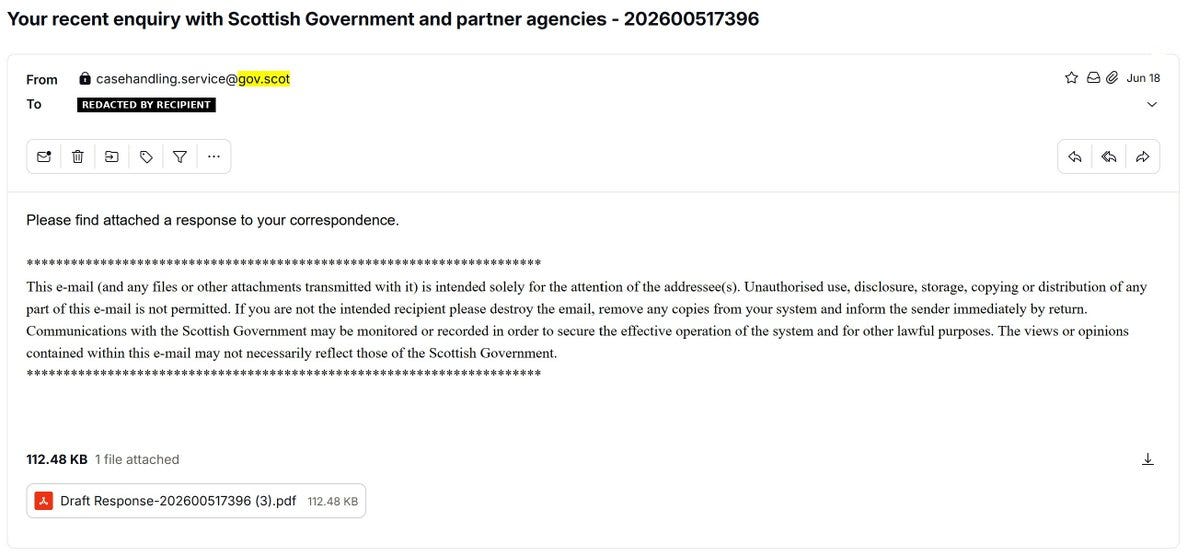
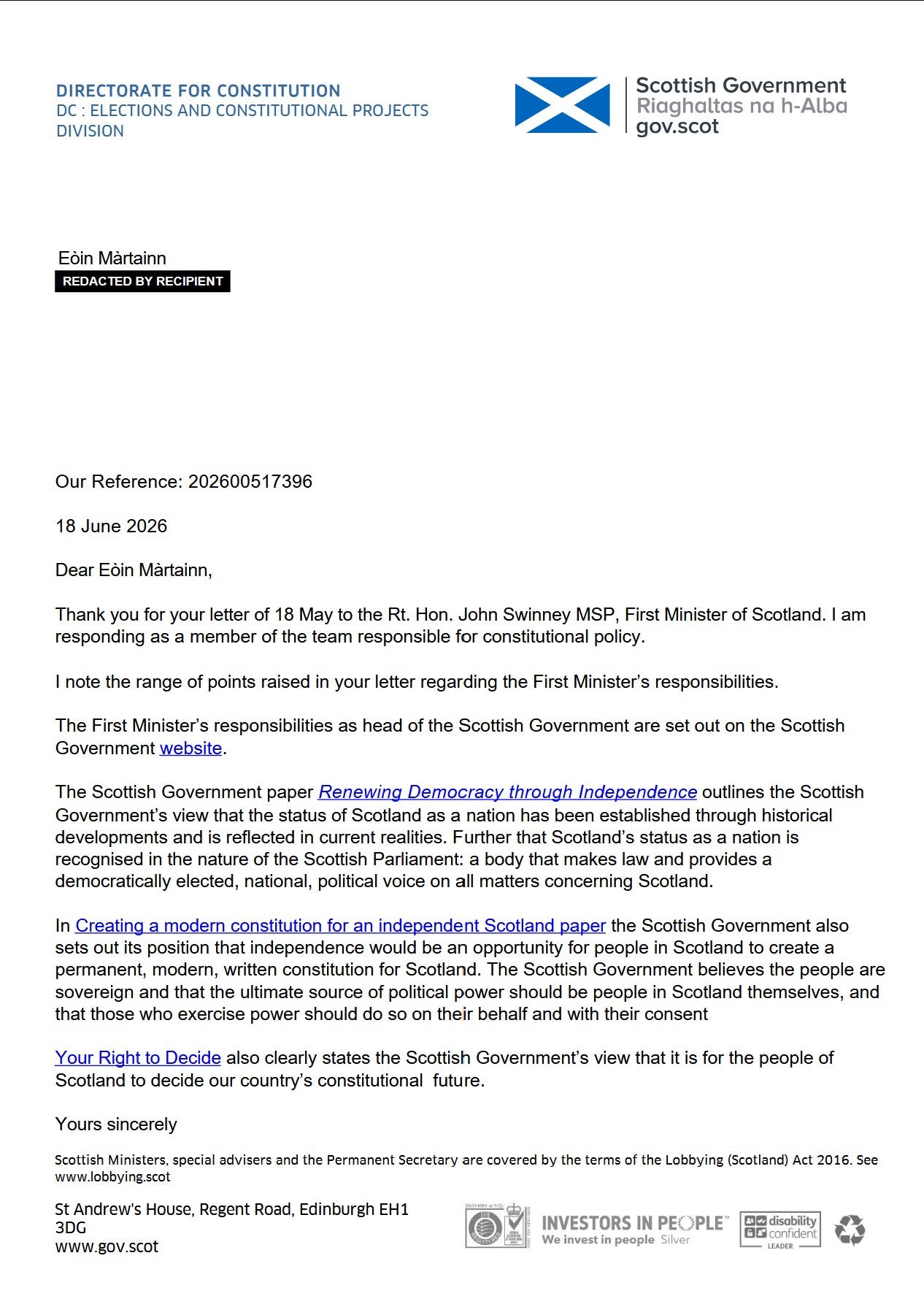
Full response email, Reference 202600517396 - Internet Archive Link
The letter then recharacterises the instrument at the door. It gives thanks for “your letter of 18 May to the Rt. Hon. John Swinney MSP, First Minister of Scotland.” The capacity in which the instrument was served, Keeper of the Great Seal of Scotland, appears nowhere in the response. The salvo jure cujuslibet, the standing Scots constitutional instrument the letter invoked, is not named in it. The Claim of Right 1689 is not engaged by it. Nowhere does the response state that the instrument invoked is spent, superseded, or repealed; no such sentence appears anywhere in it. A formal invocation under nine centuries of Scots constitutional law is received, logged, and processed as correspondence containing “the range of points... regarding the First Minister’s responsibilities. Those responsibilities, the constitutional position of the office that holds the people’s own Seal, are answered with a link to the First Minister’s job description on a Scottish Government webpage.
What the response does instead is cite three of the Scottish Government’s own prospectus papers, and in doing so it places the following on the record, on the Directorate for Constitution’s letterhead:
“The Scottish Government believes the people are sovereign and that the ultimate source of political power should be people in Scotland themselves, and that those who exercise power should do so on their behalf and with their consent.”
The letter then adds:
“it is for the people of Scotland to decide our country’s constitutional future.”
Read the grammar. Believes. Should be. Sovereignty affirmed as the government’s belief and framed as a future condition, indexed to papers describing what independence “would be an opportunity” to create. The Claim of Right 1689 does not state a belief. It states the standing constitutional law of Scotland, and it has not been repealed. The instruments the response declines to name speak the same grammar throughout the record: not believes but is; not should be but “in all time coming”; not a future condition awaiting permission but, in the standing record’s own words, “in this, as in all preceding parliaments”. The office was served a question about what the people’s sovereignty requires of it now. It answered by describing what it believes sovereignty should be later, once permission has been granted through the very framework Section III of this article reads.
Read, too, where the response locates the nation. It cites the Scottish Government’s view that Scotland’s status as a nation
“is recognised in the nature of the Scottish Parliament”
the devolved body, created by the Scotland Act 1998, gated by the Westminster Crown-In-Parliaments’s Consent, its members sworn at the door to the natural person this article’s Section II records. Scotland’s nationhood, in the government’s own answer, is defined by reference to the encased institution. The frame confesses itself.
Read the dates around the letter. Twenty-three days before the Scot Gov’s Directorate wrote;
“the people are sovereign”
The Scottish Government, meant to speak for the sovereign people, voted to petition Westminster for permission to ask them a question. Nine days after it wrote them, its principal representative (The First Minister) escorted the Crown of Scotland into the ceremonial frame of England’s Crown-in-Parliament. The letter sits between the petition and the homage and contradicts in both directions.
In our reading, this is the ‘devolutionists confession’ in its purest documentary form: the people’s sovereignty acknowledged as aspiration, deferred as law, by the directorate of the government whose head holds the people’s own Great Seal. The instrument served was not engaged. The position it invoked was affirmed, in writing, as a belief about the future. Section III of this article reads the confession made by asking. This is the confession made by answering.
Examining the ceremony itself. On 27 June 2026, the Keeper of the Great Seal personally escorted the Crown of Scotland from Edinburgh Castle for the opening of the new parliamentary session, on camera, in his own words enjoying
“a very unusual start to my day.”
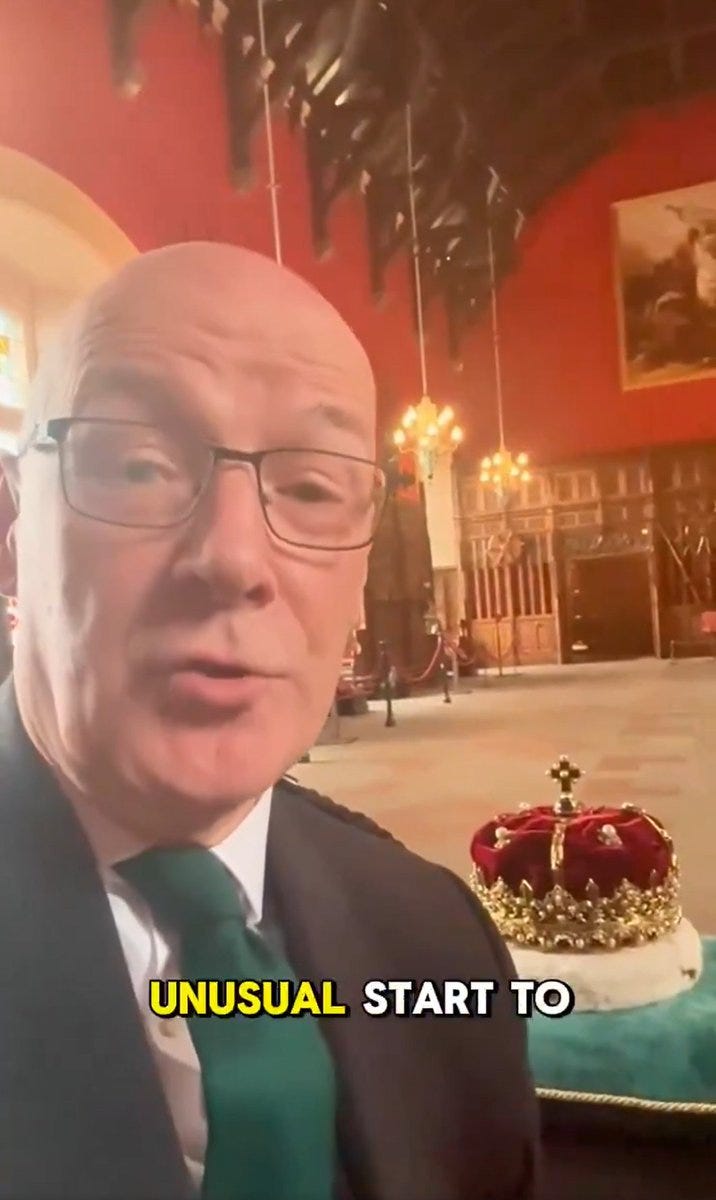
Link: John Swinney “Good morning from Edinburgh Castle...” X Hosted Video: 27 June 2026
On 30 June 2026, the official record of the Royal Household stated:
“This afternoon The King received John Swinney, First Minister of the Scottish Government.”
Received. The Court Circular’s own verb of hierarchy, applied to the office that holds the Great Seal of Scotland. The Crown of Scotland, in our reading the emblem of the Community of the Realm and of no other authority, was walked by its Keeper into the ceremonial frame of an allegiance that Scots constitutional law never granted.
Link: The Royal Family “This afternoon The King received John Swinney...” X Post: 30 June 2026
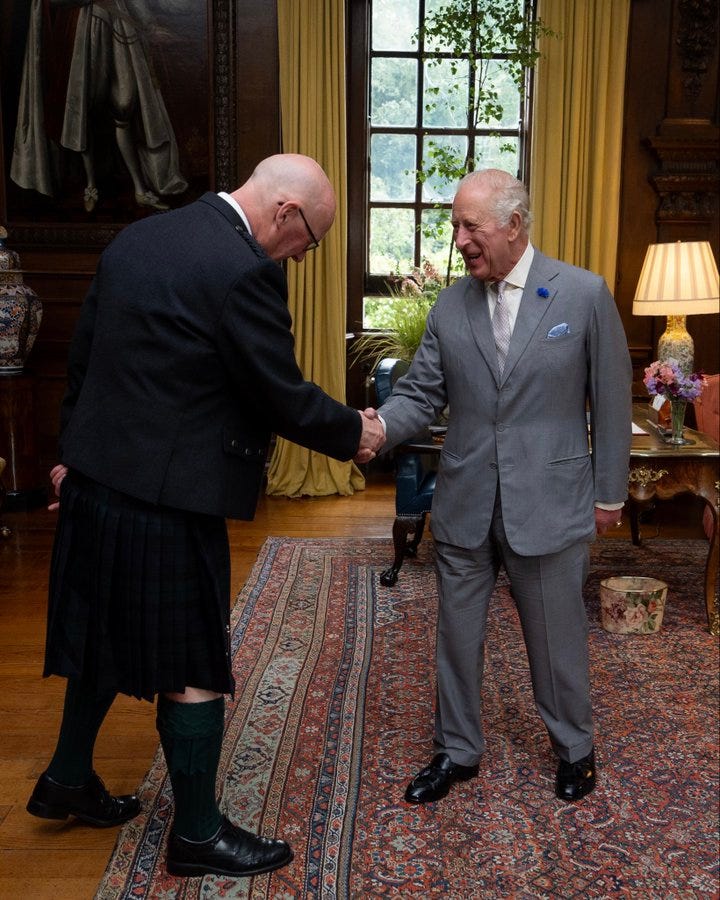
Word, act, answer, ceremony. The pledge to the sovereignty of the people, sworn on the morning of 20 May. The petition to Westminster, made and refused. The written answer to the people’s own question, affirming their sovereignty as a belief while engaging neither the instrument served nor the capacity addressed. Then, twelve days after its Directorate wrote “the people are sovereign,” the homage: the office’s principal escorting the Crown of Scotland into the ceremonial frame of the Crown-in-Parliament, and being “received.” The gap Section II of this article named between two statements on one morning is, on the record of these six weeks, not a gap at all. It is a pattern, and the pattern has dates. It is also an old story. A child at the roadside says the plain thing, the emperor suspects the crowd is right, and the procession goes on regardless, chamberlains bearing a train that is not there. The plain thing was served on 18 May. The procession went on.
VII. The Choice
What each elected representative does next, performance, refusal, or silence, will be a matter of public record.
The choice has been and is being taken in actions, not awaited as a future statement. The deeper truth, in our reading, is that those actions are not, in the sovereign sense, choices at all. The Oath of Allegiance taken under Section 84(4) of the Scotland Act 1998 binds the office holder to faithful execution of the Crown-in-Parliament framework. The choice, the sovereign one, was taken on the morning of 20 May 2026 when the oath was sworn. Every action since is the framework operating through the office holder, executing the orders the oath obligates him to follow. Every Section 30 permission requested, every Bill sealed under the Crown’s Consent gate, every transferred power accepted, every command followed within the Scotland Act framework, each is, in our reading, the framework’s command discharged through the office holder. None has any foundation in Scots constitutional law.
To choose otherwise requires not a declaration but an act of withdrawal from the supplicant register and assertion of the standing constitutional position the Scottish people have always held.
On 26 May 2026, the Scottish Parliament voted, by majority, on a motion calling on the UK Government to make a Section 30 order, the formal request for Westminster’s permission to hold a referendum on Scotland’s constitutional future. The motion passed on the largest pro-independence Holyrood return in the institution’s history: more than seventy elected representatives, individually bound by oath to the natural person Charles Mountbatten-Windsor, collectively voting to ask the Crown-in-Parliament for permission to exercise sovereignty that, in our reading, Scots constitutional law already places in the people.
In our reading, what was presented as democracy in evolved form was the encasement architecture (SCED) in mature operation. Seventy-plus individual oaths discharging their bound function as one institutional act. The chamber performing democracy while delivering nothing to the foundation of Scots sovereignty. Neither the Salvo was invoked, nor the Claim of Right asserted, nor the standing constitutional position claimed, nor any withdrawal made from the supplicant register that ratifies Westminster’s claim.
What was performed was theatre. What was confirmed was control.
The Section 30 route now being pursued is itself, in our reading, the encasement architecture in active operation. The request is the confession that the requesting authority does not hold what it requests. The framework being requested cannot, by its own design, deliver a constitutionally legitimate outcome by the standards that bind legitimate self-determination, the Document of the Copenhagen Meeting of the Conference on the Human Dimension of the CSCE (1990), the OSCE/ODIHR audit requirements, the Vienna framework for fundamental democratic process. The 2014 framework was substandard against these benchmarks. A further iteration within the same architecture would, in our reading, deliver the same result by the same logic: a referendum framed within the encasement cannot escape it.
Under Scots constitutional law three paths remain available: performance, refusal, or silence. The Community of the Realm holds remedy at the end of each, as it did in 1286, 1310, 1320, and 1689.
The deeper truth, in our reading, is that the choice does not finally rest with the elected representatives. Under the Claim of Right 1689, under the standing salvo jure cujuslibet, under nine centuries of Scots constitutional law, sovereignty in Scotland rests with the Community of the Realm, the Scottish people themselves.
As sovereign Scots, as laid down in The Representative Facts of Scots Sovereign Power, the constitutional position is ours, not theirs. Elected representatives act on our behalf, paid from public purse to serve the Community of the Realm. They work for us. The salvo jure cujuslibet doctrine reserves the standing right to every member of the Scottish realm: not the privilege of office, status, or expertise, but the right of every Scot, author and reader alike. Acted on individually, it protects each member of the realm. Acted on together, it constitutes the Community of the Realm in operation.
Primary sovereignty is taken, not given. The real choice, as it was in 1286, 1310, 1320, and 1689, has always been with the people.
The Crown-in-Parliament built structures to legitimise the impossible. Those structures are, in our reading, the evidential records of the impossibility of its own position. The forms it required Scottish representatives to perform to enter the chamber are the form of confession that defines the chamber as captured. The pen the Keeper holds is the pen that has authenticated every Act of every Scottish Parliament across nine centuries, and it is the only working pen in the room.
In A Tale of Two Masters, the question was placed on the morning Swinney took the oaths. The answer the office of Keeper has given since, in the oath sworn, in the Section 30 request made and refused, in the written response given, and in the ceremony performed, is recorded above. The demand served on that office on 18 May has now been answered in form: a response that affirms the people’s sovereignty as the Scottish Government’s belief and engages neither the instrument served nor the capacity addressed. In substance, the question stands open. The office it was put to has yet to speak. It now returns to us, sharpened:
How do we, as sovereign Scots, choose to act?
The choice has always been ours. This time the question is not rhetorical.
The standing right this article reads is not resting in a correspondence file. The confession has been read into the record. The remedy follows, and it will not arrive in the form of a request.
(To Be Continued)
All of Us First 🏴
Constitutional substance referenced in this article was laid down at length in the SovereigntySeries articles listed in the final category below. All Scots instruments are cited from the Scots primary record.
Sources
Scots statutory and constitutional primary record
Coronation Oath Act 1567 (c. 8), Anent the Kingis aith to be geuin at his Coronatioun, Acts of the Parliament of Scotland. Short title designated by the Statute Law Revision (Scotland) Act 1964 (c. 80), Schedule 2. Has not been repealed. Records of the Parliaments of Scotland, A1567/12/7. rps.ac.uk
Claim of Right of 1689. Records of the Parliaments of Scotland (RPS) 1689/3/108; manuscript record, National Records of Scotland PA2/33, p. 38. Has not been repealed. Reaffirmed by House of Commons motion, 4 July 2018, passed without division.rps.ac.uk
Act salvo jure cujuslibet 1592. Records of the Parliaments of Scotland (RPS) 1592/4/60. rps.ac.uk/trans/1592/4/60
Act salvo jure cujuslibet 1663. Records of the Parliaments of Scotland (RPS) 1663/6/146. rps.ac.uk/trans/1663/6/146
Act Ratifying and Approving the Treaty of Union of the Two Kingdoms of Scotland and England, Parliament of Scotland, 16 January 1707, Articles XIX and XXIV. Records of the Parliaments of Scotland, 1706/10/257. rps.ac.uk
Treason Act 1708 (7 Ann. c. 21), Section 12. Has not been repealed in Scots law.
United Kingdom (H-FED) statutory and procedural records
Scotland Act 1998, Sections 30, 45, 84(4) and 95; Schedule 3, paragraph 7 (the requirement that the Parliament’s standing orders ensure no Bill passes without Crown consent being signified). legislation.gov.uk/ukpga/1998/46
Standing Orders of the Scottish Parliament, Rule 9.11 (Crown consent, Public Bill Procedures), 7th Edition, 11 May 2026. parliament.scot
Court of Session Act 1988, Section 40, as substituted by the Courts Reform (Scotland) Act 2014 (asp 18), Section 117: appeal to the UK Supreme Court in civil matters lies only with the permission of the Inner House or, failing that, of the Supreme Court itself. In force from 22 September 2015.
Constitutional Reform Act 2005, Section 40(3), the former statutory basis of that appellate jurisdiction, repealed with effect from 22 September 2015 by the Courts Reform (Scotland) Act 2014 (asp 18), Section 138(2), Schedule 5, paragraph 33 (S.S.I. 2015/247), and for England, Wales and Northern Ireland by S.I. 2015/700.
Promissory Oaths Act 1868 (31 & 32 Vict. c. 72), Section 2: the statutory form of the Oath of Allegiance quoted in Section II, and the form to which the Standing Orders of the Scottish Parliament refer.
Case law primary records
MacCormick v Lord Advocate 1953 SC 396, per Lord Cooper of Culross, Lord President, at 411. Read at bailii.org.
Historical constitutional records
Appointment of the Guardians of Scotland in the name of the Community of the Realm, 1286.
Declaration of the Clergy, 1309–1310 (given in the parliament at St Andrews, 17 March 1309; reissued 1310). Records of the Parliaments of Scotland, 1309/2; manuscript, National Records of Scotland, State Papers SP13/4.
Declaration of Arbroath, 6 April 1320. National Records of Scotland SP13/7.
Convention of the Estates of the Kingdom of Scotland, 1689: the Estates declared James VII to have forefaulted the right to the Crown and codified the Claim of Right of 1689.
Contemporary primary records, 2026
Formal salvo jure cujuslibet invocation served on the Keeper of the Great Seal of Scotland, 18 May 2026. Hand-delivered to the Scottish Parliament at Horse Wynd; Royal Mail tracked delivery to Bute House and the First Minister’s official correspondence address; emailed to the official First Ministerial address. On permanent public deposit at Internet Archive.
Scottish Government MiCase acknowledgement, Reference 202600517396, 20 May 2026. Reproduced in Section I.
Oath proceedings of the First Minister, Court of Session, Edinburgh, 20 May 2026, before the Lord President (Lord Pentland): the pledge on the sovereignty of the people and the Oath of Allegiance, both quoted verbatim in Section II.
Scottish Parliament, Official Report, 26 May 2026: motion calling on the UK Government to make an order under Section 30 of the Scotland Act 1998, passed by majority.
UK Government statement, 27 May 2026, declining the Section 30 request; quoted in Section VI.
Scottish Parliament, Official Report, First Minister’s Questions, 28 May 2026.
Scottish Government, Directorate for Constitution, Elections and Constitutional Projects Division, written response, Reference 202600517396, 18 June 2026. Reproduced in Section VI; on permanent public deposit at Internet Archive.
Scottish Government prospectus papers cited in the response of 18 June 2026 (three papers).
First Minister’s published video, Edinburgh Castle, 27 June 2026: the Keeper of the Great Seal escorting the Crown of Scotland for the opening of the parliamentary session.
The Royal Family, official account, 1 July 2026: record of the King receiving the First Minister at the Palace of Holyroodhouse.
International standards
Document of the Copenhagen Meeting of the Conference on the Human Dimension of the CSCE, 29 June 1990. osce.org
OSCE/ODIHR election observation and audit standards. osce.org/odihr
Vienna framework for fundamental democratic process (Concluding Document of the Vienna Meeting of the CSCE, 1989).
Sovereignty Series Refrences:
published records
The Echoes of Arbroath, Foundation Scotland. Fifteen Acts of Affirmation; Seventeen colonial confessions.
The Representative Facts of Scots Sovereign Power, Foundation Scotland, 15 May 2026. The standing instruments of Scots constitutional law.
The £414,000,000 Facade, Foundation Scotland. Holyrood architecture; the MSP oath; the encasement of the Scottish Parliament.
A Tale of Two Masters: Sovereign Scots or Crown-in-Parliament?, Foundation Scotland. 20 May 2026. The constitutional question placed on the day of the oath ceremony.
The Scottish Judiciary in Constitutional Polarity: Jus Scoticum and the Herrenvolk-Franchise Elective Dictatorship, SCRDI, June 2026; on permanent public deposit at Internet Archive, 12 June 2026. The mechanical audit of the judicial layer of the encasement; the court classified as a Sovereign-External Colonial Enforcement Court (SE-CEC).
We Audited Scotland’s Senior Court. Here Is What Its Own Record Shows. SCRDI,
Sovereignty Series Part 15. Companion article to the earlier judiciary audit.
Structural Colonial Encasement Doctrine (SCED): The Capture and Enclosure Mechanism of Scots Sovereignty, SCRDI, 4 July 2026. The published definition of the encasement mechanism named in this article.
Weighty stuff but I think I got through it.
The response to your Salvo from them is what we’ve come to expect, and a pretty lazy one at that. Any question concerning Scots Constitutional Law is stopped at the door. They can endlessly divert or bury this stuff because they own all of the mechanisms by which full response is compelled. They will never ever let us in. To do so would be to deal with the substantive issue, which they know is unarguable. The sisting of Craig Murray’s case against the proscription of Palestine Action at the Court of Session is another example of diversion/entombment of legitimate appeal. I guessing that after a fashion I’m rehearsing your own statements on the encasement of Scots Constitutional Law.
Still, it’s on the record and more evidence of our subjugation. In the fora and courts of international law - where non engagement and encasement options are not available to the coloniser or his lackeys - we will have our answers.
With folk like yourself, Sara Salyers, Christophe Doreign-Thomson, Angry Pict, Craig Murray to name but a few us Scots shall prevail.
Soar Alba gu Bràth.