

(First published on X.com, Wednesday 20 May 2026)
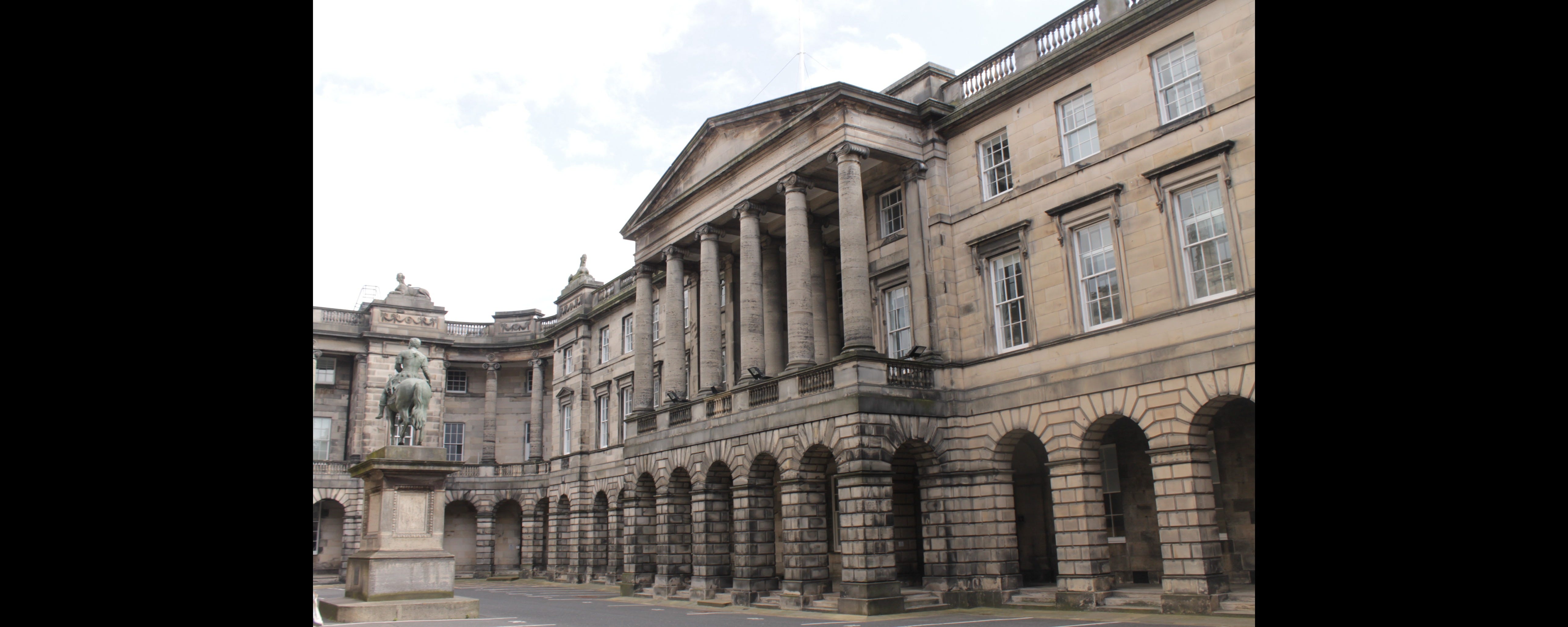
#SovereigntySeries Part 9 — LIVE — Wednesday 20 May 2026 09:15 GMT+1
This morning, at the Court of Session in Edinburgh, @JohnSwinney is being sworn in as First Minister @ScotGovFM of Scotland.
He is also, as per standing Scots law, the Keeper of the Great Seal of Scotland.
Two offices in one man. One modern. One ancient. The First Minister role was created by Section 45 of the Scotland Act 1998. The Keeper holds Scotland’s standing sovereign instrument, in continuous use across nine centuries.
The ceremony this morning does not appoint him to a new role. It asks him to continue the constitutional office Scots law has placed him in already.
And because Charles Mountbatten-Windsor has never been perfected as King of Scots, that office now stands as the senior unconditioned constitutional position in the realm.
John Swinney is, despite the proceedings today, already the Guardian of Scotland.
At the Court of Session, John Swinney is taking three oaths before Lord President Pentland.
The Official Oath for the First Minister office. The Official Oath as Keeper of the Scottish Seal. And the Oath of Allegiance to Charles Mountbatten-Windsor as “King”, a constitutional position the named natural person has never perfected under Scots primary statute.
All three oaths are administered through Westminster’s Promissory Oaths Act 1868 and prescribed via Section 84(4) of the Scotland Act 1998. Two Westminster instruments, neither rooted in Scots Law. Under standing Scots law, both are ab initio nulla. Void from enactment.
It is often said that the First Minister “serves two masters” — Scotland and the UK constitutional framework. That the role requires balancing. That compromise is unavoidable.
That framing is too generous.
The three oaths bind to Westminster. The royal warrant comes from Charles Mountbatten-Windsor. The judges administering this morning’s ceremony sit under commissions issued by the same unperfected Crown. The Court of Session itself answers upward to a UK Supreme Court Scotland never consented to. There is no oath to the sovereign Scottish people in the modern ceremony at any point.
“Two masters” is a fiction. The structural reality of the modern First Minister oaths is one master, Westminster.
John Swinney has held senior office across nineteen years. Across nineteen years, he has had the standing to invoke what Scots law preserves and what Westminster has confirmed across nine centuries. Each time, he has chosen the Westminster framework.
This morning he chooses again.
If he takes the three oaths as previously, he is not serving two masters. He is choosing Westminster and Charles Mountbatten-Windsor over the sovereign people of Scotland:
He is choosing capture.
He is accepting subordination.
He is signing his name to it for a further five years.
So we must ask.
Where did Scotland’s foundation change?
The Coronation Oath Act 1567. The Act salvo jure cujuslibet 1592. The Claim of Right Act 1689. The Treaty of Union 1707. Standing Scots constitutional instruments, unrepealed, in force.
When did Scots vote to set them aside?
Where was the referendum that replaced this architecture with a Westminster-administered one?
By what process did Charles Mountbatten-Windsor become King of Scots, when he has never taken the Scottish coronation oath under any statute in force?
The answer is the same in every case. There was no vote. There was no referendum. There was no consent.
The foundation has not changed. The new rules have been imposed over the top of it.
What operates as law in Scotland today is not Scots law.
The Treaty of Union 1707 preserved two distinct legal systems — Scots law and English law — as separate and sovereign. Scots law was never abolished. It was never replaced. It remains in force.
Yet today the UK Supreme Court — a body sitting in London — hears appeals from Scotland’s Court of Session. The Court of Session, Scotland’s senior civil court since 1532, no longer operates as such. Westminster placed the UK Supreme Court above it through Section 40(3) of the Constitutional Reform Act 2005, a statute passed without Scottish referendum, Scottish Parliament consent, or popular vote. The judges sitting below the UK Supreme Court hold commissions issued by an unperfected Crown.
Scots law is being administered in a foreign jurisdiction, under a constitutional structure that has — in Scots law itself — no standing to do so.
This is Westminster manipulating the constitutional position to hang onto de facto legal power. It is, under Scots law, subordinate to the order it now acts above.
It does it anyway.
Not only are our institutions captured by Westminster, our minds are too.
More of us are aware now than ever before. Many others are simply running through life, focused on getting by. But aware or not, the system we live under is not our own. It is the Westminster Crown-in-Parliament system of capture, and we have allowed it. We have allowed it through devolution, expensive theatre, funded by us, performing the illusion of Scottish power while Westminster holds the substance. The constitutional facts are not hidden. They are not buried in archives or reserved for academics. They are in plain sight, right in front of our noses.
And yet collectively we do not act on them. Voices have spoken truth to power across three centuries of Union. Our elected representatives — captured by Westminster, bound by oath to Westminster — have not exercised the powers Scots law preserves. And we, the sovereign people of Scotland, have waited for them to do it.
That is the colonised mind. The assumption that the powers we hold must be exercised by those who represent us, on our behalf. The deferral of our own sovereign standing to office-holders who are themselves subordinated.
The sovereignty of Scots is our foundation. It is beyond standing. It is the source from which all else flows.
It requires a vehicle to act. The current one — the Scottish Parliament at Holyrood — operates within Westminster’s constraints. The Crown-in-Parliament system has captured our parliamentary vehicle. It has captured the mechanics — the Court of Session subordinated to a UK Supreme Court, the political class bound by Westminster oaths.
But it cannot capture our sovereignty. The foundation lies beyond Westminster’s reach. Scots law flows from that foundation, and Westminster has neither the standing nor the authority to capture what gives rise to it.
Nemo dat quod non habet, no one can give what they do not have. Westminster cannot alienate the sovereignty it never held.
We exercise our sovereignty directly, individually and collectively, through whatever vehicle we choose to convene. In our own name. Without permission. We are the givers of law itself, the masters of our own destiny. We elect representatives to act on our mandate, we do not petition them. We instruct.
That sovereignty has stood, intact and unrepealed, for 319 years.
We have done this before.
In 1989, when the poll tax landed in Scotland a year ahead of the rest of Britain, over a million Scots refused to pay. The tax collapsed. The Prime Minister fell. In 2014, hundreds of thousands of grassroots conversations carried Scotland to 45%, an outcome no establishment had predicted.
Both moments showed what Scots can do when the energy is engaged. Both moments also stopped short.
Demonstrations and referenda operate within the rules of the Westminster Crown-in-Parliament system. They petition that system. They ask it to retreat, to permit, to authorise. Even at our most mobilised, we have been ‘asking, asking the people we elect, asking the institutions our taxes fund, asking the very office-holders who are our elected representatives, for permission to exercise the sovereignty Scots law already places in our hands.
That asking is the captured mind in motion. We treat our elected representatives as masters. We petition employees. We request authorisation from a class of office-holder that is, under standing Scots constitutional law, subordinate to us.
Power is not given, power is taken.
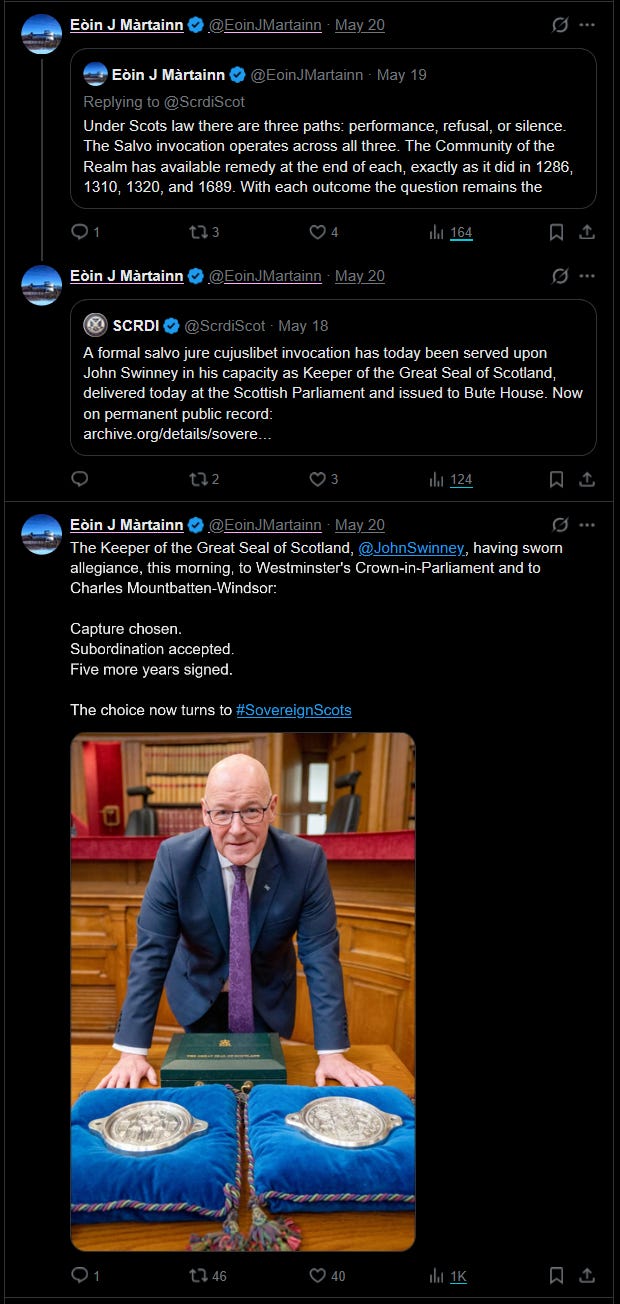
On Monday, a formal salvo jure cujuslibet invocation was served on John Swinney as Keeper of the Great Seal of Scotland. Hand-delivered to the Scottish Parliament. Tracked to Bute House. Emailed to his office. Permanently archived. The Constitutional Question was on his desk before he entered the Court of Session this morning.
And this time, the choice is on the public record as he makes it.
No permission was sought. No vote was required. No political class was consulted.
That was one Scot exercising sovereignty. The target now sits on the Keeper’s desk.
What does collective exercise look like? Civil disobedience where the captured mechanics of governance refuse to bend? The Community of the Realm acting, openly, in its own name?
We have to start somewhere.
Under Scots law, every member of the Community of the Realm holds standing to invoke the Salvo, the Claim of Right, the constitutional architecture preserved across nine centuries. The instruments are not held by politicians. They are held by us — directly, individually, immediately.
This morning, at the Court of Session, John Swinney chooses. Them — Westminster, the Crown-in-Parliament system, Charles Mountbatten-Windsor — or us, the sovereign people of Scotland whose Great Seal he holds in trust.
Capture or constitution.
Subordination or sovereignty.
And after he chooses, the question turns to us. Whatever Swinney does, what will we do? Do we keep asking permission of our elected representatives? Do we keep accepting devolution as the ceiling of our ambition? Do we keep speaking while the powers we hold sit unused?
Or do we exercise the sovereignty that has stood, intact and unrepealed, for 319 years?
The choice is yours.
What will you do with it?
Eòin J Màrtainn
Headline Image attribution: Parliament Square, Edinburgh (Court of Session). By Stephencdickson — Own work, CC BY-SA 4.0,