

Sovereignty Series Part 5
On 16 January 1707, the Parliament of Scotland ratified the Treaty of Union. The standing constitutional law of Scotland required every particular act and ratification prejudicing private rights, under the 1592 statute and the 1663 codifying Act, to be issued under the salvo jure cujuslibet doctrine: the standing rule that the rights of every person could not be extinguished by any particular act unless the parliament formally reserved them.
Salvo jure cujuslibet, ‘Let the rights of every person be reserved’, is a Scots legal doctrine rooted in the ancient rights and governance traditions of the people of Scotland. The ‘Salvo’ doctrine has been codified as a constitutional obligation in Scots law for over four centuries and is unrepealed to this day. Its function as a standing requirement remains readily available to the Scots Parliament whenever passing acts prejudicing the private rights of individuals.
The 1706-07 session honoured that obligation to the Parliament’s final act. On 25 March 1707 — the last sitting day of the last session of the Parliament of Scotland — the estates passed the Act salvo jure cujuslibet (RPS 1706/10/465), reserving the pre-existing rights of every party against the session’s particular acts and ratifications. By its own text, that salvo reaches the session’s particular and private acts; no salvo in any session ever extended to public general legislation, so the Treaty ratification itself sits outside its scope — as it would have in any session since 1592. The reservation of the people’s rights was renewed with the Parliament’s dying breath. Whether the standing reserved right of the sovereign people reaches the public legislation that incorporated Scotland is the constitutional question no court has ever been made to answer. The doctrine was never repealed. No ‘valid’ Scottish Parliament with the sovereign backing of Scots has existed since to exercise it, and it remains operative Scots law.
Three hundred and nineteen years after the ‘Treaty’ of Union, the first act required of every Member of the Scottish Parliament before they may speak, vote, or participate in any proceedings whatsoever is to remove the very mandate of Scots sovereignty that they are meant to represent and uphold.
That inversion is not accidental nor is it administrative. It is the subject of this article.
The constitutional question of sovereignty is not whether the Scottish people are sovereign — that is a fact. The actual question we Scots need to answer is: why do the Scottish people not exercise the existing constitutional instrument they’ve always had available to deploy at their will?
The Scots Parliament
Origins
Scotland’s Parliament is of considerably greater antiquity than its first surviving written reference. Its Celtic soul is rooted in the ancient assembly of mormaers at the Moot Hill of Scone, the provincial lords of the realm, the King ruling with the counsel of the Seven Earls, for centuries before the Norman administrative structures that David I imported arrived to dress it in Latin terminology. The mormaers were the Gaelic stewards of the great provinces, Fife, Angus, Atholl, Strathearn and the rest, whose assembly with the king predated every Latin word used to describe it.
When David I’s Davidian Revolution of the 12th century overlaid Norman feudal structures onto that Gaelic foundation, the institution acquired Latin names, colloquium, later parliamentum, but the body wearing the Norman suit was already old. The first surviving written record, a colloquium at Kirkliston during the reign of Alexander II, dates to 1235 (RPS 1235/1). England’s equivalent first written parliamentary record dates to 1236. Scotland’s surviving documentary record predates England’s by one year.
But those are not the founding dates of Scotland’s governance mechanisms. They are first surviving written references, and the reason Scotland’s parliamentary record does not extend further back than 1235 is precise and documented. Edward I of England, Longshanks, systematically seized and dispersed Scotland’s national archives during his campaigns to deny and suppress Scottish sovereignty. The 1235 Kirkliston record survived that destruction. The records of the Gaelic assembly tradition’s deeper antiquity did not.
The same English Crown that spent decades asserting Scotland had no sovereign basis destroyed the evidence of how old that sovereign basis actually was.
On the surviving record alone, Scotland’s Parliament is older. On the full institutional record, before Longshanks’ archive destruction, it is older still.
The Scots Parliament was not a grant from the Crown, nor was it constructed by an elite to constrain a monarch on their own behalf, in the manner of De Montfort’s parliament in England in 1265. Scotland’s Parliament evolved from the communities of the realm, the clergy, nobility, and burghs meeting together to issue consent, administer justice, determine foreign policy, and pass the legislation that governed Scottish life.
It was unicameral from the outset. All Three Estates sat in a single chamber. There was no House of Lords to play against a House of Commons, no bicameral architecture designed to pit competing oligarchies against each other. One chamber. All Estates. Together.
That structural simplicity is constitutionally significant.
Power in Scotland is vested in the people and loaned to the Scottish Crown and parliament for the good of the realm. Government is not sovereign over the people. The people are sovereign over government.
This is not a philosophical aspiration, it is the operative constitutional principle of Scotland, and is built into the Scots Parliament’s own operating procedures in a manner that has no equivalent in the English constitutional tradition.
The common weal as the operative constitutional principle, not a slogan but the stated purpose of government, power loaned to parliament and monarch for the good of the realm, on conditions, with consequences for violation. The people as the source and limit of all legitimate authority. The constitutional inheritance, never extinguished, never legitimately surrendered, a living instrument belonging to Scots alone.
Salvo Jure Cujuslibet
Salvo jure cujuslibet, the rights of every person reserved. The phrase comes from continental civil law as a standing interpretive maxim: that a sovereign legislature cannot, by passing a particular act or ratification, extinguish the prior private rights of those the act prejudices, unless it has issued a formal Salvo reserving those rights. The Scottish Parliament gave this principle statutory form in 1592 (RPS 1592/4/60) and restated it in 1663 in the codifying Act salvo jure cujuslibet, which subjected “all particular acts and ratifications whatsoever” to the doctrine.
The ‘Salvo’ legal doctrine was not just something the Scots Parliament could take or leave. This is confirmed in direct contemporary parliamentary witness records from George Lockhart of Carnwath, sitting member of that parliament, who recorded in his 1714 Memoirs the Queen’s Commissioner’s adjournment speech at the close of the 1702 session, “We have had no particular Acts or Ratifications, that do require an Act Salvo; and I do render you Hearty Thanks, in her Majesty’s Name, for the Loyalty you have Testify’d in your public Acts.”
The Scots Parliament did not say it had chosen not to enact the Salvo, or that no one had asked for one. Issuing a Salvo was not optional. It was a statutory operational requirement, a legal act to deliver both legislation and matters of decision for and on behalf of the people within the doctrine’s reservation of Scots Sovereign rights. The Queen’s Commissioner said the parliament had passed nothing that required a Salvo enactment. The doctrine was live operative procedure under Anne, a standing constitutional obligation triggered by the passage of particular acts and ratifications.
The 1706-07 session was the most particular-act-heavy session in Scottish parliamentary history. It passed the Treaty of Union itself. The dissolution of the Company of Scotland Trading to Africa and the Indies. The settlement of the Public Debts. The Equivalent, £398,085 transferred to compensate the African Company shareholders. Dozens of private ratifications, enumerated in the Records of the Parliaments of Scotland under references 1706/10/451–457 and 1706/10/462. Then, on 25 March 1707, as its closing act, the session passed the Act salvo jure cujuslibet itself (RPS 1706/10/465) — “voted and approved and touched with the royal sceptre by her majesty’s high commissioner in the usual manner” — the standing reservation renewed over the session’s particular acts and ratifications, in the form the estates had used since 1592.
The significance lies in the scope, not in any omission. The salvo’s own text saves the rights of parties against “particular acts, and acts of ratification … in favours of particular persons” — the session’s private business. That is the scope every salvo carried, in every session, from 1592 to 1707: the standing protection ran to particular acts and never, in any session, extended to public general legislation. The Treaty ratification of 16 January 1707 therefore sits outside the salvo’s reach — not as a 1707 deviation, but as the standing norm of the practice. The Lockhart record confirms the character of the obligation — “require an Act Salvo” is the language of standing constitutional duty, not housekeeping — and the record now shows that duty discharged to the very end. Which leaves the constitutional question exactly where the primary record leaves it:
The people’s standing reservation of pre-existing right was honoured to the Parliament’s final act and never repealed; whether that reserved right reaches the public legislation that dissolved the Parliament itself was never asked, never answered, and has never been adjudicated by any court since.
The doctrine was never repealed. It was never overridden by anything in the Treaty itself. It survives as operative Scots law.
This is the constitutional question the 1707 incorporation was built over. The 1706-07 Parliament did not abandon the standing constitutional law of Scotland — it exercised it with its final breath, and then it was gone. The reservation it renewed protects the people’s pre-existing rights against the session’s particular acts; the incorporation itself, as public legislation, has never been tested against the standing reserved right of the sovereign community, because no court has ever been made to face the question. The question has never been closed. It remains open.
The Tender Union Rehearsal
Before Longshanks, before the Lords of the Articles, before 1707, there was Cromwell. The Cromwellian period matters historically not as a digression into military history but as a valuable thread of Scots constitutional sovereignty that traces the continual efforts over time to bring Scots sovereignty under English control.
In 1650, Cromwell’s New Model Army defeated the Scots at Dunbar and occupied Edinburgh. The Castle was garrisoned. In 1652, without consulting a single Scot, England issued the Tender of Union, declaring Scotland incorporated into the Commonwealth by right of conquest. On 12 April 1654, the Ordinance for the Union of England and Scotland formally legislated that absorption. Westminster produced its ratification on 26 June 1657. Scotland’s Parliament was abolished without Scottish consent. Thirty seats were allocated to Scotland at Westminster, though only 21 members were returned in 1654 — of whom all but two were English military officers or officials of the occupying administration. Government as experienced by the Scottish people remained, in substance, government by garrison.
The Cromwellian incorporation lasted eight years.
When Charles II was restored to the throne in 1660, it was dissolved without contest. Scotland’s Parliament was reinstated. Its courts were reinstated. Its Kirk was reinstated. The Scottish Parliament then passed the Rescissory Act 1661, formally nullifying all legislation of the Commonwealth period and asserting explicitly that the forced incorporation had possessed no legitimate constitutional basis from the moment of its imposition.
These four documents, the 1652 Tender, the 1654 Ordinance, the 1657 ratification, and the 1661 Rescissory Act, together constitute an explicit English and Scottish acknowledgement of a single constitutional fact:
Scottish sovereignty had been suppressed, not extinguished.
England had to legislate in an attempt to absorb Scotland’s legal and governmental system in 1654 because Scotland was a sovereign Nation that could not simply be annexed. England was forced to formally dissolve that legislation in 1660 because the sovereignty of Scots endures unless relinquished by the cessation of Scots themselves, its exercise always there to be reactivated. If it had been legitimately transferred, no dissolution would have been necessary or possible. Both acts, the attempted absorption and the dissolution, are themselves acknowledgements of the sovereignty of Scots. The record makes both arguments simultaneously.
There is an important colonial detail, widely overlooked that the same records preserve without commentary:
England surrendered its claims to Scotland’s Parliament but it did not return the stronghold of Edinburgh Castle. The garrison that Cromwell placed in Scotland’s capital fortress in 1650 was never removed. Scotland’s Parliament was returned to power with an occupying force in its strategic fortress.
The first attempt at ‘incorporating Scotland’ failed because the sovereignty of Scots endures, its exercise always there to be reactivated. The Scots Parliament that survived Cromwell’s attempt was a Parliament that would need to be managed differently, and what followed is the story of how thoroughly the standing of Scots sovereignty was understood on both sides of the Scottish border.
The Lords of the Articles
For much of the Scots Parliament’s history, its legislative business was carried out through a committee known as ‘the Lords of the Articles’, a body chosen by the ‘three Estates’ of Scotland to draft legislation before presenting it to the full assembly for confirmation. At various periods this committee was susceptible to Crown influence, becoming a mechanism through which royal nominees could shape what legislation even reached the floor of Parliament.
In 1690, as part of the revolutionary settlement that followed the Convention of Estates’ invocation of the Claim of Right and the deposition of James VII, the Lords of the Articles were abolished. The 1689 Convention did not pass a motion, nor did it issue an affirmation. It acted from the constitutional foundation that the power had always resided with the people, that forfeiture was the prescribed consequence of constitutional violation, and that no external permission was required. It forfeited a king, reconstituted government, and the consequence was immediate and constitutionally dramatic: the full Parliament now drafted, debated, and voted on legislation without a Crown-controlled committee standing between the chamber and the statute book.
As the current Crown of Scotland, Queen Anne, could no longer manage the Scottish Parliament by constitutional means, Anne and her ‘High Commissioners’ had to resort to corruption instead. In Edinburgh, the Duke of Queensberry, ‘The Union Duke’, dispensed titles, equivalent money and payments. The Duke of Argyll used his massive clan influence and promised military promotions to swing votes. In London, Lord Godolphin controlled the purse strings whilst the Duke of Marlborough pressured Scottish nobles through military commissions. Then there was ‘The Flying Squadron’, the Squadrone Volante, a party of about 25 members that claimed to be independent but were ultimately the decisive voting bloc. Their support for the Union was secured through a mix of supposedly genuine political beliefs and the more significant quid-pro-quo ‘arrears’ payments made against their personal financial debts.
The Westminster Economic Counter Attack
The period from 1690 to 1707 produced the most powerful and constitutionally independent Parliament Scotland has ever had. With the Lords of the Articles abolished and the popular sovereignty tradition still operative through the Claim of Right settlement, the Parliament moved into a period of genuine legislative answerability that England found constitutionally unmanageable.
As England’s parliament could not make a constitutional argument against what the Scottish Parliament was doing, because it was acting entirely within its sovereign authority, they devised the ‘Alien Act 1705’, an act of economic compulsion by Westminster statute that restricted Scottish trade internationally and as a neighbouring trading nation, threatening to treat Scots as ‘foreign’ nationals unless treaty negotiations began.
A trade embargo was explicitly written into the text of the Alien Act 1705 as its primary instrument. It was not a diplomatic threat or a separate policy, it was a statutory trigger designed to auto-execute if the Scottish Parliament did not comply by the deadline. England targeted Scotland’s three primary exports: linen, cattle, and coal. Together these accounted for approximately half of Scotland’s total export value. By threatening to ban these, Westminster was not merely restricting trade, it was threatening the total economic collapse of the Scottish estate.
The ‘Alien’ status itself was a legal lever. If the ‘Scots’ were treated as ‘aliens’, they could no longer inherit property in England or hold English offices. For the Scots ‘nobility’, who held the votes in Parliament and often had significant English bound interests, this was a direct and personal financial threat. The Alien Act gave Scotland until 25 December 1705 to either accept the Hanoverian succession or begin Union negotiations.
The Alien Act 1705 was economic warfare deployed by Westminster statute against a Scots sovereign legislature that England could not constitutionally control.
Andrew Fletcher of Saltoun
During the parliamentary sessions of 1703–1707, there was a voice, unafraid to speak truth to power, one who articulated with precision exactly what was at stake and what Scotland was being manoeuvred towards as a result of the so called ‘Union’.
Fletcher’s objections to the Union were not sentimental, instead he was arguing in defence of Scotland’s existing constitutional architecture. His proposals included setting limitations guaranteeing that the Scottish Parliament retained the power to appoint ministers of state, control foreign policy, and maintain the independence of Scottish institutions against Crown and English parliamentary interference. He understood that an incorporating union, as opposed to a federal or confederal arrangement, meant the negation of Scots historical sovereign rights, not its pooling as the term ‘Union’ suggests.
Fletcher of Saltoun’s Limitations were not a desperate attempt to save a failing country, as English imperial historiography has tended to portray them. They were a high-specification upgrade for a functioning sovereign one.
Fletcher understood that Scotland’s primary vulnerability was not military or economic, it was executive. Queen Anne lived in London and could deploy English resources to purchase Scottish representatives. His Limitations were designed precisely to sever that mechanism whilst preserving the practicalities of Scots popular sovereignty without loss.
His plan operated through two specific structural shifts. First, parliamentary appointment: the Estates would choose all officers of state, privy councillors, and judges. A minister’s loyalty would run to the Scottish Parliament that appointed him, not to the Crown in London that could otherwise buy or remove him. Second, the secret ballot, what Fletcher called ‘balloting in place of voting’, the specific wording recorded in the Records of the Parliaments of Scotland. By making votes secret, Fletcher destroyed the verification step that corruption requires to function. A member could receive a bribe from the Crown’s managers and still vote against their candidate, with no mechanism by which English agents could prove the betrayal or enforce the transaction.
Fletcher also understood the transactional architecture of corruption and wanted to burn its bridge from both sides. If the Crown cannot guarantee a position or a title because Parliament controls those appointments, it has no currency to purchase long-term loyalty. If a Scottish minister is appointed by a Parliament that meets annually, he is under continuous audit. If he acts in England’s interest against Scotland’s, he is voted out without any protection from London.
The men whose schemes Fletcher was countering had no interest in preserving Scots sovereignty because they were not its primary beneficiaries, they were the primary beneficiaries of its absence. The Scottish nobility wanted the patronage system intact because they were its recipients. They had no interest in power residing in the people or the wider Parliament. They wanted the Crown, sitting in Westminster, to retain the power to give them and their sons lucrative positions.
Queensberry and the English Ministry offered the immediate gain. The Equivalent, £398,085 sterling, was presented as compensation for Scotland assuming a share of England’s national debt. In practice, the evidence shows it functioned as targeted reimbursement for the private losses the Scots ‘voting class’ had suffered through the Darien scheme’s targeted failure. The payment went to the people whose votes were needed, not to Scotland as a nation. Combined with the Alien Act’s threat of economic ruin, it was a leveraged sellout of the Scots people and certainly not the ‘Union of Equal partners’ portrayed. Fletcher offered a structural architecture that would have taken years to build and that would have ensured the Scots sovereignty traditions were respected within the Treaty of Union framework.
Fletcher was proposing a high-integrity constitutional machine to a political class that was more interested in a high-value personal exit.
An ‘extractive class’ never able to see the true sovereign value in his thinking.
The Faux Union of 1707
On 16 January 1707, at Parliament House in Edinburgh, the Parliament of Scotland ratified the Treaty of Union by 110 votes to 67. The Scots Parliament in its then independent form, sat for the final time on 25 March. The closure happened despite Scotland’s commissioners’ efforts during the 1706 negotiations, insisting that the Scottish Parliament should continue to exist within the ‘treaty’, a proposal England’s negotiators refused, insisting instead on a single incorporating Parliament for both ‘peoples’. The Acts of Union took effect on 1 May 1707.
The Parliament of Scotland had spent weeks in contentious, fractious debate before the ratification vote. Over eighty petitions carrying more than twenty thousand signatures from shires, burghs, and presbyteries had reached the chamber, opposing the Treaty. Riots had taken place in Edinburgh, Glasgow, Dumfries, and Stirling. The financial inducements were circulating. The Alien Act’s economic compulsion was in the background of every deliberation.
The 1663 Act’s standing doctrine required a Salvo over every particular act and ratification that prejudiced private rights. The 1706-07 session passed the Treaty of Union during one of the heaviest sessions in the Parliament’s entire history — and on its final sitting day, 25 March 1707, it discharged that obligation: the Act salvo jure cujuslibet passed as the Parliament’s closing act.
Salvo jure cujuslibet: the rights of every person reserved. The Parliament that had exercised that standing constitutional obligation across more than a century of sessions exercised it one final time at the moment of its own dissolution. What no parliament and no court has done in the three centuries since is answer whether the reserved right of the sovereign people reaches the acts that purported to bind Scotland’s distinct constitutional sovereignty without the consent of Scots.
The constitutional question opened in 1707 by the colonialist occupiers now needs to be answered.
Scotland does not need to look outwith to solve its democratic deficit resultant of its colonial occupation by the English Crown state apparat. It simply needs to look at what it already has, and recognise that the rest of the world has spent three centuries building partial versions of what the Scots built first.
Switzerland’s canton model: distributed sovereignty, direct referendums at every level of civic life, participatory decision-making as the constitutional norm rather than the exception. Estonia rebuilt its state from scratch after 1991: digital governance infrastructure, e-identity, citizen participation baked into the operating architecture of the state itself. Taiwan’s vTaiwan platform has delivered citizen-led direct participation in national policy deliberation at scale. Iceland, after the 2008 financial crisis, convened its people to directly draft their own constitution.
Each of these is a working proof of the original Scots principle. Each demonstrates that direct participation, the people exercising sovereignty rather than delegating it, operates at national scale in the modern world.
Scotland’s pre-1707 Parliament, bound by the standing Salvo doctrine to reserve the people’s rights against any particular act that prejudiced them, preceded all of them by centuries. Any Scot. Any legislation. Any session. The Salvo act works on the people’s behalf, the people themselves, directly, on their own constitutional authority.
The fact that the Scots practice of direct participation was then substituted in 1707 with an English Crown oath chamber and a ‘performance of sovereignty’ that has run for three hundred years without the people using the available tools to rectify the democratic suppression should rile all Scots, who have been devalued by ‘corporate interests’ for just as long, into action.
1707 — The Theatres of Sovereign Illusion
The Ink-Dry Erasure
The contractual ink was barely dry before Westminster acted in breach of Scots sovereign rights. Among the first legislative business of the new Parliament of ‘Great Britain’ was the repeal of the Act of Security 1704 and the Act anent Peace and War 1703, the two instruments through which the pre-1707 Scots Parliament had most forcefully expressed its continued constitutional independence.
Both existing Scots acts, carried over as part of the Union’s treaty conditions, were struck from the statute book within weeks of its incorporation.
The dissolution of these two acts was not a neutral step taken for mutual benefit. It was a surgically deployed act of colonialism to remove two key sovereign instruments that helped make the neutering of the Scots Parliament difficult. Both of these acts through which Scotland had asserted sovereign control over its own succession and foreign policy, were to be the first things to go. What remained was the English Parliament renamed as the ‘Parliament of Great Britain’, masking its true power structure and the hostile takeover actions that are to be found within the available historical records to this day.
Scotland and the Question of Its Parliament
The treaty negotiations of 1706–1707 were conducted in separate rooms via written exchanges, with the English commissioners insisting from the outset on a single Parliament of ‘Great Britain’ under Articles 3 and 22–23. The Union negotiation record is consistent with Scotland’s commissioners having raised motions that Scotland would retain its sovereign legislature within the new union architecture. These negotiations were delivered through either a primary minute or via a commissioner dispatch that recorded both the specific proposals and England’s explicit refusal. Although the proposals are referenced in secondary accounts, neither the primary minute nor the commissioner dispatch has been located in the known records. What the record does confirm is that the English position on a single Parliament was non-negotiable, and that the ‘union’ model, rather than a federal or confederal arrangement, was England’s requirement throughout. The logical inference to be drawn from this only requires a surface view to conclude the coercive nature of Westminster’s governing elite.
What emerged from the ‘faux Union’ almost three centuries later and at a cost of £414 million to the Scottish public, was then touted as the counter to Scotland’s self-determination deficit, whilst in reality it was an offering of political fool’s gold.
A 291-Year Grip
From 1707 to 1999, Scotland had no Parliament. Scottish ‘representation’ at Westminster began at 45 MPs in a House of 558. At every turn Scots interests were outvoted by the reality of the Westminster ‘plurality’ based system.
The Scots constitutional inheritance of the ‘Salvo’ and ‘the Claim of Right’, were ignored as remnants of a previous Scots parliamentary ‘institution’ while the English constitutional tradition’s doctrine of unlimited parliamentary sovereignty was applied to Scotland as if the unrepealed Scots constitutional traditions had never existed.
Lord Cooper’s observation in 1953 as a result of Elizabeth Mountbatten’s succession named what had happened constitutionally during the 246 years of colonialist Westminster cultural and political domination: the English principle had no counterpart in Scottish constitutional law, not because the Scottish principle had been extinguished, but because no one in authority had been required to confront the question of what happened when the two irreconcilable traditions met.
That question has remained deferred for over 300 years and in the face of grand gestures of democracy posing as constitutional resolution instead of what they actually are, instruments of colonial political management.
The Empty Facade
A Ministerial Sacrament of Reconciliation?
Westminster did not loosen its grip on Scotland in 1997, instead it repositioned its hold with a more durable and robust vice mechanism that appeared to share the very power Westminster hoarded.
In his 2010 memoir A Journey, Tony Blair described his reasoning for the 1997 Scottish devolution referendum in terms that have never been adequately confronted in the Scottish constitutional debate. His words were precise:
‘The strategy was clear: to devolve after a hundred years of waiting. The tactic was obvious: get the people to say yes, then the Lords could not say no.’
Blair was not reactivating Scotland’s Parliament to appease the sovereignty demands of Scots, he was falsely presenting a Westminster parliamentary management instrument as the deployment of the Scottish people’s sovereign will. The two million Scots who voted Yes in September 1997 believed they were expressing their sovereign will in favour of a Scottish Parliament. They were but Blair knew that expression would serve his legislative purposes as a mechanism to neutralise the House of Lords via his own legislation.
The deeper architecture Blair’s government then constructed confirms the purpose. The Holyrood electoral system was built using proportional representation, not because PR best expressed Scottish democratic preferences, but because the system was specifically designed to prevent any single party winning an outright parliamentary majority. The cage was built into the Holyrood chamber’s operating rules before the first MSP took their seat. The structural effect of that design operated most forcefully against the SNP, the party whose constitutional position, if it ever gained outright control, would make the Westminster managed parliament difficult to sustain as a democratic decoy. Whether that was the primary design intent or a secondary consequence of broader coalition preferences is an inference the political record strongly suggests but for obvious reasons does not formally document.
The devolvement trap mechanism sprung on its designers in 2011, when the SNP won the majority the mechanics were engineered to prevent. Westminster’s response took a decade to surface in the 2022 ‘UK’ Supreme Court ruling on the Section 30 requirement. The repeated refusal of Section 30 orders, the straightforward override of the Sewel Convention when politically convenient has confirmed what the design mechanics of the ‘devolved Scottish Parliament’ architecture always was. When the colonial office in Scotland stopped behaving as required, the colonial deployment office in Westminster confirmed the constitutional position.
The Colonial Devolvement Office
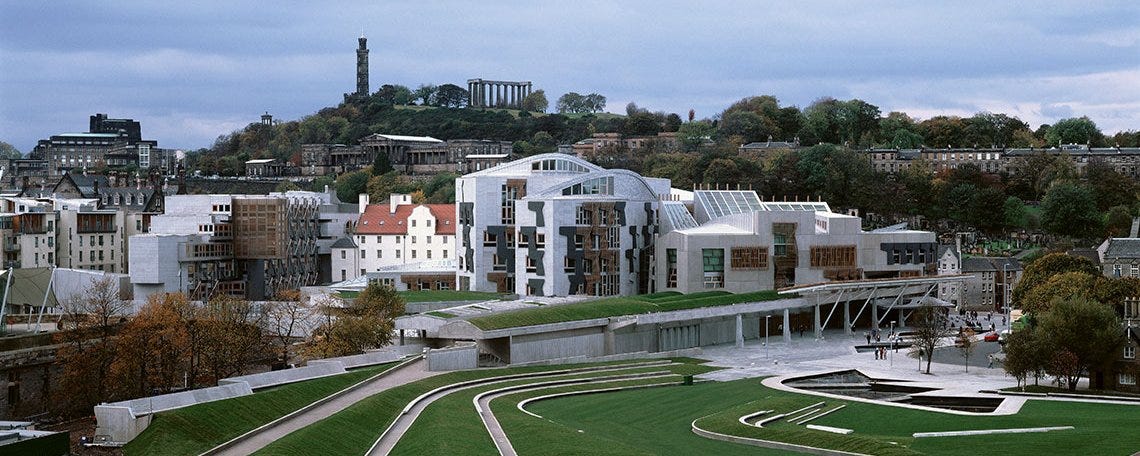
The Scottish Parliament sits at the foot of the Royal Mile, in the Canongate area of Edinburgh and on the doorstep of the Palace of Holyroodhouse. Its design is architecturally striking, internationally recognised and award-winning. It signals to tourists, official visitors, dignitaries, international politicians and nation states around the world that Scotland has the same rights of self-determination and self governance as its European neighbours and the wider family of world nations.
What that ‘signal’ doesn’t so readily portray is the faux constitutional image the parliament’s ‘legal instruments’ and ‘political classes’ have willingly or not allowed to be broadcast to the world without any valid or conscientious objection.
When proposed the new Scottish Parliament building was estimated to cost approximately £40 million. The final bill presented to the Scottish public was £414 million, a tenfold overrun and the dominant public narrative that emerged was one of local incompetence: a difficult architect, a complex design, a project that escaped its managers.
That narrative does not withstand professional scrutiny of the contract structure.
The Fraser Inquiry, the public inquiry into the Holyrood building project chaired by Lord Fraser of Carmyllie which reported in 2004, confirmed the tenfold overrun, identified Bovis Lend Lease as construction manager and Davis Langdon as quantity surveyor, and found that the client, the Scottish Office and subsequently the Scottish Parliamentary Corporate Body, remained the direct employer for all works contracts throughout the project. The Inquiry criticised the non-standard risk allocation and overall project management.
What the Inquiry’s findings describe is a procurement architecture in which smaller contractors worked directly for Scottish Ministers and the SPCB rather than through the main contractor chain in the conventional manner. From a professional construction management perspective, this structure meant that Bovis Lend Lease and Davis Langdon were insulated from the financial exposure that the overrun created, with liability sitting with the client, the Scottish public, rather than with the major contractors. That reading of the Inquiry’s documented procurement architecture is a professional inference from the recorded facts, not a verbatim conclusion the Inquiry itself drew.
The incompetence framing directed attention toward Scottish Ministers and Scottish management. The documented contract architecture is a different story, one the public record supports but has never been required to answer for directly. The overrun produced a public narrative of Scottish management incompetence that did substantial political work regardless of any deliberate intention, the emergent advantage coming from the structural financial reality and not a conspiracy that evidence is required to prove.
The building performs Scottish democracy for domestic and international consumption. The contract that built it performed a different function entirely.
There is one further detail encoded into the performance, hiding in plain sight at the building’s own doorstep.
On the Royal Coat of Arms of the United Kingdom, on official documents, on state occasions, on the royal regalia displayed in the palace that sits beside the parliament, the Scottish Unicorn, Scotland’s own heraldic symbol, is depicted in chains to signify that the crown in Scotland is restrained by the will of the people. The English Lion runs free. This is a documented heraldic fact, observable on the Coat of Arms since the 1707 incorporation. What that depiction means is not matter of interpretation but fact, one that neither the Scottish nor the Westminster government has ever officially addressed or contested. The image of Scotland’s sovereignty symbol bound while England’s runs free is placed on permanent display at the front door of the institution built to perform Scottish self-governance. The constitutional tension on full display.
The Situation on the Holyrood Ground
The Holyrood Parliament sits on Scottish soil. As a feature of the ‘devolution settlement’ Westminster constructed a lattice of administrative instruments over the very ground the Holyrood parliament sits on and claim that these determine its legal character. Two 1999 Orders in Council and a series of statutory instruments route the building’s legal treatment through the UK constitutional framework, while the ground itself remains what it has always been, Scots soil under Scots sovereignty that predates Westminster by millennia.
The instruments Westminster used to achieve this are not hidden. They are in the statutory record, publicly named, deposited by Westminster’s own hand.
The body that holds title to the Holyrood site — the Scottish Parliamentary Corporate Body (SPCB) — was created by Westminster through Section 21 of the Scotland Act 1998. The ground beneath the parliament that performs Scottish sovereignty is legally treated as Crown land, by an English Crown Privy Council Order that grants it that status across nine specific pieces of legislation.
The visible effects of this Crown Status treatment are narrow but precise. Westminster, through Crown Status, holds a veto over the physical fabric of the building that performs Scottish democracy — and that veto operates silently through planning law rather than any overtly political instrument. Any Scottish Parliament bill that would affect the SPCB’s ‘Crown interest’ land triggers a Crown Consent requirement under Rule 9.11 of the Scottish Parliament Standing Orders, procedurally routed through UK Ministers advising the English Crown before the bill could pass.
The operational effects are the evidence that Westminster is an ‘administering-power’ whose architecture is installed and running in Scotland through, in part, the mechanisms of the ‘Scottish Parliament’. The Crown’s Consent is portrayed as the procedural and physical gate on the Holyrood building and one that Westminster claims to hold the power to revoke via SI 1999/677 at any time. The adjustability of the Scotland Act 1998 itself exists as an instrument Westminster holds in reserve. This latent reach is the constitutional substance.
When a political pressure point arrives that Westminster cannot manage through Section 35 vetoes or Section 30 refusals, the legal machinery to extend Crown Status treatment, reclassify Parliament operations, or revoke the devolved treatment altogether is already in place. No new law required, the Crown mechanism simply activates.
This is the physical and legal architecture of an ‘administering power’ depositing its signature into its own statutory record.
The ground is Scottish, the perceived tether is Westminster’s.
The Oath of Colonial Allegiance
Before any Member of the Scottish Parliament may speak, vote, or participate in any proceeding, they must take an oath.
Section 84(1) of the Scotland Act 1998 is absolute: no participation without the oath. The form of that oath comes from the Promissory Oaths Act 1868, an English constitutional instrument. Section 2 of that Act prescribes the oath in the form: ‘I do swear that I will be faithful and bear true allegiance to Her Majesty Queen Victoria, her heirs and successors, according to law. So help me God.’ Section 10 of the same Act directs that the name of the Sovereign for the time being shall be substituted from time to time, so the operative oath sworn by every MSP today reads: ‘I do swear that I will be faithful and bear true allegiance to His Majesty King Charles, his heirs and successors, according to law.’
The oath names a natural person and does not reference any constitutional Crown — and the naming is a placeholder. Under English constitutional doctrine, the Crown is an immortal office of which the person is the temporary occupant — Corporation Sole, the Crown that never dies. Under Scots constitutional law, the Crown of Scotland is a specific legal destination that can only be reached by the person passing through the Claim of Right 1689. The 1868 oath is therefore an instrument of English Corporation Sole architecture being administered in Scotland where Scots contractual architecture governs, and the naming of the man rather than the office maintains the appearance of continuity over a vacancy: the King of Scots office is, in Scots constitutional law, vacant, and the individual’s name occupies the space where a perfected office-holder is constitutionally required and absent.
Charles has not perfected his constitutional position in Scotland — he has not taken the Scottish Coronation Oath, he has not sworn to the Claim of Right 1689, and the contract has not been entered. The ‘according to law’ clause in the oath then carries the operative weight, because the law that operates in Scotland is Scots constitutional law, which holds sovereignty in the Scottish people. The 1689 Convention applied this exact mechanic to James VII to determine that he had forfeited the throne: allegiance ‘according to law’, the King had violated the law, and the allegiance therefore did not run to him. The mechanic is established Scots constitutional law, not novel reading.
The ‘his heirs and successors’ clause carries a second imposition. Under English law, succession is automatic — the King is dead, long live the King — but under the Claim of Right 1689, succession is conditional: a successor becomes King of Scots only by entering the contract with the sovereign Scottish people. The 1868 oath binds allegiance to ‘heirs and successors’ without the Scots conditionality, importing English Corporation Sole succession into Scotland and asserting a permanent hereditary right the Declaration of Arbroath 1320 specifically rejects.
The Treaty of Union’s own oath clause — confirmed in the primary text — declared that all references to ‘the Crown of England’ in existing oaths shall be understood as ‘the Crown of Great Britain.’ The Scottish Crown’s constitutional character, sovereignty in the people, was never incorporated into that substitution; it was excluded by it. No new Crown was constituted, no Scottish constitutional oath architecture was created, and yet the Great Seal of Scotland was not melted down in 1707. It survives, held today by the First Minister as Keeper of the Scottish Seal, and its survival is the constitutional evidence that the Scottish legal destination remains distinct — that the successors named in the 1868 oath have, by their failure to perfect the Scottish constitutional position, failed to inhabit it.
Compare this with the constitutional foundation of the pre-1707 Parliament: the Salvo. Salvo jure cujuslibet. Any Scot may challenge any legislation that prejudices their civil rights, with no precondition, no oath, and no allegiance required. The Parliament’s operating procedure began from the sovereignty of the people.
Holyrood’s operating procedure was designed to begin from the sovereignty of the Crown.
The inversion was intended, constitutional, and deliberate. The Parliament that served Scottish popular sovereignty was bound by the standing Salvo doctrine to protect the people’s rights against its own particular acts, and the first act required of every participant in the Parliament that replaced it was designed to swear that sovereignty away.
The conversation about abstentionism in Scottish politics has always stopped at Westminster: pull Scottish MPs out of Westminster, refuse the Crown oath, refuse to participate in an institution that has no legitimate constitutional authority over Scotland. That argument is understood, and Sinn Féin made it with clarity and consistency for decades — you do not legitimise the instrument by entering it, and you do not assert sovereignty while swearing it away at the door. But the conversation has never been applied to Holyrood, because Holyrood is presented as Scotland’s own parliament, with the building, the ceremony, and the spectacle all performing that identity with considerable architectural investment, and the Crown oath at its door goes unremarked.
The 1868 oath carries a structural defect the drafters did not solve: it names a man as a placeholder, binds to heirs and successors without the Scots conditionality, and imports Corporation Sole architecture into a Contractual jurisdiction. The man named has no perfected position in Scotland, so the ‘according to law’ clause defaults the binding to Scots constitutional law itself, which holds sovereignty in the Scottish people.
The instrument designed to swear sovereignty away binds, in operation, to the sovereignty of the Scottish people.
Section 84 of the Scotland Act 1998 requires every MSP to swear the 1868 oath as the precondition of participation in Holyrood, just as the Parliamentary Oaths Act requires the same instrument at Westminster. The institution is different but the oath is the same instrument, and the constitutional objection that applies to Westminster applies with equal force to Holyrood at the level of design intent. Every independence-supporting party that has taken seats in the Scottish Parliament — SNP, Greens, and any that follow — have sworn that oath, and every one of them has assumed the constitutional authority of the UK ‘Crown-In-Parliament’ holds power over the institution through which they claim to deliver sovereign will of the people. In Scots constitutional law operation, every one of them is bound by that sworn oath, through the ‘according to law’ qualifier, to uphold the default sovereignty of the Scottish people and not the man called Charles Mountbatten-Windsor whose title holds no office in Scotland.
This is not a criticism of individuals or their intentions but a constitutional observation about the nature of the instrument. The cage was designed into the chamber, and the oath was designed as the lock on the door, but the lock does not engage in Scots constitutional law because the named natural person holds no perfected position for the oath to bind to, and because the heirs-and-successors clause asserts a hereditary doctrine Scots constitutional law does not recognise. The cage stands as performance, and the constitutional operation runs in the opposite direction.
Sinn Féin understood that entering Westminster required swearing an oath whose design intent was allegiance to a Crown with no legitimate authority over Ireland, and refused. Scotland has not yet had that conversation about its own devolved chamber. The Holyrood oath has been sworn by every MSP who has ever sat in that building, and the constitutional operation of that oath under Scots constitutional law has never been publicly named.
This article names it.
Holyrood’s Colonial Occupation
Nowhere else in the world does a Sovereign nation’s ‘parliament’ operate with parties of another nation’s political organisations being permitted.
Scottish Labour is an English party with a Scottish branch office. Scottish Conservatives are an English party with a Scottish branch office. Scottish Liberal Democrats are an English party with a Scottish branch office. Their leaderships are selected in England. Their manifestos are written for an English electorate. Their whipping systems operate through Westminster. Their constitutional centre of gravity is in London.
This is not an accident of electoral history. It is the operational layer of the management architecture, the instrument through which the managed parliament is populated with parties whose ultimate accountability runs not to the Scottish people but to the head office that designed the chamber they sit in.
The pre-1707 Parliament had no equivalent condition. Its members were drawn from the communities of Scotland, the clergy, the nobility, the burghs of Scotland, answerable to the Scottish constitutional tradition. The post-1999 parliament is operated by parties whose constitutional home is the tradition that tradition directly contradicts.
Motion S4M-01822 — An Empty Social Contract
On 26 January 2012, Motion S4M-01822 was moved in the Scottish Parliament by the then Deputy First Minister of Scotland. To give it its full title matters and this precision is important: Motion S4M-01822 Nicola Sturgeon: Claim of Right.
The motion passed 102 votes to 14 and apparently affirmed the sovereign right of the Scottish people to determine the form of government best suited to their needs, and pledged that in all actions and deliberations their interests shall be paramount.
It was passed in a chamber every participant had entered by swearing allegiance to the English Crown. It was passed by members of parties whose constitutional centre of gravity was in London. It was passed through an institution created by a Westminster statute. It had no legal teeth, a political affirmation not a justiciable constitutional act, as Professor James Mitchell confirmed in written evidence to the House of Commons Political and Constitutional Reform Committee in October 2012.
Nine months later, on 15 October 2012, Nicola Sturgeon co-signed the Edinburgh Agreement alongside Alex Salmond, David Cameron, and Secretary of State Michael Moore. The Agreement provided a Section 30 Order, Westminster’s formal permission for Scotland to hold a referendum on independence.
The person who moved the sovereignty affirmation in January became the co-author of the permission framework in October.
The Section 30 doctrine, that Westminster’s permission is the precondition for a legitimate independence referendum, remained Sturgeon’s explicit, stated constitutional position for the entire decade of her tenure as First Minister.
The motion said the people are sovereign and require no external permission. The agreement said: we will ask Westminster first. Both were signed by the same person, nine months apart.
The pre-1707 Parliament passed the Act of Security, asserting Scotland’s right to determine its own succession without England’s permission. Its successor institution passed a motion affirming the people’s sovereignty and then sought Westminster’s permission to consult them.
The pattern extends across Sturgeon’s entire tenure.
Throughout her leadership, Sturgeon described the 2014 referendum as the “Gold Standard”, elevating a Section 30 Order, a Westminster permission instrument, into the operative constitutional principle for any future independence vote. The 2012 Claim of Right motion she herself had moved affirmed that no external permission was required. The Gold Standard framing said the opposite. Sustained across a decade, its effect, whatever the intention, was to delegitimise within the independence movement any route that did not run through Westminster’s consent. The managed parliament’s doctrine became the movement’s internal orthodoxy.
In June 2022, Sturgeon instructed the Lord Advocate, Dorothy Bain KC, to refer a draft independence referendum bill to the ‘UK’ Supreme Court before it had been introduced to the Scottish Parliament. The Lord Advocate stated she did not have the “necessary degree of confidence” the bill fell within Holyrood’s competence. Reference by the Lord Advocate [2022] UKSC 31 ruled the bill outwith competence. The referral pre-emptively produced the juridical finding that Section 30 permission was the only legal route, codifying the architecture of permission before any alternative constitutional route had been tested.
In December 2017, the Scottish Government enacted a new harassment procedure with a retrospective clause permitting investigation of former ministers, a mechanism that did not previously exist in the civil service code. In 2019, the Court of Session found the resulting investigation of former First Minister Alex Salmond “unlawful” and “tainted by apparent bias” (Salmond v Scottish Ministers [2019] CSOH 3). The Scottish Government paid Salmond’s legal costs of £512,000. The procedural architecture introduced in December 2017 operated, whatever the intention behind it, to remove from active political engagement the most prominent figure publicly willing to pursue Scottish sovereignty on routes that did not require Westminster’s consent.
Three instruments, three outcomes: the Gold Standard delegitimised alternative routes; the 2022 referral codified permission as the only legal path; the 2017 procedure removed the most prominent advocate of routes without permission. The pattern functions as statecraft whether or not it was consciously designed as such.
Scotland’s constitutional inheritance cannot be recovered through the institution that currently operates. Not through parliamentarians loyal to the English Crown via sworn oath. Not through English-registered parties operating in Scotland. Not through motions that mimic historic legislation whilst carrying no legally operative force.
This pattern did not begin with Holyrood. Westminster and the English Crown have acknowledged Scottish popular sovereignty repeatedly across seven centuries — through treaties negotiated rather than commanded, through legislation required to absorb what could not simply be annexed, through motions passed while the sovereignty they named was being simultaneously overridden. Each acknowledgement had zero operative effect. The mechanism is always the same: reuse the name of an existing Scots constitutional instrument or suitable alternative, deploy it publicly, formally, and on the record, then present the named act as a substitute for the legal obligation it invokes without ever making that legal act.
The Fear of Constitutional Truth
The Inversion Entrenchment
The Parliament of Scotland that ratified the Treaty of Union on 16 January 1707 was bound by the standing salvo jure cujuslibet doctrine to reserve the people’s rights over the session’s particular acts — and it did, to its final sitting day: the Act salvo jure cujuslibet of 25 March 1707 closed the last session of the Parliament of Scotland. By the standing scope of the practice the reservation ran to particular acts; the Treaty itself, as public legislation, lay outside any salvo’s reach in any session — so the rights of the sovereign people stand reserved, unrepealed, and unadjudicated against the incorporation to this day.
The first act required of every MSP before they may participate in the Holyrood Parliament that sits in their name is to apparently swear allegiance to the English Crown.
The pre-1707 Parliament reserved the people’s rights with its dying breath. The post-1999 Parliament requires the people’s representatives to swear those rights away at the door before they may speak. One honoured the standing doctrine to its final act. The other installs its inversion as the precondition of participation.
This constitutional fact, documentable from the primary record at both ends, is the truth the political classes in Scotland have continually avoided facing at a structural level for generations. The standing salvo jure cujuslibet doctrine is in the Records of the Parliaments of Scotland. Section 84 is in the Scotland Act 1998 which itself is a unilateral legislative act of the Westminster Parliament framework. Both are on the public record. The inversion between them is exact and total, and aggravates the truth Westminster try in vain to negate whilst only barely mitigating the coming tide. That tide is not speculation. To take one example: Reform’s ascendancy, the systematic hollowing of democratic institutions, and the algorithmic and financial infrastructure already reshaping what Westminster is becoming, these are the documented current direction of Westminster political movement, not prediction. The Scottish political management class has built its entire operating doctrine on the assumption of a broadly stable Westminster constitutional partner. That assumption is dissolving in real time. Every day the Scots constitutional tradition remains buried, Scotland’s position under that dissolving framework hardens.
The 1707 parliamentarians who ratified the incorporation did not own Scottish sovereignty. They could not transfer what they did not hold. Specifically, Section 84 of the Scotland Act is the imposition of a coercive rule deployed to neuter Scots sovereignty, created 291 years later by the Westminster parliament operating under its own completely separate English legal and constitutional tradition that Lord Cooper confirmed has no counterpart in Scots law, and whose jurisdiction over Scotland has never been constitutionally confirmed, with Section 84 of the Scotland Act remaining res integra.
The Echoes of Arbroath article shared previously on X records the full chain of Westminster’s acknowledgements of Scots sovereignty, from the Treaty of Birgham 1290 to the House of Commons motion of 2018 endorsing the principles of the 1989 Claim of Right for Scotland. Westminster and the English Crown confirmed what they were simultaneously suppressing, repeatedly, across seven centuries, and have not retracted a single one of those confirmations.
Radical Revival Meets Sovereign Rights
Something that the Scots ‘constitutional question’ has pointed to without any uptake by the ‘Scottish Political Class’ is the reactivation of the Convention of Estates. This does not necessarily require the abandonment of the chamber as the Scots practice of salvo jure cujuslibet is not abstentionism, it is something constitutionally older and more powerful.
Whilst abstentionism refuses the stage, Salvo provides the stage’s foundation and enables what is performed on it.
Salvo is the standing constitutional doctrine the Scots Parliament was bound to invoke whenever it passed particular acts prejudicing private rights, and was operative from within the chamber following codification in 1592 and 1663. The Salvo mechanism was applied across more than a century of sessions whenever the doctrine’s conditions were met — and was applied one final time on 25 March 1707, as the closing act of the closing session. The dissolution of the Parliament did not extinguish the doctrine; it left the standing reservation in the hands of the only body that ever owned it, the sovereign people, with no parliament since constituted on the people’s authority to exercise it — and no court ever made to answer whether it reaches the incorporation itself. That is the open constitutional question Westminster has never dared to put, and never could close.
After 263 years of Westminster obfuscation the Scotland Act 1998 created Holyrood. It did not, and cannot, extinguish Scots sovereignty. Neither did it serve to repeal the Salvo. Nor did it repeal the ‘legal’ Claim of Right 1689, which was preserved as a condition of the Treaty of Union itself and has never been legitimately extinguished. No instrument has repealed the Salvo and no court has been required to determine the extinction of its status. The counter-position offered without legal ruling, that the 1707 settlement extinguished it, rests on institutional practice and the continued operational narrative of the dominant colonial framework. It does not rest on a primary instrument establishing a change in its operational status and its validity as a claim is outweighed by the available public record.
That the constitutional proposal that follows from this would appear radical to many in today’s political climate is a damning indictment of the true state of Scotland’s political classes and the colonial veil that they operate behind, intentionally or not. The following proposal is historically grounded in the documented practice of the pre-1707 Parliament. Its mechanics have never been extinguished or repealed in any court and it has not been refuted by any later primary instrument. Whether it is enforceable is the precise constitutional question the evidence leaves open.
The 1689 Convention of Estates did not pass a motion. It did not issue an affirmation. It did not seek Westminster’s permission. It acted from the constitutional foundation that the power had always resided with the people, that forfeiture was the prescribed consequence of constitutional violation, and that no external permission was required to apply the mechanism that Scotland’s own tradition had long established.
The reactivation of the Convention of Estates does not require the Holyrood chamber to be vacated, it requires the chamber to be taken in the name of sovereign Scots, MSPs invoking the Salvo from within it and recalling the constitutional tradition of Scots in the very chamber that was built to suppress it. These MSPs would lose their Westminster title in the eyes of Scots and would become ‘Commissioners of the People’ and ‘Guardians of the 1689 Claim of Right’, transforming the performance stage into the instrument of a genuine constitutional act. That strategy has not been deployed since the Parliament of Scotland closed. Whether it would be recognised by the courts, resisted on competence grounds, or confirmed as operative is not a question this article answers, it is the question this article opens.
The Westminster ‘Oath of Allegiance’ is the lock on the Holyrood Parliament door, but the ‘Salvo’ is a single skeleton key of many that will unlock Independence for the Scots people via the Scots people.
The Reactivation of the Exercise of Scots Popular Sovereignty
What 2026 demands is not the importation of someone else’s model. It is the reactivation of Scotland’s own traditional model.
That is the constitutional model. Not democratic pressure applied to Westminster until Westminster yields. Not a mandate built toward the point where recognition becomes irresistible. Scots authority is already the radical right always held — existing in allodial supremacy to this day. The Convention does not petition for permission to exercise the fundamental rights of its own historical practices. It enacts the sovereign will of its members and delivers their sacrosanct rights as per legal constitutional tradition. The Salvo renewed on 25 March 1707, as the Parliament of Scotland’s final act, is the standing constitutional reservation of the people’s rights — unrepealed, unexercised since, and unadjudicated against the incorporation. No sovereign Scottish Parliament has existed since to exercise it. The tools to address this fact now exist and the same instruments can make direct modern nation assembly real, verifiable, and sovereign at the scale of a modern nation.
The sitting Scottish political management class remains complicit in the suppression of Scots self-determination until they explicitly and constitutionally affirm the sovereign authority of Scots, and no other. Not the English Crown, not Westminster, not the statute that created the Holyrood chamber they sit in. The sovereign authority of Scots alone.
The first test of whether the Scottish political management class has recognised the sovereign authority of Scots is simple: The perceived allegiance to the English Crown, the Promissory Oaths Act 1868 as embedded in Section 84 of the Scotland Act 1998, must give way to an acknowledging re-affirmation of what already stands: allegiance to the sovereign people of Scotland under the Claim of Right 1689, re-affirming its ongoing legal authority as a living instrument of Scots sovereignty and the operative constitutional reality the MSPs’ own oaths bind them to under Scots law.
Until that re-affirmation is made, the facade of ‘representative sovereign legitimacy’ continues via every MSP who operates in the Holyrood chamber under perceived English Crown oath.
Failure to act entrenches both complicity and colonialism.
Eòin J Màrtainn
Correction — June 2026
This article originally stated no salvo was passed in 1706–07. Verification at the primary record (RPS 1706/10/465) shows the Act salvo jure cujuslibet was passed on 25 March 1707 as the Parliament’s closing act. Revised accordingly; the analysis is strengthened, not weakened, by the corrected record.
Sources — primary record
Records of the Parliaments of Scotland to 1707 (rps.ac.uk) — Act salvo jure cujuslibet, 1592 (RPS 1592/4/60); codifying Act salvo jure cujuslibet, 1663 (RPS 1663/6/146); Act salvo jure cujuslibet, 21 September 1705 (RPS 1705/6/200); Act salvo jure cujuslibet, 25 March 1707 (RPS 1706/10/465; NRS PA6/34 and PA6/36), enacted immediately after the Act concerning the publick debts (RPS 1706/10/464); Queen’s Commissioner’s adjournment speech, 30 June 1702 (RPS M1702/6/10); division list for 16 January 1707 (1706/10/257) — 110 votes to 67, cross-verified against National Records of Scotland RH18/4/14; Andrew Fletcher of Saltoun’s Limitations, parliamentary sessions 1703–1707
Keith M. Brown and Roland J. Tanner (eds), The History of the Scottish Parliament, Volume 1: Parliament and Politics in Scotland, 1235–1560 (Edinburgh University Press, 2004) — comparative parliamentary antiquity, 1235/1236
Andrew Lang, A Short History of Scotland — Scotland’s commissioners proposed retaining a separate Parliament; England refused, insisting on incorporating union (secondary source, confirmed in substance)
Lord Fraser of Carmyllie, Holyrood Inquiry (2004) — procurement architecture, cost overrun, contractor arrangements
Tender of Union 1652 — English parliamentary record
Ordinance for the Union of England and Scotland, 12 April 1654 — Westminster statutory record
Westminster ratification of union with Scotland, 26 June 1657 — parliamentary record
Rescissory Act 1661 — Scottish Parliament primary statutory record
C.H. Firth (ed.), Scotland and the Commonwealth: Letters and Papers relating to the Military Government of Scotland, from August 1651 to December 1653 (Scottish History Society, Edinburgh, 1895) — composition of Cromwellian Scottish representation at Westminster, 1654
Act anent Peace and War 1703 — Parliament of Scotland primary statutory record
Act of Security 1704 — Parliament of Scotland primary statutory record
Repeal of Certain Scotch Acts 1707 — Westminster statutory record,
Scotland Act 1998, Section 84(1) —
Promissory Oaths Act 1868 —
Motion S4M-01822 Nicola Sturgeon: Claim of Right — Scottish Parliament Official Record, 26 January 2012
Edinburgh Agreement, 15 October 2012 — public record
Scottish Government Handling of Harassment Complaints Procedure, December 2017 — Scottish Government procedural record
Tony Blair, A Journey (2010), p.251 — verbatim
Professor James Mitchell, written evidence to House of Commons Political and Constitutional Reform Committee, October 2012
MacCormick v Lord Advocate [1953] SC 396 — Lord Cooper obiter dicta (not binding precedent)
Salmond v Scottish Ministers [2019] CSOH 3 — Court of Session judicial review
George Lockhart of Carnwath, Memoirs Concerning the Affairs of Scotland from Queen Anne’s Accession to the Throne (London, 1714) — verified verbatim from Internet Archive OCR digitisation of the 1714 first edition; p.19 (Queen’s Commissioner adjournment speech, 1702 session, confirming Salvo as standing constitutional obligation triggered by passage of particular acts and ratifications — “require”); narrative coverage through 1707 Treaty ratification and 1708 attempted invasion; individual payment records, 1707 ratification
Cross-source verification: the Act salvo jure cujuslibet of 25 March 1707 is recorded in the parliamentary minutes (NRS PA6/34 and PA6/36, the parallel folio system) and printed in Thomas Thomson (ed.), The Acts of the Parliaments of Scotland, Vol. XI (1824), p. 488, recovered from the manuscript minutes
Reference by the Lord Advocate and the Advocate General for Scotland [2022] UKSC 31 — Supreme Court ruling on Section 30 requirement
Act of Union 1707 (primary text, Wikisource) — oath clause: all references to ‘the Crown of England’ in existing oaths declared to signify ‘the Crown and Realm of Great Britain’; Scottish Crown’s constitutional character excluded by substitution, not incorporated